
Descendants of Frederick Douglass and John Brown on Juneteenth warn against backsliding on civil rights
Douglass Greene and Evans called out acts of the current Trump administration and Supreme Court, while discussing the lasting impact of slavery in the United States.

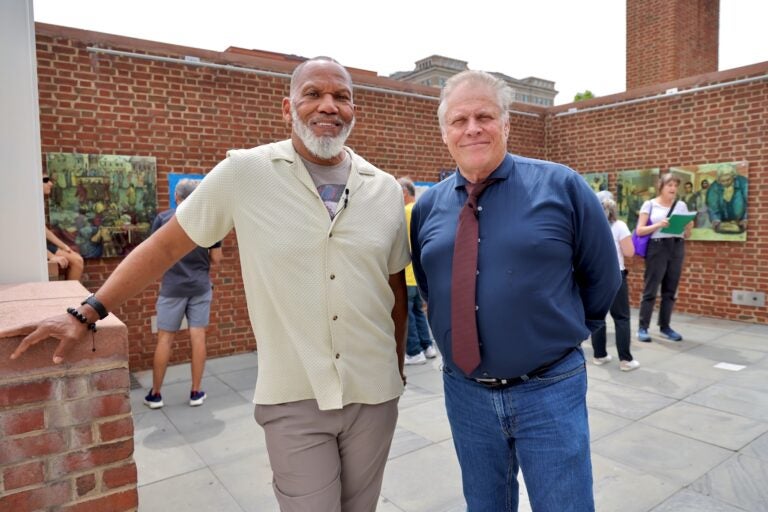
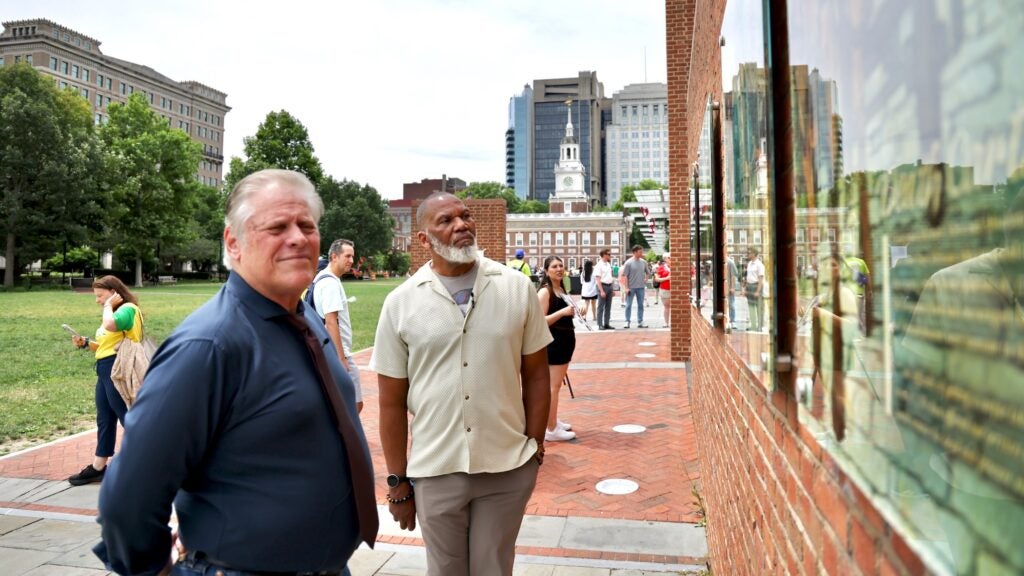
Kevin Douglass Greene, a direct descendant of Frederick Douglass, and Brian Evans, a direct descendant of abolitionist John Brown, visit the President's House slavery exhibit on Independence Mall. (Emma Lee/WHYY)
Two direct descendants of prominent abolitionists reflected on the legacy of slavery and the challenges facing Black Americans during a visit to WHYY on Juneteenth.
Kevin Douglass Greene, a descendant of Frederick Douglass, said he has little sympathy for people who believe they have lost rights or privileges, noting that African Americans spent generations fighting for basic rights and opportunities.
“I can’t feel sorry for … certain populations in the United States [who] felt that they lost their rights and privileges. Just think about the amount of time that it took for African Americans in this country to achieve those rights and privileges,” Douglass Greene said.
Douglass Greene said the glass ceiling that has long obstructed advancement for Black Americans has been covered in cement.
“It’s harder to get through cement than glass,” he said. “We just have to do better.”
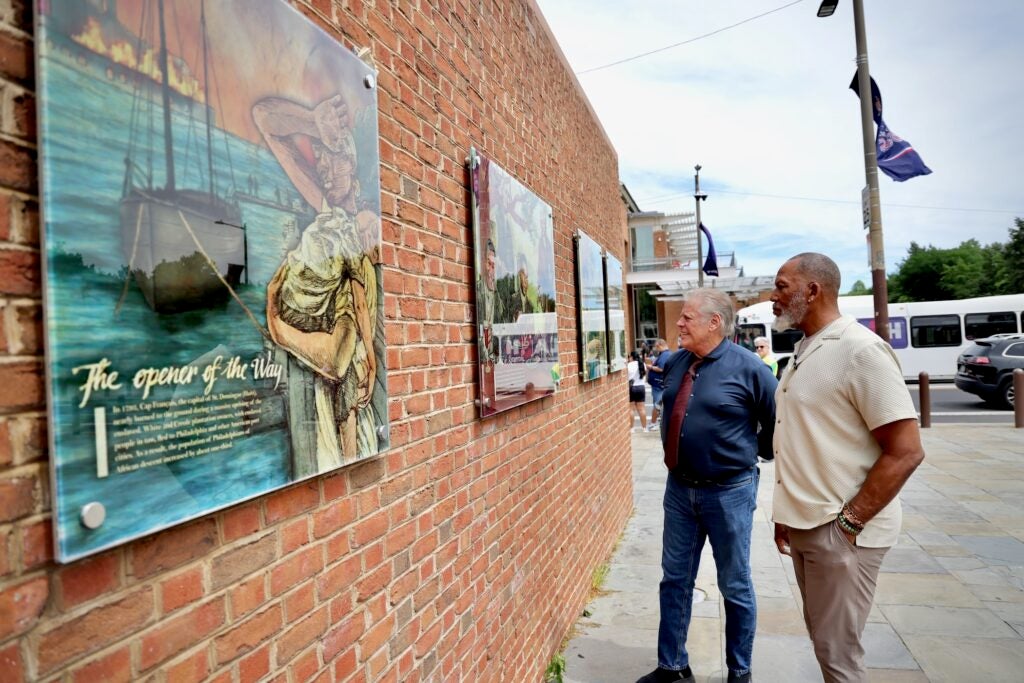
Douglass Greene criticized the recent court ruling allowing the Trump administration to replace the President’s House Site exhibit focused on the nine people enslaved by George Washington, calling it a “whitewashing” of history.
“When the world, especially at this time – the 250th – comes into the United States and visits these different sites that they don’t want them to see — that this is part of what the history of what the United States is,” he said.
Related Content
Frederick Douglass’ descendant delivers free memoirs to Philly students
Against the backdrop of recent book bans, Kevin Douglass Greene's efforts have been highlighted as a way to help preserve American history.
2 years ago
Listen 1:33Brian Evans, a semiconductor scientist who is a descendant of abolitionist John Brown, echoed Douglass Greene’s concerns about how American history is remembered and taught.
“I think it’s very important on the 250th [anniversary] that we don’t venerate the founding fathers the way we have been taught to through school. They were not persons who wanted democracy. Remember, they were all slaveholders. They were not going to change that themselves,” Evans said.
“We have to understand that they were — yes, they wanted to get away from King George, but they wanted to be King George in a new land. And so, they brought those ideas, etc., over here,” he continued.
Evans went on to say that he thinks the founding fathers had a bad record on human rights.
“Remember, women didn’t have rights. Non-property owners didn’t have rights,” he said.
Evans said the current Supreme Court’s interpretation of the Constitution is taking the country backward, contributing to voting rights disputes and opening the door to gerrymandering in states, including Tennessee and Alabama.
Douglass Greene and Evans said the country has a long way to go to address the legacy of slavery.
Evans said he is working with historically Black colleges and universities to teach entrepreneurship through a NASA partnership tied to a semiconductor patent he holds. He hopes the effort will create opportunities for future entrepreneurs of color.

Never miss a moment with the WHYY Listen App!


WHYY is your source for fact-based, in-depth journalism and information. As a nonprofit organization, we rely on financial support from readers like you. Please give today.
Philadelphia’s oldest Juneteenth festival draws thousands to the Johnson House in Germantown
The festival celebrated its 20th year with music, vendors, a small-business opening and renewed calls to preserve Black history.
2 months ago
Juneteenth celebration doubles as 50th birthday party for African American Museum in Philadelphia
Thousands gathered outside the museum for music, dancing, food and exhibits honoring Black history and culture.
2 months ago
At a WHYY community event, historians and residents examined how one formerly enslaved woman's fight for freedom reveals the contradictions at the heart of America's founding.
2 months ago
Listen 1:24