

We the people: At Stenton, Dinah’s story reveals the contradictions of liberty and slavery in Revolutionary Philadelphia
At a WHYY community event, historians and residents examined how one formerly enslaved woman's fight for freedom reveals the contradictions at the heart of America's founding.
Listen 1:24
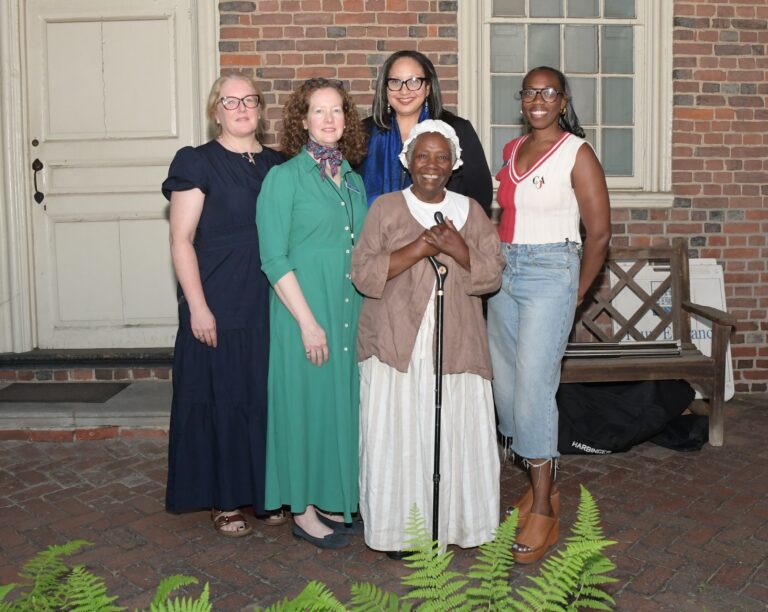
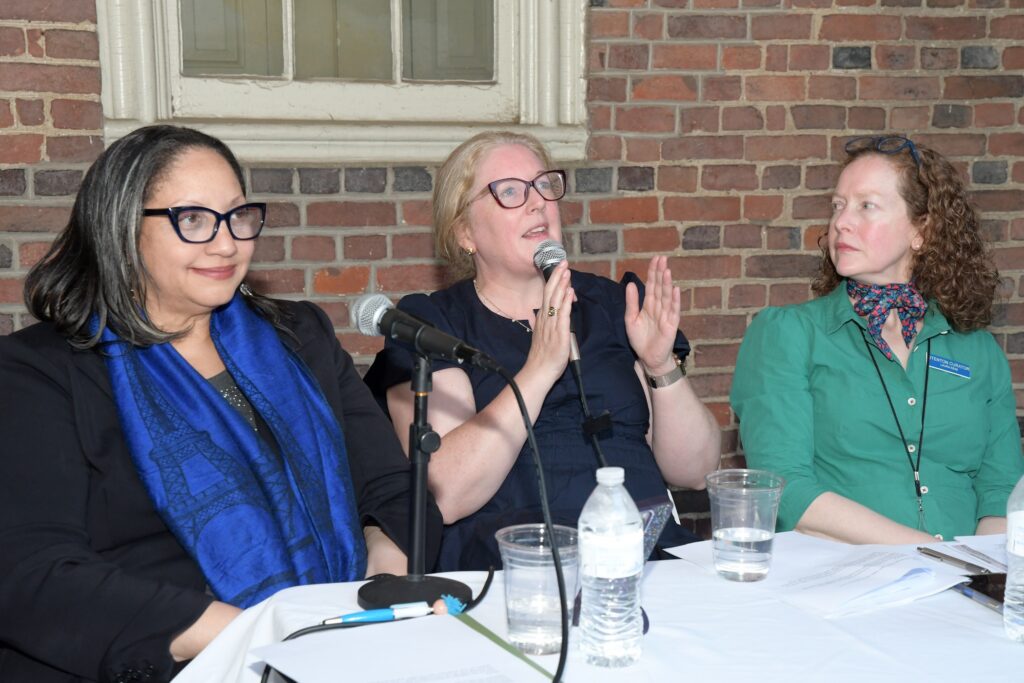
From left, Emma Hart, Laura Keim, Sarah Glover, Irma Gardner-Watson (portraying an enslaved woman named Dinah) and Stephanie Watts.(Marissa Weekes Mason for WHYY)
From Philly and the Pa. suburbs to South Jersey and Delaware, what would you like WHYY News to cover? Let us know!
As Philadelphia prepares to celebrate the 250th anniversary of American independence, historians and community leaders are urging residents to confront a harder truth: The city that helped give birth to the ideals of liberty was also built by enslaved people.
That tension was the focus of “Freedom Isn’t Free: How Spirited Dissent Powered the American Revolution,” the latest installment of the We the People series, presented by WHYY, The McNeil Center for Early American Studies at the University of Pennsylvania and Stenton.
The program combined historical scholarship, community perspectives and a dramatic portrayal of Dinah, an enslaved woman who worked in the Stenton house for decades.
For 20 years, storyteller Irma Gardner-Hammond has embodied the story of Dinah.
“Don’t forget my name,” Gardner-Hammond told the audience in character. “I’m not just any old Dinah. I’m a Dinah that played a big part in saving this house.”
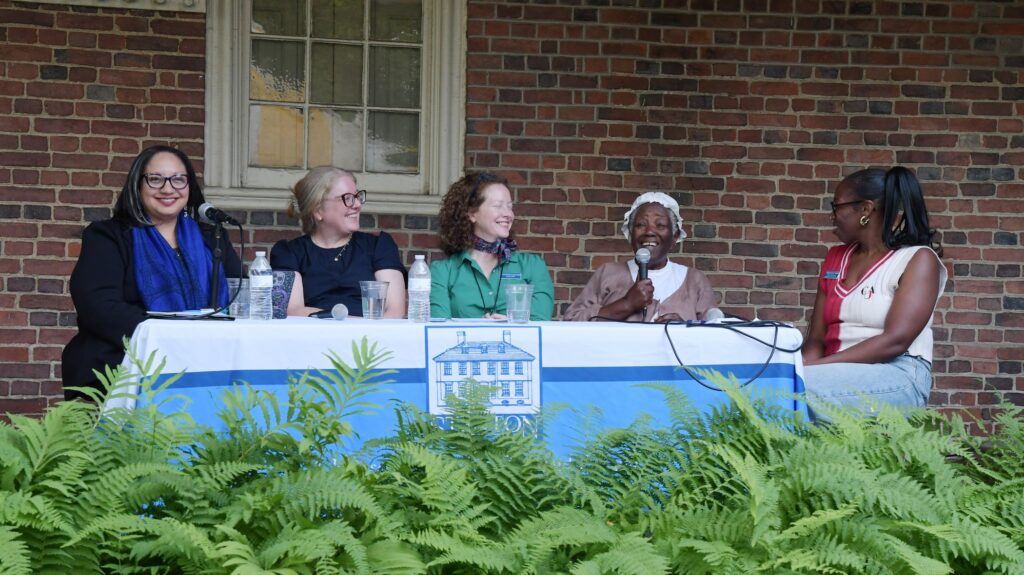
Sarah Glover, vice president of news and civic dialogue at WHYY, moderated the discussion, with Laura Keim, executive director of Stenton; historian Emma Hart of the McNeil Center; Stephanye Watts, community engagement coordinator for Historic Germantown; and Gardner-Hammond.
The Quaker dichotomy
Held on the grounds of one of Philadelphia’s most significant colonial-era estates, historians at the event noted that Dinah’s life reflected the contradictions of colonial Pennsylvania. Although Quakers would eventually become leaders in the abolitionist movement, with Pennsylvania being the first to limit the practice, slavery was still common.
Emma Hart, director of the McNeil Center for Early American Studies and a professor at the University of Pennsylvania, explained that Philadelphia’s prosperity was deeply connected to slavery.
“This was taking place against the background of a city that was growing to a large degree on wealth from trading with places that depended on enslaved labor,” Hart said. “Philadelphia wouldn’t have grown and it wouldn’t have existed as such an important city without the labor of enslaved people either here or elsewhere.”
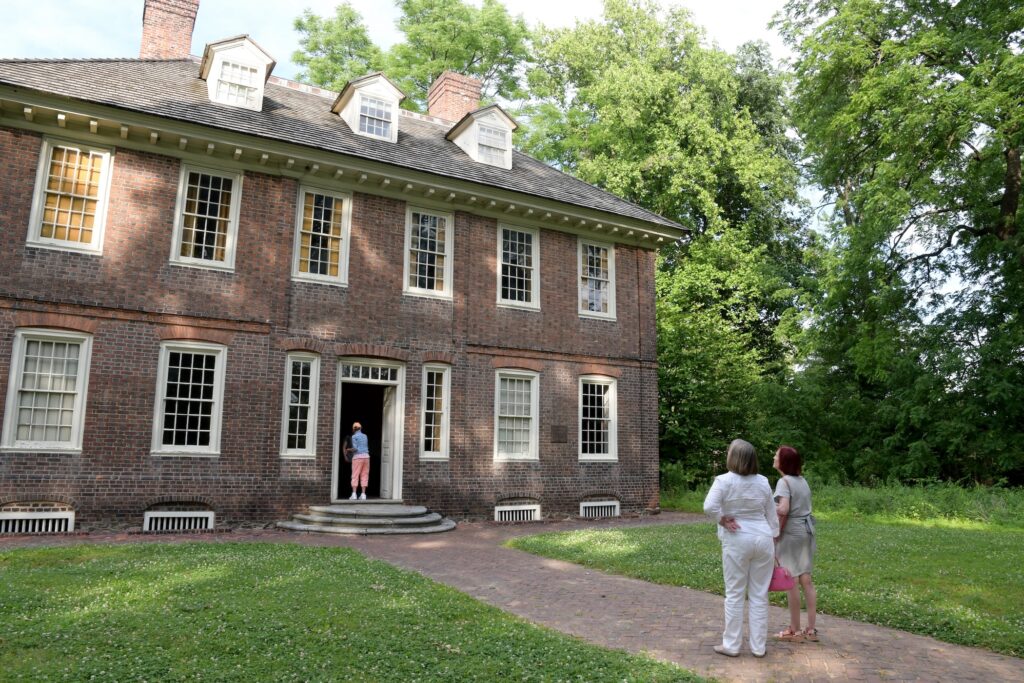
According to historical records discussed during the program, Dinah was enslaved by the Logan family, one of colonial Pennsylvania’s most prominent families. James Logan, secretary to William Penn and a wealthy merchant, built Stenton in the 1720s as a country estate and a symbol of his influence.
In Gardner-Hammond’s portrayal, Dinah recalled being given to Hannah Emlen when she married James Logan’s son William, as part of her dowry.
“Can you imagine a person being a gift to another person?” she asked the audience. “I had to do all kinds of things for that woman.”
Related Content
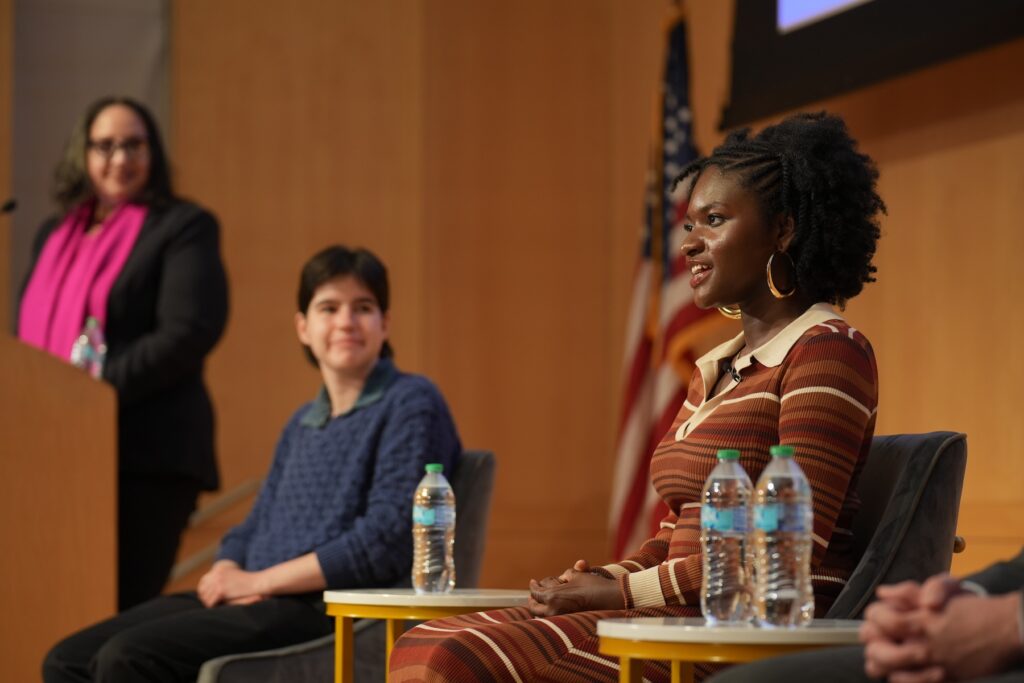
America 250th: Philly event highlights youth perspectives on the American Revolution
The event, hosted by WHYY and Penn’s McNeil Center, brought together a panel of students and educators to discuss the meaning of democracy.
5 months ago
Many visitors to Stenton, Keim noted, are surprised to learn that members of the Logan family practiced slavery while they belonged to a religious community that would eventually become associated with abolition.
“We think of Quakers as abolitionists,” she said. “Many people would be surprised when they realized that the Logans were Quakers — that they were also enslavers.”
In reality, attitudes toward slavery evolved slowly.
Hart described the efforts of early antislavery activists such as Benjamin Lay, a radical Quaker who publicly protested against slavery decades before abolition became a mainstream cause.
“He was too radical for the Quaker congregation at that time,” Hart said. “They ejected him for his very firm antislavery stance … I think it’s also important to say that these Quaker abolitionists were not really in majority yet by the time of the Revolution.”
‘I want my freedom’
Unlike many enslaved people who escaped or purchased their freedom, Dinah repeatedly pressed her enslavers to free her. Gardner-Hammond captured that determination in her performance.
“I want my freedom, and I want it now,” she declared. “I want to be able to come and go when I get ready. I want to wear the clothes that I want to wear. I want to have some time when I have time.”
Eventually, the Logans relented. Dinah was freed in 1776, the same year the Declaration of Independence was signed.
Historians know that from Dinah’s manumission, the formal, voluntary act of a slaveholder freeing an enslaved person.
“We have a copy of it on site here, and it literally says, ‘and William and Hannah are signing off on this, she having requested us to let her have her freedom,’” Keim said. “So she’s all about dissent, really.”
Dinah’s most famous act came later during the turmoil of the Revolutionary War. With much of the Logan family absent and military forces moving throughout the region, Dinah remained at Stenton as its primary caretaker. The estate became a strategic location during the conflict. Gen. George Washington and his troops camped there in 1777, and British forces later occupied the area.
One evening, Dinah encountered two British soldiers who arrived at Stenton with orders to burn the property.
According to the story passed down through generations, the soldiers were drunk and careless. After learning their intentions, Dinah directed them toward the barn under the pretense of helping them find hay and straw.
When they entered, she locked them inside. Soon afterward, a British patrol searching for deserters arrived.
“Yes sir,” Dinah told them. “There’s two right there in our barn.”
The soldiers were arrested and taken away, and Stenton was spared.
Related Content
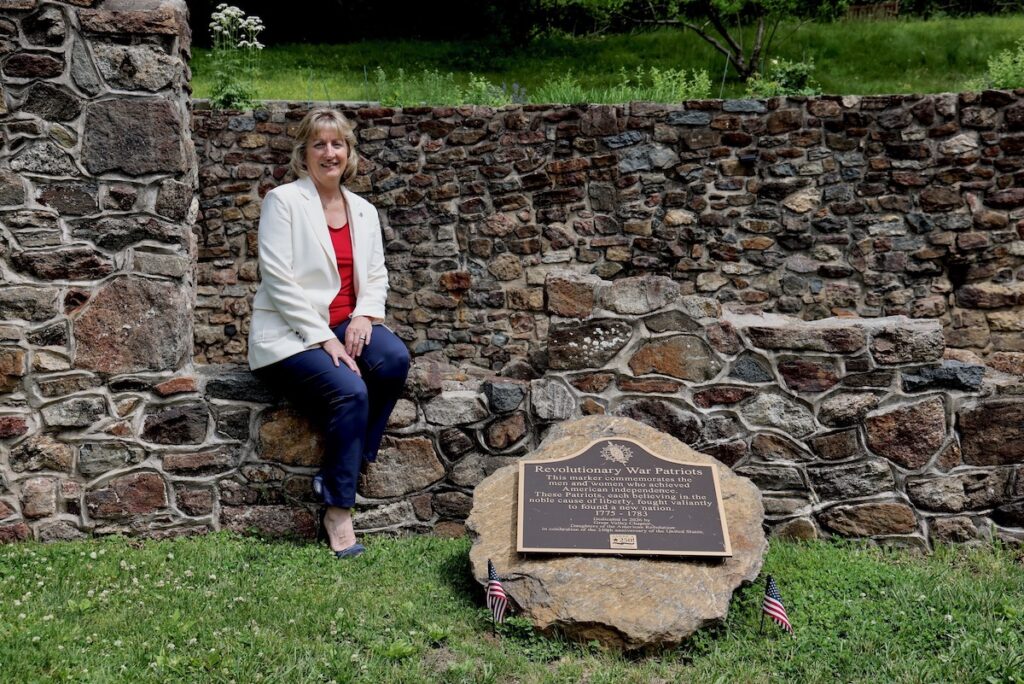
For decades, descendants of Abigail Hartman Rice have hunted for evidence of their ancestor’s patriotic contribution to enshrine her in the nonprofit.
5 months ago
Listen 1:11Remembering Dinah
The story has become one of the defining moments in Stenton’s history and helped elevate Dinah from a little-known historical figure to a local legend.
For decades, her story remained largely absent from mainstream narratives about Philadelphia’s Revolutionary past, but Watts said neighborhood residents had preserved Dinah’s memory even before public recognition.
Dinah has been commemorated through public art, educational programming and a memorial at Stenton. Gardner-Hammond’s likeness even serves as the face of Dinah on a mural at the Germantown YWCA.
Watts said Stenton’s evolving mission is to ensure that stories like Dinah’s remain central to Philadelphia history.
“Our Nicetown neighbors knew exactly who Dinah was,” Watts said. “They already had admiration for her, but it was important for us to do the same, lift her up in a way that felt culturally relevant to our neighbors who had known who she was for years.”
WHYY will host the next event in the We the People series, “Life, Liberty & the Rocky Pursuit of Happiness,” on June 23.

Get daily updates from WHYY News!
WHYY is your source for fact-based, in-depth journalism and information. As a nonprofit organization, we rely on financial support from readers like you. Please give today.
Part of the series
Philadelphia 250
The United States is marking its semiquincentennial — or its 250th anniversary — in and around the City of Brotherly Love.
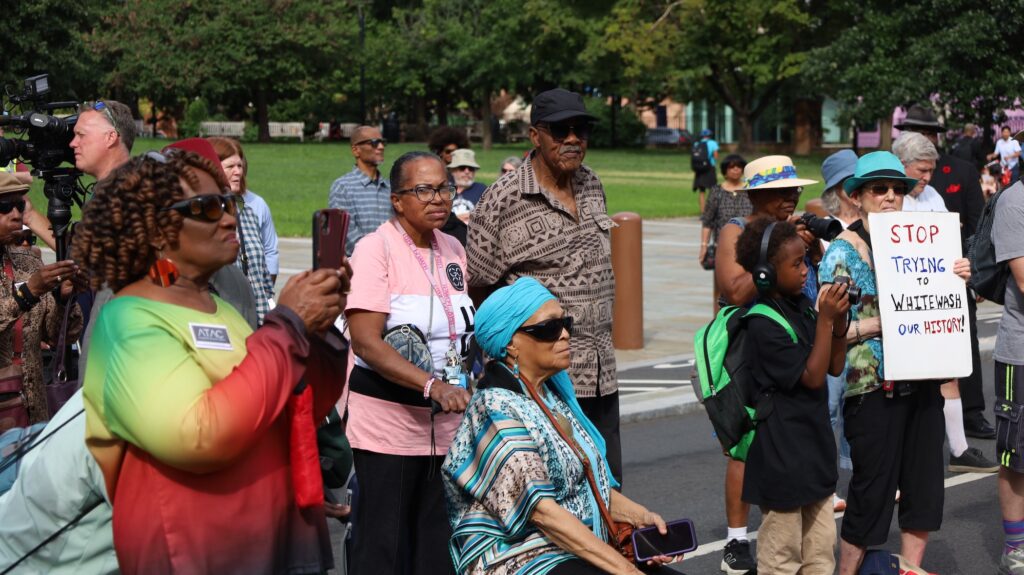
Amid a dispute between federal and city officials over the site’s slavery exhibit, the gathering marked the anniversary of enslaved Africans’ arrival in America in 1619.
2 months ago
Listen 1:29
After days of oppressive heat, thunderstorms cut Philly’s July 4th concert short
After storms forced attendees to evacuate, the concert resumed around midnight with a shortened performance by The Roots, followed by fireworks.
4 months ago
Listen 0:55
Patriotic Pet Parade at Betsy Ross House in Old City celebrates America’s 250th birthday
The competition boasted 22 pets donning a range of red, white and blue attire.
4 months ago