

Court ruling clears way to replace slavery exhibit in Philadelphia at President’s House Site, handing Trump a win
A unanimous appeals court panel ruled Philadelphia lacks authority to control exhibits at the Independence Mall site.

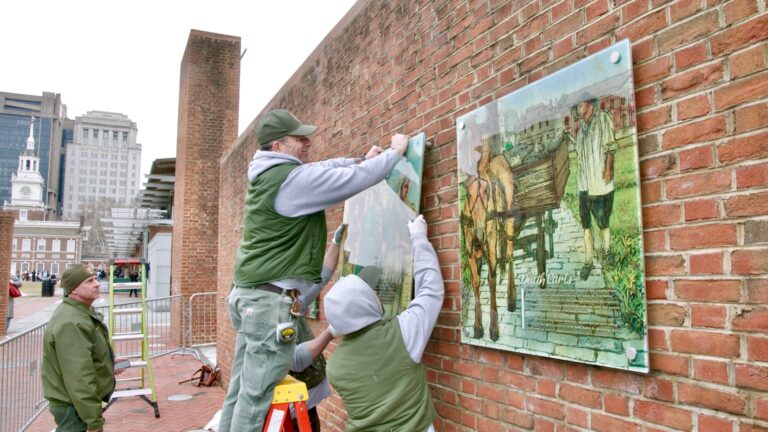
National Park Service employees restore the exhibit on slavery to the President's House Site on Independence Mall. (Emma Lee/WHYY)
From Philly and the Pa. suburbs to South Jersey and Delaware, what would you like WHYY News to cover? Let us know!
A federal appeals court has paved the way for the Trump administration to replace the slavery exhibit it removed at the President’s House Site on Philadelphia’s Independence Mall.
Thursday’s decision effectively discards a February injunction ordering the National Park Service to restore the site, which included a series of illustrated panels about the nine people enslaved by George Washington at the executive mansion while he was president in the 1790s.
The panels were taken down, then partially restored, as part of a monthslong legal fight rooted in an executive order issued by President Donald Trump. Citing a 2006 agreement, the city sued the Park Service and the Interior Department in January after it abruptly removed the exhibit to comply with the order.
In its unanimous ruling, the Third Circuit Court of Appeals found that the city does not have any “statutory, property, or contractual rights that empower it to curate the exhibits in the President’s House.” The judges also concluded that the Trump administration’s replacement panels, which NPS has posted online, are “full of historical context.”
“They highlight the momentous events that took place in the President’s House and the other sites at Independence National Historical Park. They acknowledge the evil of slavery, including its injustices and hypocrisies, and, by telling the story of the nine slaves that Washington kept in the President’s House, remind us of their essential humanity,” wrote Judge Thomas Hardiman, who authored the appellate court’s opinion.
Related Content
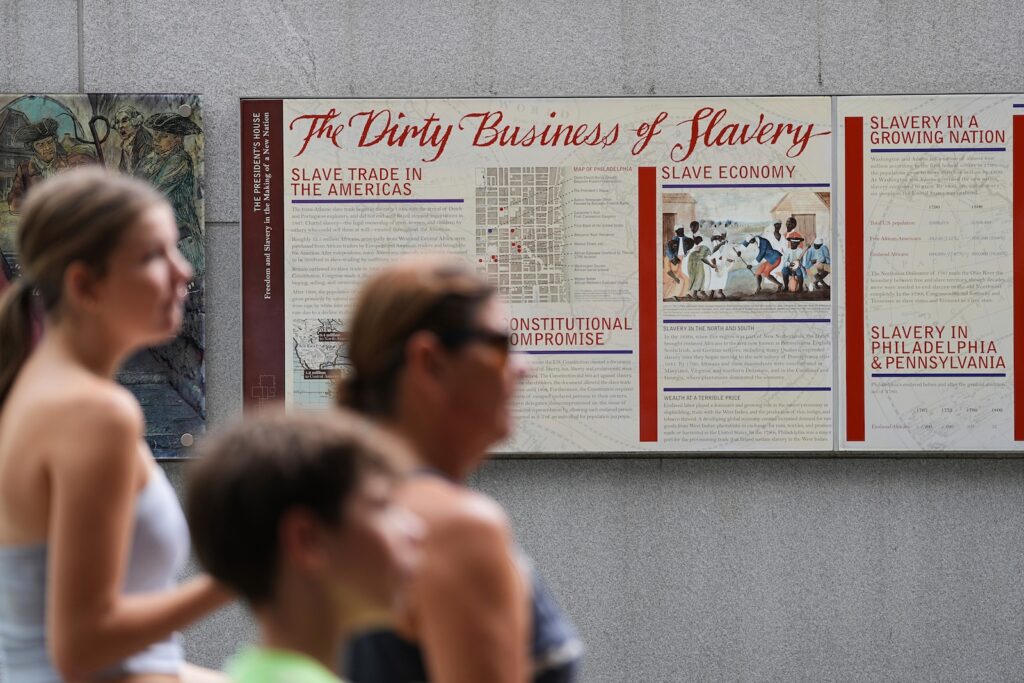
Court blocks National Park Service plans to replace slavery exhibit at President’s House Site
Advocates for the site say the new renderings diminish references to slavery and whitewash American history. A federal court stopped any further changes.
6 months ago
The city’s Law Department did not have an immediate response to the ruling.
A spokesperson for the U.S. Department of Interior did not immediately respond to a request for comment.
Critics have argued that the new panels would change the overall tone of the site, softening and significantly reducing references to slavery. The Avenging the Ancestors Coalition, which led the movement to develop the original site to focus on Washington’s slaves, has said the exhibits are a form of “whitewashing.”
“What we are seeing now is not restoration—it is revision,” the statement read. “It is an attempt to sanitize history and present a version of the past that is more comfortable, but far less truthful,” the coalition said in an April statement.
On Thursday, the group said it was “disappointed” by the Third Circuit’s decision and vowed to continue its fight to ensure “the full truth of our nation’s history is preserved and presented accurately.”
“We are currently conducting a thorough review of the Court’s opinion and consulting with our legal team to fully understand its implications,” the group said in a statement. “As we carefully evaluate the decision, ATAC will consider all available options moving forward.”
How the fight over the exhibit began
Last March, Trump issued a sweeping executive order titled “Restoring Truth and Sanity to American History,” a directive aimed at reshaping how American history is presented at federal sites. It called for the removal of what it described as “negative” or “disparaging” portrayals of the nation’s founders.
In January, the Park Service removed the entire slavery exhibit at the President’s House, alarming advocates and prompting the city to file a federal lawsuit seeking to restore the panels. Mayor Cherelle Parker’s administration called the decision to remove the exhibit “arbitrary and capricious,” violating federal law.
The following month, on Presidents Day, U.S. District Court Judge Cynthia Rufe sided with the city, granting a preliminary injunction that ordered the Park Service to restore the site to its original “physical status” while a lawsuit challenging the removal played out.
In her ruling, Rufe sharply criticized what she called the government’s unilateral decision to remove the exhibit, calling it an attempt to suppress historical information. The judge used a literary reference to drive home her opinion of the government’s rationale, likening the government to the fictional Ministry of Truth in George Orwell’s novel “1984.”
Many of the panels were restored the same week, but not all of them.
Less than a week ago, a district judge in Massachusetts ordered the Trump administration to restore the missing plaques. The decision temporarily blocked the Park Service from removing or altering content at federal sites across the country.
It’s now unclear whether the city has any legal options left to stop the administration from installing new panels.
Technically, its lawyers could request a rehearing from the Third Circuit, but Thursday’s unanimous opinion makes that path challenging, legal experts say. Asking the U.S. Supreme Court to stay the ruling is also viewed as a longshot.
In a video message posted to Facebook on Thursday evening, Mayor Cherelle Parker said she “will pursue every legal action possible” to reverse Thursday’s decision.
“We cannot and we will not rest until the full story of American history, including the existence of slavery at the President’s House, here in our great city of Philadelphia, the birthplace of democracy, is told for our nation and, quite frankly, the world to see,” Parker said.
In the meantime, the Massachusetts ruling appears to bind the Park Service, at least for now.
Related Content
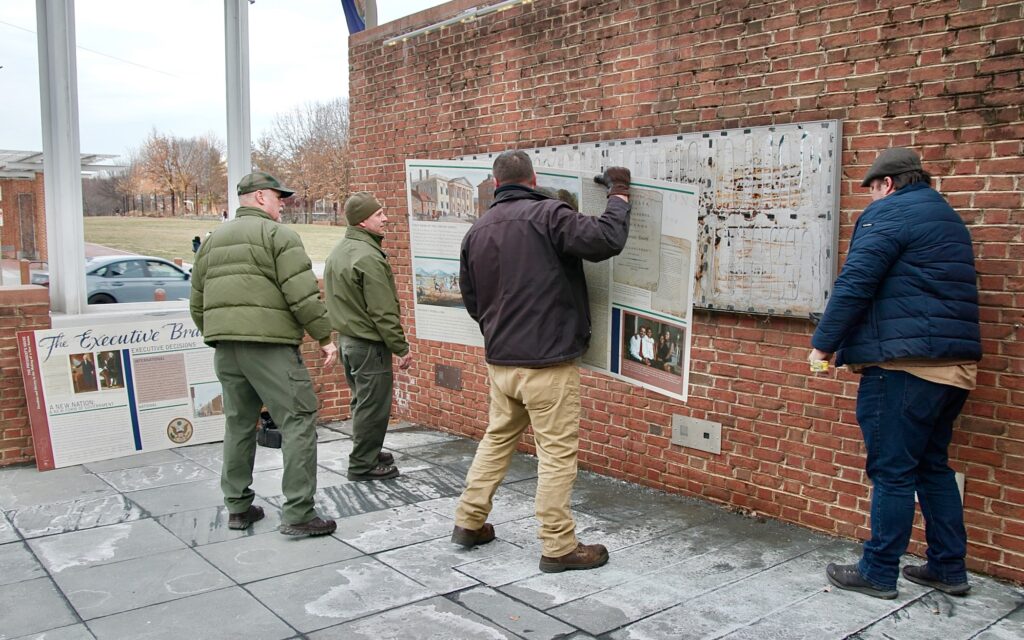
Judge orders the immediate restoration of Philly’s President’s House slavery exhibit
The Trump administration said Tuesday it plans to appeal the judge's earlier ruling ordering the park service to restore the exhibit.
8 months ago
Critics say new panels rewrite history
The new plaques include references to slavery, the Underground Railroad and figures such as Frederick Douglass. Like the previous panels, they also make mention of the nine enslaved people held by Washington while he was president and living in Philadelphia.
But opponents say the panels are an attempt to place Washington in a better light.
For example, text on one notes that the U.S. Constitution did not contain the word “slavery,” and another argues that Washington had “doubts” about the institution.
“Privately, George Washington often expressed discomfort with the institution and a desire to see it abolished,” it reads. “Yet as a Virginia plantation owner, his wealth and livelihood were deeply tied to it.”
On Thursday afternoon, a visitor at the President’s House Site said he wasn’t thrilled by the prospect of the Trump administration installing the new panels.
“I don’t think they should be doing that,” said Samuel Saint Germain. “These signs are really powerful and impactful in what Philadelphia has in its history.”

Get daily updates from WHYY News!
WHYY is your source for fact-based, in-depth journalism and information. As a nonprofit organization, we rely on financial support from readers like you. Please give today.
Appeals court hands Trump a loss on mail voting as Supreme Court considers his executive order
The decision Thursday by a panel of the 1st Circuit Court of Appeals comes even as the Supreme Court is already considering the same case.
3 weeks ago

ICE mandatory detention policy is unlawful, federal appeals court in Philly rules
Under the Trump administration policy, ICE has sought to detain nearly all undocumented immigrants and deny them bond hearings.
1 month ago
Listen 1:06
Supreme Court clears the way for Trump mail voting order in advance of midterms
Democratic officials in 23 states and the District of Columbia, including Pennsylvania, sued to block Trump's order.
1 month ago