
Penn appeals a federal court ruling requiring the university to turn over information related to Jewish staff
The university requested a stay of the court order to release the records, arguing that doing so would cause "irreparable harm.”
Listen 1:10

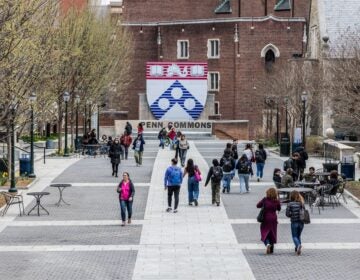
Students head to class on the campus of the University of Pennsylvania in Philadelphia. (Kimberly Paynter/WHYY)
From Philly and the Pa. suburbs to South Jersey and Delaware, what would you like WHYY News to cover? Let us know!
The University of Pennsylvania has formally appealed a federal judge’s order enforcing a subpoena from the Equal Employment Opportunity Commission, escalating a closely watched legal battle over antisemitism complaints, employee privacy and the limits of federal authority.
The appeal challenges a March 31 ruling that required Penn to comply with the subpoena that seeks information about Jewish faculty and staff. At the same time, Penn has asked the district court to pause enforcement of that order during the appeal.
The case stems from a broader federal effort to investigate allegations of antisemitism on college campuses following the October 2023 Hamas attack on Israel, Israel’s war in Gaza and the wave of protests that followed. The EEOC launched an inquiry into Penn in late 2023 after a commissioner filed a charge alleging a hostile work environment for Jewish employees.
Last year, the commission issued a subpoena seeking detailed information about individuals involved in complaints against the university and those affiliated with Jewish organizations, including members of Penn’s Jewish studies program and related campus groups.
Penn resisted the EEOC subpoena, arguing that it is too broad in its requests and that responding would require the university to effectively identify employees by religion.
Faculty, Jewish and civil rights groups have raised concerns about the historical implications of government efforts to identify individuals based on religion. Some intervened in the case to oppose the subpoena, arguing it could set a dangerous precedent.
At the end of March, U.S. District Court Judge Gerald J. Pappert sided with the EEOC, concluding that the subpoena met the legal standards for enforcement. He found the requested information “relevant” to the agency’s investigation and rejected Penn’s arguments that the requests were overly burdensome or unconstitutional, though his order did include some limits, including a block on information that would directly reveal affiliation with specific Jewish organizations.
Related Content
Penn argued that complying with the request for information would put employees and students at risk.
3 months ago
Listen 0:59On Monday, Penn filed a notice they are escalating the case to the U.S. Court of Appeals for the 3rd Circuit. They also asked the district court for a stay on Pappert’s order, to prevent it from being enforced as the appeal proceeds. Penn argued that being forced to comply would cause “irreparable harm,” given the “constitutionally protected First Amendment and privacy rights” at stake in the case.
On Tuesday, the district court gave the government until Friday to respond to Penn’s requests and Penn until the following Tuesday to reply.
The investigation became part of the Trump administration’s aggressive push to scrutinize antisemitism on campuses and the universities’ handling of complaints during the escalation of Israel’s response to the Hamas attack, which has caused the deaths of thousands of Palestinians and disrupted millions more.
Trump has long accused elite colleges around the country of antisemitism. In 2019, he signed an executive order to make Title VI of the 1964 Civil Rights Act apply to antisemitic acts.

Get daily updates from WHYY News!
WHYY is your source for fact-based, in-depth journalism and information. As a nonprofit organization, we rely on financial support from readers like you. Please give today.
Part of the series
Justice Department sues Philadelphia over law regulating ICE operations
The Justice Department argues cities do not have the authority to regulate federal officers.
3 weeks ago

A unanimous appeals court panel ruled Philadelphia lacks authority to control exhibits at the Independence Mall site.
3 weeks ago

Trump administration launches investigation into Philadelphia gun permit denials
Critics call Philly’s permitting standard subjective and unconstitutional, while gun control advocates say the DOJ is attacking any restrictions on ownership.
4 weeks ago
Listen 1:00