

Health experts warn summer relief may hide ongoing mental health struggles for teens
Teenagers may seem happier once school ends, but mental health experts say summer can mask anxiety and depression rather than resolve it.

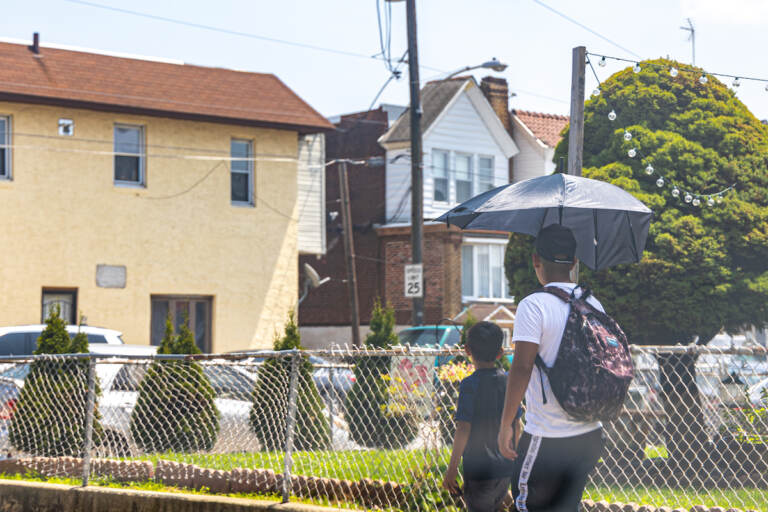
Two pedestrians use an umbrella for sun protection in Philadelphia’s Hunting Park neighborhood on July 26, 2023. (Kimberly Paynter/WHYY)
From Philly and the Pa. suburbs to South Jersey and Delaware, what would you like WHYY News to cover? Let us know!
As summer gives teenagers a break from homework, tests and packed schedules, many parents notice what appears to be a happier, calmer child. However, mental health professionals caution that those changes can be misleading.
The absence of school-related pressures may temporarily reduce visible symptoms of anxiety or depression, but that doesn’t mean the underlying issues have improved, according to clinicians at Pennsylvania-based behavioral health provider Sanare.
“What parents are seeing isn’t healing,” said Kate Racine, Sanare’s product operations director. “[They’re] seeing this short-term relief. And we just took the trigger away temporarily, which was school. And it’s kind of taught [us] that putting that to the side, that feels good. But what happens when that trigger comes back, we get flooded with those emotions again.”
Racine compares the experience to hanging a backpack on a hook at the end of the school year. A feeling where students hope they’ve packed away their anxiety until fall. Yet, in reality, she said that the backpack is still waiting for them, along with other challenges they are set to face after the summer season and at the start of autumn.
In Philadelphia, schools and community groups are now prioritizing students’ mental health support beyond the school day because of these concerns.
The Office of Prevention and Intervention of the School District of Philadelphia continues to provide behavioral health referrals and wellness resources during the summer. It also encourages families to see the season as a chance to strengthen, rather than pause, emotional well-being.
Related Content
Why seasonal depression can linger even as days get longer in Philadelphia
Health experts say seasonal affective disorder symptoms can decrease in April and May, though they may not disappear entirely.
7 months ago
School isn’t necessarily the problem
While school often appears to be the source of stress, clinicians say it’s more accurate to view it as the place where emotional challenges become most visible.
Rachel Bevilacqua, Sanare’s president and a licensed professional counselor, said many families mistakenly conclude that school itself causes a child’s distress.
“The problem is kids don’t know how to respond to a pressure put on them where expectations are being upheld, which are not happening in the summer,” she said.
Without school, many adolescents lose the routines that help organize their days. Bedtimes become later, meals less consistent and hours spent on phones or video games often increase.
“We like to stay exactly where we are,” Bevilacqua said. “The path of least resistance is what the brain likes.”
District officials say those changes are why parents should continue watching for shifts in mood, sleep, appetite, behavior and social engagement throughout the summer. A break from school, they note, doesn’t mean a break from mental health challenges.
Related Content
Inside the program that helps kids in Philly’s foster system deal with trauma
Here’s a look at the CHOP program helping foster families deal with children’s past trauma and mental health struggles.
10 months ago
Listen 1:13Relaxation and avoidance can look similar
One challenge for parents is distinguishing healthy downtime from signs that a teen may still be struggling.
Rather than looking only for obvious symptoms like crying or panic attacks, Racine encourages families to compare their child’s current behavior with what’s normal for them.
Warning signs can include withdrawing from family or friends, spending significantly more time isolated in a bedroom, sleeping excessively, losing interest in favorite activities, or eating irregularly.
“It might look like relaxation,” Racine said, “but it could really be something more serious.”
Bevilacqua also recommended that parents pay attention to how much effort routine tasks require.
“Does it take more energy from them? Does it seem like things are just a lot slower? Because that is a sign that … life is challenging,” she said.
Related Content

Experts recommend parents and caregivers read out loud to babies and young children.
7 months ago
Listen 1:21Summer can also bring loneliness
For some adolescents, school provides far more than academics. It offers friendships, trusted adults, structured routines, meals and a safe environment. When those supports disappear for several months, some teens become increasingly isolated.
“It absolutely can really impact individuals whose primary connection was school,” Racine said. “That was their lifeline.”
Recognizing that need, the Philadelphia School District has expanded supports beyond the traditional school calendar. This summer, the district hosted Camp SDP Rise Together, a healing-centered overnight camp for students affected by community violence. The program paired clinician-led wellness workshops with outdoor recreation, peer connection and leadership activities designed to help students build resilience before returning to school.
The district also continues connecting families to services such as Intensive Behavioral Health Services, the Support Team for Educational Partnership Program and its Virtual Wellness Zone, which offers mindfulness exercises and mental health resources year-round.
“Mental health doesn’t take a vacation when school lets out,” the Office of Prevention and Intervention said in a statement. “Small, everyday actions like listening without judgment, maintaining routines, encouraging healthy habits and staying connected can have a lasting impact on a child’s well-being.”
Related Content

Older adults are the most socially isolated in America. How do we fix that problem?
According to the surgeon general’s 2023 report on loneliness, a lack of social connection is as dangerous as smoking 15 cigarettes a day.
1 year ago
Parents don’t have to wait for a crisis
Rather than waiting until symptoms become severe, clinicians encourage families to use the slower pace of summer to build coping skills before students return to school.
“The one thing that summer gives us is time,” Racine said. “It gives us time and relief from the trigger … to really dive in and build those skills while we have the time and the space.”
That includes having more intentional conversations. Instead of asking, “How was your day?” Bevilacqua recommends questions that invite more thoughtful responses, such as asking about a favorite moment, something surprising that happened or what a child enjoyed most that day. Those conversations help strengthen connections without making children feel interrogated, she said.
Racine also advises parents not to force difficult conversations. Instead, she suggests patiently creating opportunities for connection through activities like fishing or playing basketball. These activities offer a more casual, creative way to connect rather than immediately trying to break through emotional barriers.
“If the parent is just continuing to try to bulldoze through that wall, that’s never going to be the tactic,” she said.
Related Content
How nature is fostering kids’ creativity in Philadelphia
Studies suggest nature can help lower stress and boost attention. Researchers and educators say it can also help kids express creativity.
10 months ago
Listen 4:42Screen time presents additional challenges
Longer days and fewer obligations often lead to increased phone use and social media consumption. While digital communication helps teens stay connected, excessive screen time can disrupt sleep, fuel unhealthy comparisons and replace meaningful, in-person interaction.
“It distorts reality for kids,” Racine said. “They’re feeling left out, and they’re feeling not good enough … there’s so much comparison that happens.”
Bevilacqua said blue-light, late-night scrolling and the instant gratification of social media can make it harder for adolescents to engage in activities that require more effort but ultimately support their well-being.
“If you are depressed, anxious, whatever it might be, you’re going to feel like you’re alone and isolated,” she said, emphasizing the importance of in-person relationships and structured group activities.
Related Content
Parents across the country who are worried about excessive screen time in schools are lobbying educators to go back to pencils and paper.
5 months ago
Looking beyond the summer months
Both clinicians said one of the biggest mistakes families make is evaluating a child’s mental health based solely on how they appear during summer break.
“If things seemingly get better as soon as school’s gone, that to me is the red flag,” Bevilacqua said. “That shows you that they’re only able to regulate when they don’t have stressors.”
Rather than viewing summer as a pause from mental health, Racine encourages families to see it as an opportunity to strengthen routines, deepen relationships and build coping skills before the demands of a new school year return.
She also hopes parents remember that seeking help doesn’t take away a child’s summer — it can help them enjoy it more.
“I love you too much to watch you suffer,” Racine suggested parents tell their children. “I’d be doing you a disservice if we didn’t intervene and get you the help now.”
The Office of Prevention and Intervention echoed that message, encouraging families to have open conversations early and seek support before challenges escalate. District officials say maintaining routines, staying connected and accessing available resources can help students feel safe, supported and better prepared for the transition back to school.
Ultimately, mental health professionals and district leaders agree the goal isn’t to eliminate stress. It’s equipping young people with the resilience, confidence and support systems they need to navigate it — during the summer, throughout the school year and beyond.

Saturdays just got more interesting.
WHYY is your source for fact-based, in-depth journalism and information. As a nonprofit organization, we rely on financial support from readers like you. Please give today.

Kids, often barely out of elementary school, are internalizing the idea that their futures depend on getting into an Ivy League school.
1 year ago
Listen 8:07
A bill is moving forward in N.J. to allow employees eligible for Family Leave to get bereavement leave from work under certain conditions.
2 years ago
Listen 1:16
Gen Z's changing habits: Less alcohol, tobacco, and sex
Gen Z seems to be leading a more modest lifestyle, with lower rates of drinking, vaping, and sexual activity. But is this shift a positive development?
Air Date: September 18, 2024 12:00 pm
Listen 51:44