
School District of Philadelphia revises facility plan again, sparing one more school from closure
The update raises the plan’s price tag by $200,000 and spares North Philadelphia’s Ludlow Elementary School from recommended closure.
Listen 0:58
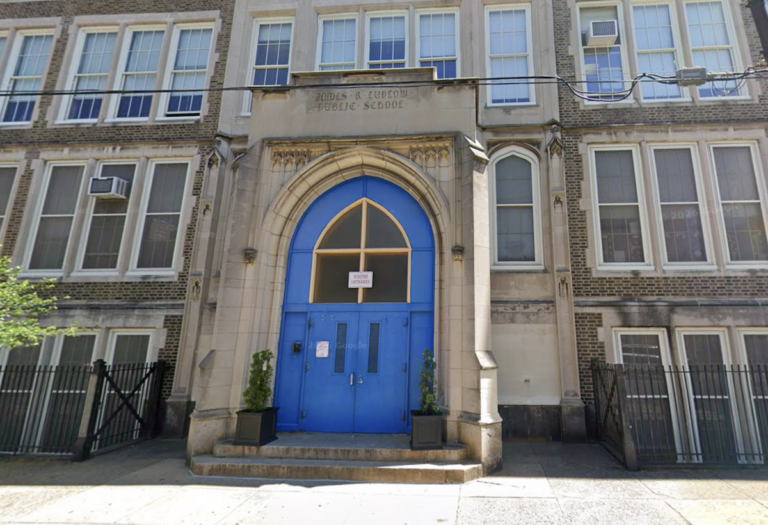
James R. Ludlow Elementary School is no longer included in the planned school closures. (Google maps)
From Philly and the Pa. suburbs to South Jersey and Delaware, what would you like WHYY News to cover? Let us know!
The School District of Philadelphia has again revised its plan for closing, merging and investing in school facilities over the next 10 years. An updated plan released Monday reduces the number of proposed school closures to 17, sparing James R. Ludlow Elementary School.
The latest version of the plan, which Superintendent Tony Watlington referred to as the “final, final” plan on a call with reporters Monday, would retain the Paul Robeson High School and Lankenau Environmental Science Magnet High School properties, but both schools are still slated for closure. The district would seek community feedback on future uses for the Robeson property, which could include demolishing the building and reimagining another school on the property, Watlington said, and would convert the Lankenau property into an environmental education center for students across the district.
The changes boost the plan’s price tag from $2.8 billion to $3 billion, with the school district planning to borrow $1 billion through capital bonds. The school district plans to seek additional support from the state government and philanthropic organizations to cover the remaining costs.
It’s the second time Watlington has scaled back the school closures proposed in the district’s years-long facilities planning process amid criticism from students, families and staff. The plan aims to redistribute resources across the district to deal with aging facilities and under- and over-enrollment in different schools.
“We heard the people,” Watlington said Monday.
Watlington presented an earlier version of the facilities plan to the school board in March, which included modernizing 159 school facilities, co-locating school programs in six facilities and closing 18 schools, down from the 20 closures the district originally proposed in January, which would have disproportionately impacted Black students and moved hundreds of students to lower-performing schools.
Related Content
The School District of Philadelphia’s Facilities Planning Process: What you need to know
The district is moving to rightsize its building stock. Some Philadelphians are concerned about whether their voices will be taken into account.
1 year ago
The latest version of the plan would modernize 10 additional school campuses, bringing the total to 169. It would increase investments in City Council districts 3 and 5 in West and North Philadelphia, which Watlington said bore the greatest impact of a prior round of school closures in 2013.
The district’s revised roadmap also pauses its plan to transfer some of the to-be-shuttered school properties to the city for job creation or affordable housing, to give the school board more time to weigh “legal and policy considerations.” Watlington said he may again recommend that the properties be conveyed from the district’s portfolio at a later time.
The plan still needs approval from the Board of Education.
If approved, the school closures would likely take effect starting in the 2027-2028 school year.
Ludlow Elementary removed from chopping block
Ludlow Elementary currently serves 216 students in North Philadelphia, less than half of the building’s capacity, according to the district. The district rated the building as “unsatisfactory” and its alignment with programming needs as “poor.”
But teachers said the district’s original plan to close the school would disrupt learning for the school’s substantial population of special education students. Students expressed worries about being split up from their friends and younger students having to travel farther to school. Community members also worried the housing that could be built at the site would not be affordable for neighborhood residents.
Watlington said Monday that the district looked at “all the feedback” when reevaluating its list of proposed closures, and Ludlow’s prominent location north of Girard Avenue caused officials to rethink its recommendation.
“It’s a … very prominent property in the city of Philadelphia, and to the extent that we could keep it in the footprint, we thought it was appropriate,” he said.
Lankenau will close, but would operate as an environmental education center
The district’s plan to close Lankenau and turn it into an honors program within the nearby Walter B. Saul High School of Agricultural Sciences, while conveying the property to the city for job creation or affordable housing, has drawn outcry from students, staff and elected officials. Community members argue that Lankenau is a thriving school that offers unique, hands-on programming and gives students access to hundreds of acres of natural land.
Legislation introduced to City Council earlier this month would rezone the school property, blocking the district’s original plan.
Watlington said Monday that under the new plan, the Lankenau environmental education center would be open to former Lankenau students at Saul “as often as they need it.” He said that while it might seem counterintuitive to close the school while retaining the property, the district stands by its decision to merge the school with Saul.
“We cannot drive faster improvement and at the same time support really small high schools,” Watlington said. “It is just inevitable that we’ve got to reallocate some of our resources.”
Jonathan Hoffmeier, who teaches algebra and agriculture business at Lankenau, called the latest plan “discouraging.” He said Lankenau already serves as an environmental education resource for the whole district through middle school campus tours. He worries that busing students, including those who currently attend Lankenau, to the campus will be expensive and unreliable.
“Our students already have access to it,” Hoffmeier said. “Why eliminate something that works?”
17 schools still slated to close
The latest version of the district’s plan would close the following schools:
PreK-8 schools
- Robert Morris Elementary
- Samuel Pennypacker School
- John Welsh Elementary School
- Laura W. Waring School
- Overbrook Elementary School
- Rudolph Blankenburg School
- Fitler Academics Plus
Middle schools
- General Louis Wagner Middle School
- Stetson Middle School
- Warren G. Harding Middle School
- William T. Tilden Middle School
- Academy for the Middle Years (AMY) at Northwest
High schools
- Lankenau High School
- Paul Robeson High School
- Parkway Northwest High School
- Parkway West High School
- Penn Treaty High School
The district says its plan aims to strengthen Pre-K through eighth-grade programming, reinvest in neighborhood high schools, reduce student transitions between schools, and expand students’ access to criteria-based admission programs and career and technical education.
School board likely to vote on the plan Thursday
Board of Education President Reginald Streater said Monday he plans to bring a resolution approving the final plan to vote on during Thursday’s board meeting.
He said this resolution will adopt the plan as “guidelines of where we’re trying to head,” but will not supplant other board approvals that will be necessary in the future to facilitate specific school closures and capital projects.
Streater expressed support for Watlington’s final plan, calling it “very necessary” and noting it would reduce the number of school buildings rated as ‘unsatisfactory’ or ‘poor’ to zero.
“This plan right now is the best thinking that it appears the Superintendent has, based upon the data and information that he has and in the environment that we’re in,” Streater said.
“This is ripe … for board consideration,” he added.

Get daily updates from WHYY News!
WHYY is your source for fact-based, in-depth journalism and information. As a nonprofit organization, we rely on financial support from readers like you. Please give today.
Part of the series


Pennsylvania Gov. Shapiro signs legislation guaranteeing 30 minutes of recess to elementary students
The governor signed a bill Wednesday that was approved by the state legislature as part of the 2026-27 budget.
2 weeks ago

New leader of Philadelphia organization for arts in schools sees hope in collaboration
As Anjoli Santiago takes the helm of Philadelphia Arts in Education Partnership, the state has changed its arts funding priorities.
3 weeks ago
Listen 1:14
2 more Philadelphia schools will close due to asbestos issues
Previously, both schools were cleared of asbestos.
3 years ago