

Pa. schools are in a ‘reading recession,’ but these Philly-area schools are on the rise
Years after the COVID-19 pandemic, learning loss has left Pennsylvania schools lagging behind much of the country.
Listen 0:53
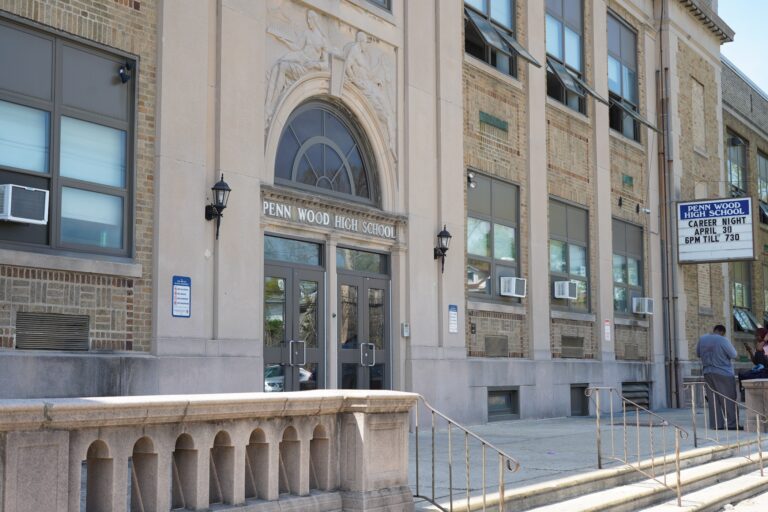
Penn Wood High School in Lansdowne, Pa. (Kenny Cooper/WHYY)
From Philly and the Pa. suburbs to South Jersey and Delaware, what would you like WHYY News to cover? Let us know!
There’s a nationwide “reading recession” in U.S. schools, and Pennsylvania is among the states hardest hit, according to researchers studying academic recovery since the COVID-19 pandemic.
Despite making small gains in math scores, the average Pennsylvania student is performing 0.19 grade levels lower than 2022.
According to researchers at Dartmouth College, Harvard University and Stanford University, Pennsylvania ranks 21st in math recovery among 38 states and 27th in reading recovery among 35 states.
Wednesday’s release of the fourth annual Education Scorecard paints a grim picture of academic recovery across the United States. Scholars analyzed state test results for roughly 35 million students in grades 3–8 nationwide. Only five states and Washington, D.C., showed improvement in reading scores between 2022 and 2025.
Some states, including Pennsylvania, did see meaningful progress in math test scores since 2022, according to the data. In Pennsylvania, the average student is performing about 0.17 grade levels higher than they were in 2022. However, the average student in Pennsylvania is still performing at roughly half a grade level lower than in 2019.
“We sometimes forget just how much progress has been made in K–12 education,” said Thomas Kane, a Harvard professor and report co-author. “Often we tell the story about how results have been stagnant for a while. That is actually really only describing the last decade. Prior to 2015, there were substantial improvements in reading and math.”
Kane, faculty director of the Center for Education Policy Research, called the pandemic a “mudslide” that “followed seven years of a steady erosion in achievement that started around 2013.”
“In fact, it’s worth noting that the rate of learning loss in the three years before the pandemic and the three years after the pandemic was the same as it was during the pandemic itself,” Kane said.
Which Philly-area school districts are ‘on the rise’?
Education Scorecard co-author Sean Reardon, a Stanford professor and director of the Educational Opportunity Project, said previous eras of improvement should remind the public of what the country can achieve.
“We can provide better educational opportunities and more equal educational opportunities, but we haven’t been doing that very effectively over the last decade or so,” Reardon said.
The Education Scorecard identified more than 400 districts nationwide as “districts on the rise” that outperformed demographically similar school districts within their respective states.
“The way we identify those is we find the five districts in the same state as the target district that are closest in terms of size, socioeconomic composition, racial ethnic composition position, free and reduced-price launch eligibility rates and urbanicity,” Reardon said.
In Greater Philadelphia, the Rose Tree Media School District has seen notable progress in both math and reading scores.
The Central Bucks School District, the Chichester School District, the Coatesville Area School District and the Kennett Consolidated School District are rising faster than similar districts in reading scores.
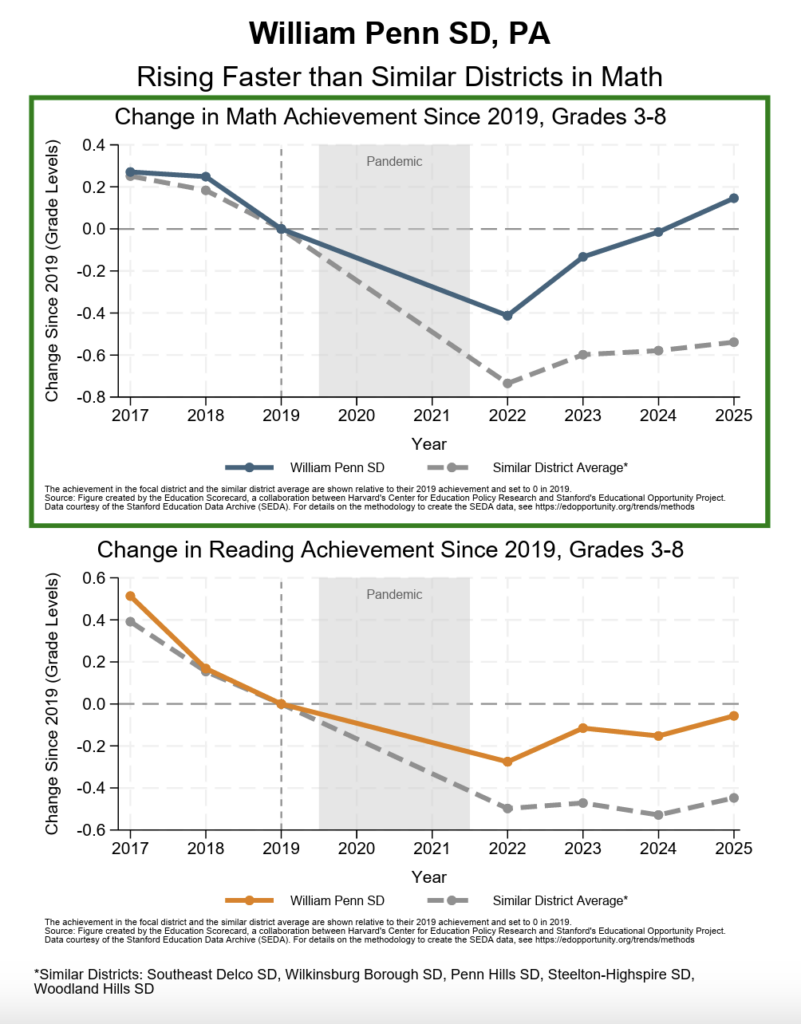
The Downingtown Area School District, the Haverford Township School District, the School District of Philadelphia and the William Penn School District are outperforming similar districts in math scores.
“We owe it to children to understand what is happening in these districts and encourage states to pair up each of these districts with other districts in the state that are not recovering to try to share recovery strategies,” Kane said.
Eric Becoats, superintendent of the William Penn School District, told WHYY News that the positive acknowledgement validates the “very intentional” work that teachers and school leaders have done to improve student success.
“You have teachers in this district that are so committed to making sure that our students have everything that they need,” Becoats said. “We would not be where we are without them. I would say the same for our administrators.”
He said the data shows him students are more than capable of achieving academic improvement — if given the adequate tools.
“We need to provide the appropriate resources so that they can achieve at the levels that we know that they can,” Becoats said.
Related Content
17 Philadelphia schools are set to close in 2027. Here’s what to know
Philadelphia's school board voted to pass the district’s facilities plan last Thursday, despite protests from city officials and residents.
5 months ago
Inside William Penn’s recovery strategy
William Penn serves approximately 5,000 students from the boroughs of Aldan, Colwyn, Darby, East Lansdowne, Lansdowne and Yeadon. A majority of the district’s students in Delaware County come from economically disadvantaged households.
The district was among six that successfully sued Pennsylvania in 2014, arguing that the state’s funding model was discriminatory and unconstitutional. A landmark ruling in 2023 sided with the districts, but it did not immediately resolve the district’s persistent money problems.
Becoats’ introduction to the district coincided with the COVID-19 pandemic. Although the decline in the nation’s reading test scores predates the quarantine, the period of subsequent shutdowns and social-distance learning saw the cratering of academic measures of success across the board.
“The pandemic basically highlighted the fact that there were districts in Pennsylvania that did not have some basic resources, I would say, that were needed for our 21st-century education,” Becoats said.
He said William Penn did not let the pandemic upend the implementation of its strategic plan.
In fact, he said, the district leveraged the influx of federal relief dollars to purchase more educational tools, provide professional development for teachers and improve the infrastructure of the buildings.
“In addition to that, we also implemented an instructional model that focused on supports being in schools,” Becoats said. “So every school had an instructional facilitator. Every school had two academic interventionists.”
The researchers behind the Education Scorecard also highlighted William Penn’s use of frequent assessments to track student progress, along with quarterly review sessions and the hiring of a research supervisor.
“Are we perfect? No,” Becoats said. “[In] no way, form or fashion are we perfect, but we have a model that I think works and we have a model that I believe will continue to move the district forward.”
The role of money in academic recovery from the pandemic
Becoats cautioned that any future breaks or gaps in funding could slow the trajectory of recovery.
“We now need to make sure that we continue to push the state and others to continue the level of funding that they provided for our district,” Becoats said.
His belief in the role of money in pandemic recovery is supported by the data.
Education Scorecard researchers pointed out that much of the recovery has been “U-shaped,” meaning that more affluent districts and the poorest districts — buoyed by federal relief funds — have seen the largest improvements. School districts in the middle of the wealth spectrum have largely not seen such progress.
“The median federal relief grant for the highest-poverty districts was $6,000 per student,” Kane said. “That was about three times as high as the median grant for districts that were 40–50% poor.”
Without the federal grant money, researchers estimated, there would have been no recovery in math in the highest-poverty districts and even larger loss in reading in the highest-poverty districts.
The Education Scorecard report highlights four priorities for education and policy leaders to adopt: Direct more resources to districts with lingering learning losses; lower chronic absenteeism; spend more money on research into student performance; and pair “districts on the rise with similar underperforming peers.”

Get daily updates from WHYY News!
WHYY is your source for fact-based, in-depth journalism and information. As a nonprofit organization, we rely on financial support from readers like you. Please give today.
Part of the series
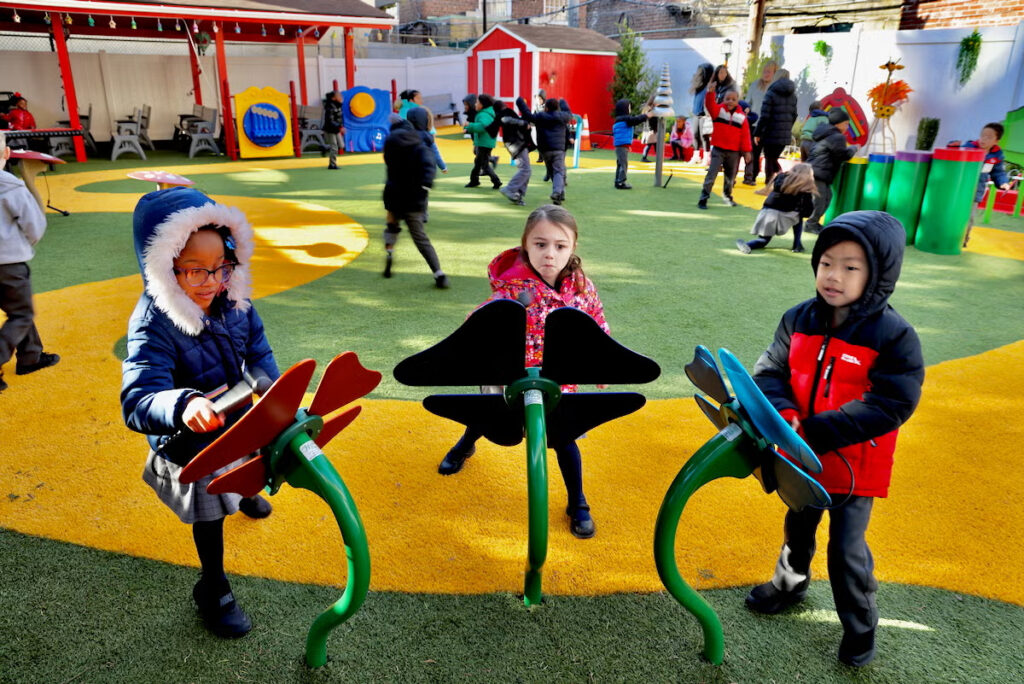
Pennsylvania Gov. Shapiro signs legislation guaranteeing 30 minutes of recess to elementary students
The governor signed a bill Wednesday that was approved by the state legislature as part of the 2026-27 budget.
3 weeks ago
New leader of Philadelphia organization for arts in schools sees hope in collaboration
As Anjoli Santiago takes the helm of Philadelphia Arts in Education Partnership, the state has changed its arts funding priorities.
4 weeks ago
Listen 1:14
The “bell-to-bell” bans face skepticism from students and parents. After going phone-free, early adopters say the difference is striking.
1 month ago
Listen 3:44