

‘Too good to be true?’: No, WHYY’s Terry Gross did not personally email you to be a guest on ‘Fresh Air’
AI-fueled scammers are asking people to appear on WHYY’s “Fresh Air” and other popular shows and podcasts in exchange for money.
Listen 1:05
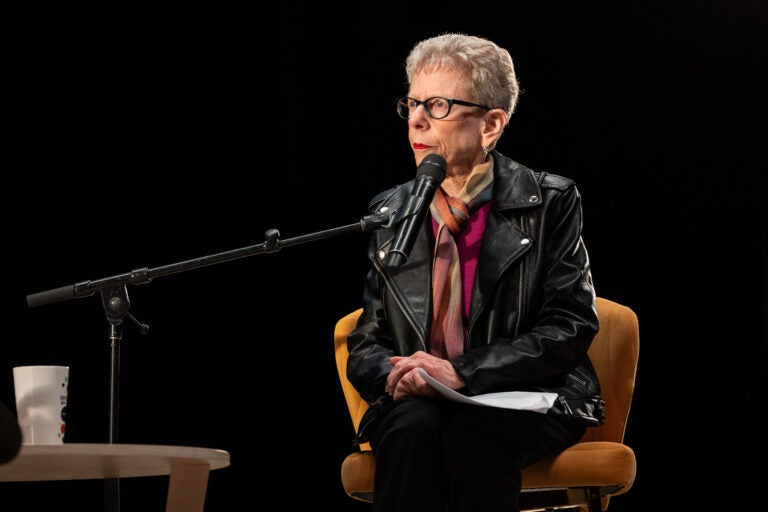
''Fresh Air'' host Terry Gross listens to documentary filmmaker Ken Burns during an interview about his new film about the American Revolution at the Freedom Mortgage Pavillion in Camden, N.J. on October 9, 2025. (Kimberly Paynter/WHYY)
From Philly and the Pa. suburbs to South Jersey and Delaware, what would you like WHYY News to cover? Let us know!
An email offering an interview with Terry Gross may sound like a career-making opportunity. But a string of messages using the name of the longtime “Fresh Air” host has instead led recipients into an increasingly elaborate scam.
Authors, entertainers and other public figures have reported receiving highly personalized invitations from people claiming to represent Gross, WHYY, NPR or the “Fresh Air” production team. The messages include detailed references to the target’s work, proposed interview topics and what appears to be a professional booking process.
Jennifer M. Black, a professor of history at Misericordia University, said she was excited when she first got what she thought was an invitation to be on the show to discuss her recent book.
“My first reaction was ‘Oh my gosh, Terry Gross wants to talk to me,” she told WHYY News. “I texted my friends and coworkers, ‘OMG, OMG, OMG’ with a screenshot.”
She responded to the email, but gradually, some things started to tip her off that it wasn’t real, like it purportedly came from Gross herself.
“I have been contacted by production assistants before, not necessarily the person in charge. So that was sort of strange,” she said. “And there was something about the pitch that just struck me as AI.”
Her suspicions were confirmed when a follow-up email asked her to pay $250 for “production costs.”
Black said she was initially “flattered” by the request, but she has made media appearances before, so it didn’t seem too unrealistic.
“They’re totally playing to people’s vanity, and they know their audience,” she said. “An academic historian who recently published a book getting an interview request from Terry Gross, of course I’m going to respond to that.”
According to Temple University professor Aunshul Rege, who specializes in cybersecurity and social engineering, artificial intelligence has turbocharged old-school scams.
“Criminals have been pretending to be trusted people for a very, very long time,” she told WHYY News. “So what’s changing is how cheaply and convincingly they can personalize that impersonation.”
She called it “a really interesting example of social engineering.”
WHYY has received complaints from others who have received similar — though personalized — emails and is working with National Public Radio and law enforcement in investigating the matter.
Related Content

Delaware doctor who ordered tests for people she didn’t examine to pay feds $180,000
Dr. Shayasta Mufti agreed with prosecutors that she “made no effort to determine whether genetic testing was medically necessary.”
4 months ago
Listen 1:02Comedy writer Bruce Vilanch told The Hollywood Reporter a similar email he received appeared legitimate
“It was so articulate and so like her,” he said, adding that he was also promised compensation after conducting the interview.
The impersonation attempts are not limited to Gross. The Hollywood Reporter described similar approaches made in the names of comedians Nikki Glaser and Amy Poehler and journalist Katie Couric. Some targets were directed to provide social-media login credentials, potentially allowing scammers to take control of their accounts.
WHYY, NPR and “Fresh Air” said they are aware of fraudulent emails impersonating Gross, co-host Tonya Mosley and other members of the program’s staff. WHYY said it never charges guests to be interviewed and does not pay people for interviews on its programs.
“Any communication asking a prospective guest to pay a fee – or offering payment for an interview while claiming to represent WHYY or Fresh Air – should be treated as illegitimate,” the statement read.
Rege said that there’s not much else WHYY or other organizations can do to avoid future attempts to defraud people in their names, except to monitor reports about such scams and publicize incidents when they happen.
“You can play an active part in educating your audience on what to look at,” she said. “You can also make legitimate booking procedures easy to verify. If you were to call guests to come and join your show, whatever that invitation email might be, have multiple ways of crosschecking.”
However, there are flags potential victims can look out for such as the email. At least some of the emails purportedly from Gross came from “terrygrossfreshair@gmail.com.”
“One red flag was the procedure — ‘Fresh Air’ is a major production, yet Terry Gross was personally handling logistics. That does not make sense,” Rege said. “And if there’s a request for money, that should, by default, make anyone question things.”
She also advised recipients of such emails to find a legitimate contact at the organization and verify the request that way rather than respond to a suspicious message.
After she began to suspect fraud, Black said she called WHYY to verify the invitation but was initially transferred to Gross’ voicemail. She called again and said, “Before you transfer me, I think this might have been a scam.” She was eventually put in touch with WHYY security, and an investigation was launched.
Rege said that this incident may be a harbinger of more sophisticated, AI-enabled scams coming. In prior eras, efforts tended to be typo-riddled messages blasted out to large populations of susceptible prey, such as youth and seniors.
In the past, Rege said, one way to identify a scam was if it was “too good to be true,” but AI means messages can be individualized for specific targets that may be lured by what appear to be credible requests.
Vilanch, for example, is a two-time Emmy Award–winning comedian who wrote jokes for the Oscars and was featured by NPR just last year.
“If someone’s well-known like an actor, an author, musician, any public figure, being invited onto a major podcast or a radio program can actually be completely normal,” Rege said. “And this is exactly what the attacker is banking on because they’re deliberately choosing this pretext or this backstory that fits the victim.”

Get daily updates from WHYY News!
WHYY is your source for fact-based, in-depth journalism and information. As a nonprofit organization, we rely on financial support from readers like you. Please give today.

After 50 years as an interview host, Gross fields questions from Nézet-Séguin about opera, life choices and smoking.
3 months ago
Listen 1:34
WHYY wins Mid-Atlantic Emmy awards for Arts and Interview programs
Programs featuring cellist Yo-Yo Ma and dancer Angel Corella earned top industry honors.
12 months ago

From Dolly Parton to MrBeast, James Patterson is always learning
One of the best-selling authors of all time sat down with Terry Gross for an onstage interview as WHYY gave him its annual Lifelong Learning Award.
1 year ago
Listen 1:35