
‘We need to go big’: Redding Consortium votes to consolidate northern New Castle schools districts into one
Advocates for one single consolidated say the less fragmented students are across New Castle County, the greater chance of student success.
Listen 0:57
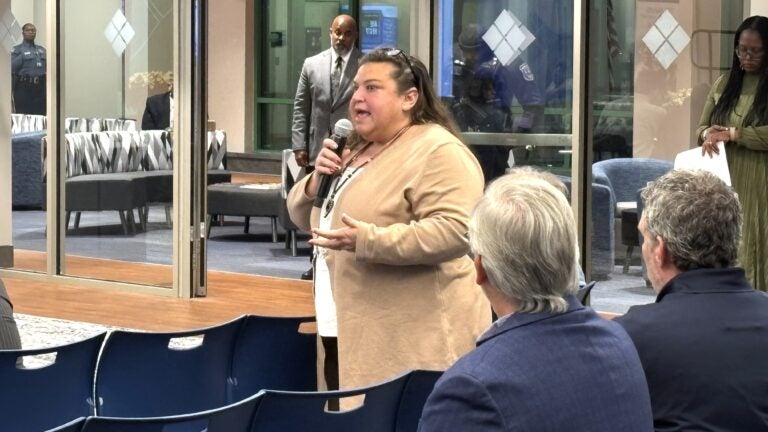
Michelle Suchyj, a teacher a Maurice Pritchett Academy in Wilmington, expresses her concern about the redistricting options. (Sarah Mueller/WHYY)
What are journalists missing from the state of Delaware? What would you most like WHYY News to cover? Let us know.
The Redding Consortium decided to go big Tuesday night, voting to consolidate all of the school districts serving northern New Castle County.
The determination paves the way for the state group, created in 2019 and tasked with redrawing lines for the school districts currently serving the city of Wilmington and northern New Castle County, to develop a detailed plan for redistricting. State lawmakers must eventually approve it.
The consortium had been considering three models:
- A single county district
- A Metropolitan Wilmington School District that would consolidate Brandywine, Red Clay and the city of Wilmington into one district.
- The Red Clay and Brandywine option where Wilmington students would be split between the two districts.
The Christina School District would leave the city in all of the options.
“Nothing is going to change if we aren’t willing to change,” Red Clay school teacher Mike Mathews said. “I know that we need to go big. It’s going to slay some sacred cows in the room and some leaders, who may not be leaders after all this is said and done, but we got to put kids first.”
The single county district model faces uphill political battle
Any plan has already been deemed “dead on arrival” in the General Assembly by some. The chosen model is the priciest and could be the hardest to implement.
Drew Atchison, a researcher at American Institutes for Research, analyzed the cost of each scenario in a report released last week. He estimated the cost to implement the single school district plan would total around $20 million, with the metropolitan district costing about half of that and the Brandywine/Red Clay option being the least expensive. The largest expenses would be leveling up salaries for educators, and initial planning and coordination.
But supporters of the county district idea argue that it would create a larger tax pool for the districts, increasing resources for low-income students and multilingual learners.
Some in the consortium and in the community wanted to go smaller, backing the Red Clay/Brandywine option, also known as the “river plan,” as the most politically viable and less disruptive. Versions of this have been discussed all the way back to at least 2001. A Red Clay/Brandywine plan failed in the state Legislature in 2016.
Some, like Christina School teacher Michelle Suchyj, worry about Wilmington losing its voice. Suchyj works at the new Maurice Pritchett Academy, which was the first Wilmington school built in 50 years. She said she’s worried the single district model could negatively impact her students.
“I don’t want northern New Castle County because I don’t want my kids in the city of Wilmington to get lost in an even bigger pool than they’re already lost in,” she said.
Parent Kendra Brown said she supports the single district model.
“We all did this together,” she said. “We all failed our children together, so we need to fix the problem together. The state of Delaware is failing their children.”
Related Content

Some Brandywine school board members pushed back on the proposed redistricting, vowing to lobby state lawmakers against moving forward.
3 months ago
Listen 1:03Wilmington Mayor John Carney, also a consortium member, supported the “river plan,” but ultimately voted “yes” on the county district plan. He said he’ll use his political muscle to push for it, despite some lingering doubts.
“People think that you have a larger district. That means a greater voice for the people I represent in the city, I’m not so sure about that,” he said. “The issue, too, is that this one’s going to be more costly, which makes it, frankly, more difficult to get it approved.”
Redding Consortium co-chair state Sen. Elizabeth “Tizzy” Lockman, D-Wilmington, said she’s confident lawmakers will approve this model after the consortium makes their case.
“We wouldn’t be doing this if I didn’t,” she said. “I know the people there, and I believe that they want the best, not just for their constituents, but for our state. So I’m gonna say ‘yes.’”
Brandywine opposition bring race to forefront
Suburban opposition to redrawing lines led hundreds of people to pack into last week’s Brandywine school board meeting to voice concerns about redistricting, drawing accusations from some of racism.
Brandywine School District Superintendent Lisa Lawson said they oppose consolidation, but she and the school board president Jason Heller said they were open to one of the variations of the Red Clay/Bradywine model. Heller called it the “lowest risk option.” A consortium member, Lawson voted “no” on the single county district model.
The debate over school districts in New Castle County dates back to a 1978 federal court order mandating busing and the consolidation of the mostly Black Wilmington school district and the 10 suburban school districts into a single county school district. Delaware created the four districts within New Castle County in 1981 as part of an effort to provide equal access to a quality education. While court-ordered busing ended in 2000, some students continue to be bused today.
Despite court interventions to force desegregation of Wilmington schools, Delaware Department of Education data shows the students are majority Black or Latino, and up to 73% of them are low-income. Students continue to struggle to overcome obstacles resulting from living in poverty, including crime, mental illness, housing instability and a lack of transportation.
Lawson said opposition from the Brandywine community was really about a desire to protect their unique community.
“It is a passionate group of people who are just seeing lines being redrawn without any other proposals or guarantees on the plate,” she said. “And I think that’s what’s difficult. Just because we disagree on a path forward as to how we support the children and families of Wilmington does not mean that we don’t care or that we don’t want the best for every child.”
The plan that the Redding Consortium will develop in the early months of 2026 will go to the Delaware State Board of Education and then the General Assembly. It could take years to implement.


Get daily updates from WHYY News!
WHYY is your source for fact-based, in-depth journalism and information. As a nonprofit organization, we rely on financial support from readers like you. Please give today.
Part of the series

El estado de Delaware recuperó decenas de miles de dólares en fondos robados utilizados como pagos por un camión y una casa rodante, junto con dinero incautado.
20 hours ago

“What we wanted to highlight at the State of the Union was that, a year later, things are not better,” said Democratic Sen. Lisa Blunt Rochester.
3 weeks ago

Delaware recovers less than half of taxpayer funds stolen by state employee in 2023
The state of Delaware recovered tens of thousands of dollars in stolen funds used as payments for a truck and a camper, along with money seized from a bank account.
3 weeks ago
Listen 1:02