

Princeton’s president says university will tighten budget because of endowment outlook
Though the Ivy League institution is financially strong, Christopher Eisgruber said it must be more efficient in the future.

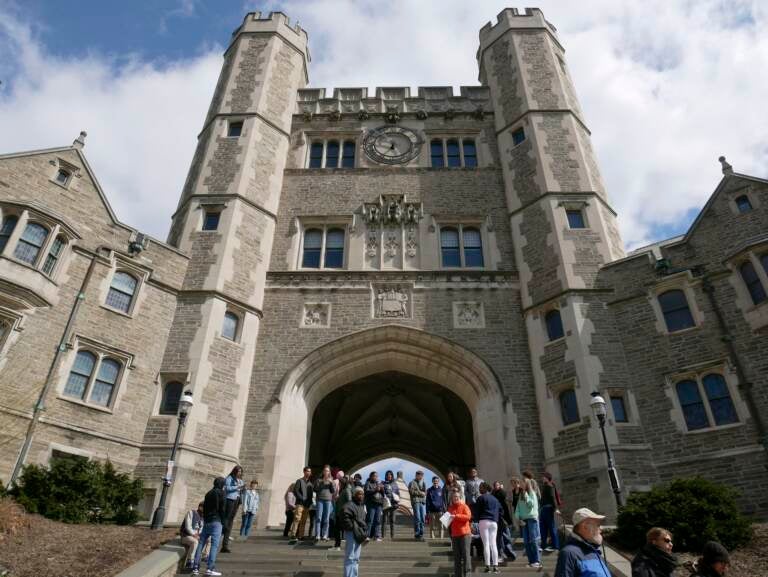
In this April 5, 2018, file photo, people walk through the Princeton University campus in Princeton, N.J. (Seth Wenig/AP)
From Camden and Cherry Hill to Trenton and the Jersey Shore, what about life in New Jersey do you want WHYY News to cover? Let us know.
Christopher Eisgruber, president of Princeton University, announced that the Ivy League institution will tighten its budget while investing in core priorities such as research and student support.
The change in course was part of his State of the University letter that Eisgruber posted Monday on his blog. He said a shift in endowment prospects is driving the change.
“As we emerge from a period of rapid growth, we will have to look for areas where we can consolidate or cut, both to offset rising costs (including salaries and benefits) and to support the investments required for teaching and research excellence,” he said.
From expansion to restraint and reduction
Under a 2016 strategic framework, Princeton embraced growing facilities, programs and financial aid. That era is now seemingly coming to an end.
Eisgruber said the university must pursue its mission “more efficiently, including through thoughtful decisions about when to eliminate or reduce existing programs.”
Related Content

Princeton University Library marks America’s 250th with Revolutionary War artifacts and stories
Among the artifacts are copies of the Declaration of Independence and U.S. Constitution, as well as a cannonball.
2 months ago
Listen 1:13Economic and political threats are prompting Princeton to change course
Returns across Princeton’s endowments were among the worst the university experienced recently, according to Eisgruber. The three-year average from 2022 to 2024 was the second worst in more than four decades.
Eisgruber said the university currently depends “more heavily than ever” on its endowment which, he adds, is also challenged by political threats, in addition to economic threats.
Princeton spends roughly 5% of its endowment annually on campus operations, including salaries, financial aid, research equipment and building maintenance. The endowment now provides about 65% of operating revenue for the university, a 10% rise from 2016.
Eisgruber said the university will continue to pursue new opportunities, but added that it must shift its overall financial strategy.
“We will be making these changes, moreover, not in response to some dramatic, verifiable event…but because of long-term trends and projections,” he said, using the 2008 global economic crisis as an example of a verifiable event.
Princeton is among several higher education institutions that have had to adjust since President Donald Trump returned to office. The university has seen dozens of federal research grants suspended. In addition, the university’s Prison Teaching Initiative lost its grant from the National Science Foundation as it was preparing to help other universities create similar programs.
Princeton also faces an increase of its endowment tax for the 2026-2027 academic year, from 1.4% to 8%, according to the Inquirer.
The endowment, along with research grants, account for 83% of Princeton’s revenue, according to Eisgruber. Departments over the last year were asked to trim 5–7% from their budgets.
What could Eisgruber’s announcement mean for Princeton students and faculty?
Although Princeton remains financially strong, Eisgruber signaled efficiency measures and reductions are likely in the future.
Certain programs could be consolidated, scaled back or eliminated to support “investments required for teaching and research excellence.” The president also said that future growth would rely more on philanthropy.

Get daily updates from WHYY News!
WHYY is your source for fact-based, in-depth journalism and information. As a nonprofit organization, we rely on financial support from readers like you. Please give today.
Black enrollment is waning at many elite colleges after affirmative action ban, AP analysis finds
At Princeton and some others, the number of new Black students has fallen by nearly half. Some colleges attribute it to natural fluctuations.
5 months ago

Federal cuts threaten Princeton University program for formerly incarcerated persons
The university’s Prison Teaching Initiative has built partnerships to scale programs that provide formerly incarcerated students with research opportunities.
7 months ago
Listen 3:30
A look at the universities with federal funding targeted by the Trump administration
The Trump administration has increasingly used funding cuts as a tool to influence campus policies to comply with his political agenda.
11 months ago