

‘Game the system’: Philadelphia state legislator seeks to outlaw insider betting on prediction markets
Rep. Tarik Khan says he was motivated after a U.S. special forces soldier won $400,000 betting on the capture of Venezuela's president before the raid was carried out.
Listen 1:15
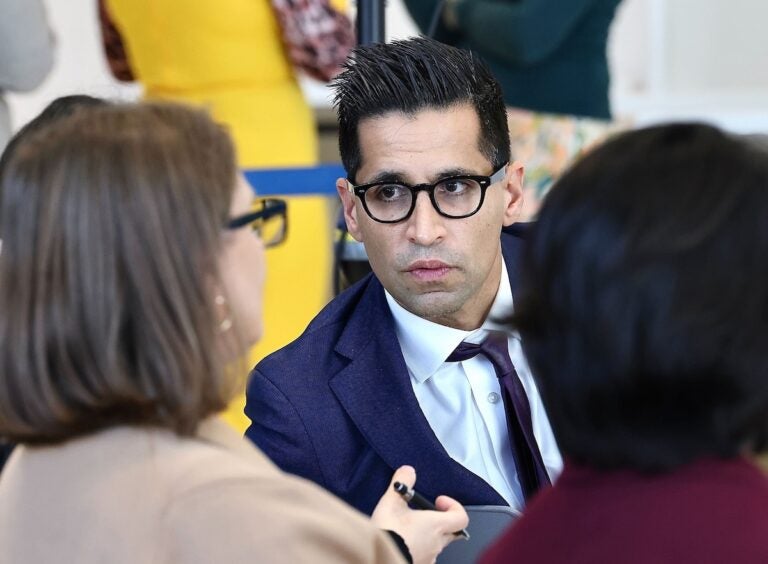
File - Pennsylvania state Rep. Tarik Khan attends a press conference at Children's Hospital of Pennsylvania where Gov. Josh Shapiro signed an executive order protecting vaccine access. (Emma Lee/WHYY)
From Philly and the Pa. suburbs to South Jersey and Delaware, what would you like WHYY News to cover? Let us know!
Pennsylvania lawmakers introduced legislation earlier this week that would prohibit people with insider knowledge from betting on outcomes using prediction markets.
State Rep. Tarik Khan, D-Philadelphia, on April 29, filed a bill that proposes certain restrictions on prediction markets, or platforms where users can wager on everything from the weather to election results.
For example, athletes couldn’t bet on their own games or politicians on their own elections.
Khan told WHYY News that his legislation would not outlaw the platforms themselves but would protect the general public from those that would use them to cheat.
“We have a duty to make sure that these markets are legit and that people are not getting scammed,” Khan said. “To think that people that have inside information — people in power — are able to game this system and make millions off the backs of people that are trying to do it the honest way — it’s a problem.”
The bill is co-sponsored by several other Democrats, including fellow Philadelphia Rep. Danilo Burgos and Rep. Jim Prokopiak of Bucks County, but Republicans Jeremy Shaffer of Allegheny County and Jamie Flick of Lycoming County have also signed on, giving it bipartisan credibility.
The legislation also would prohibit betting on some high-risk and unethical markets, such as those involving death or mass casualty events, and would ban minors from participating.
The bill would also forbid betting on high school sports in the commonwealth, which Khan called a “common sense” solution to a growing problem.
“There’s just too much of a risk of corrupting and adulterating the purity of these sports,” he said. “That’s a problem.”
Related Content
What happens when you can bet on everything?
Today, we pull back the curtain on prediction markets. Who’s using them? How do they make money? And what are the real risks and rewards beneath the hype?
Air Date: February 11, 2026 12:00 pm
Listen 50:37Khan said he was motivated to file the legislation after learning about the case involving U.S. Army Special Forces Master Sgt. Gannon Ken Van Dyke. Van Dyke was indicted last week and charged with using classified information for personal gain. He allegedly made $400,000 on Polymarket, one of the two biggest prediction market platforms, after making a bet on the operation to remove Venezuelan President Nicolás Maduro before the raid was made public.
Van Dyke, who helped plan and execute the mission, pleaded not guilty last week and is now awaiting trial. While he was the only one to be facing criminal charges, other reports have surfaced recently about similar possible activity, such as another Polymarket user who bet President Donald Trump would pardon certain individuals, which he eventually did, netting the user more than $300,000.
Khan said he would leave it to the courts to decide whether prediction markets were legal or not, but he said the platforms would be legally required to detect and report suspicious activity.
“Because people, consumers, neighbors are wagering money on these outcomes, we have to make sure that they’re protected,” he said. “We have a duty to protect the public.”
WHYY News reached out to Polymarket and Kalshi, the other of the largest two prediction market platforms, for comment but neither responded by the time of publication.

Get daily updates from WHYY News!
WHYY is your source for fact-based, in-depth journalism and information. As a nonprofit organization, we rely on financial support from readers like you. Please give today.
A recent raid in Montgomery County prompted legislation similar to bills proposed in other states. ICE’s acting director has defended the practice of wearing masks.
1 year ago
Listen 1:16
Pennsylvania’s Supreme Court rejects Cornel West’s bid to get on ballot, clears way for mail voting
The decision by the state Supreme Court sets in motion the process for counties to issue mail-in ballots to voters who requested one ahead of the Nov. 5 election.
2 years ago

Pennsylvania Senate votes to expand ban on using cell phones while driving
The Pa. state Senate wants to expand a ban on texting while driving and is advancing legislation that increases the penalties for motorists who are handling their cell phones.
3 years ago