
‘The system is failing us’: Philadelphia utility customers call on City Council to help rein in bills
Customers, advocates and experts outlined the limited tools the city has to control costs during a hearing on rising utility bills.
Listen 0:55
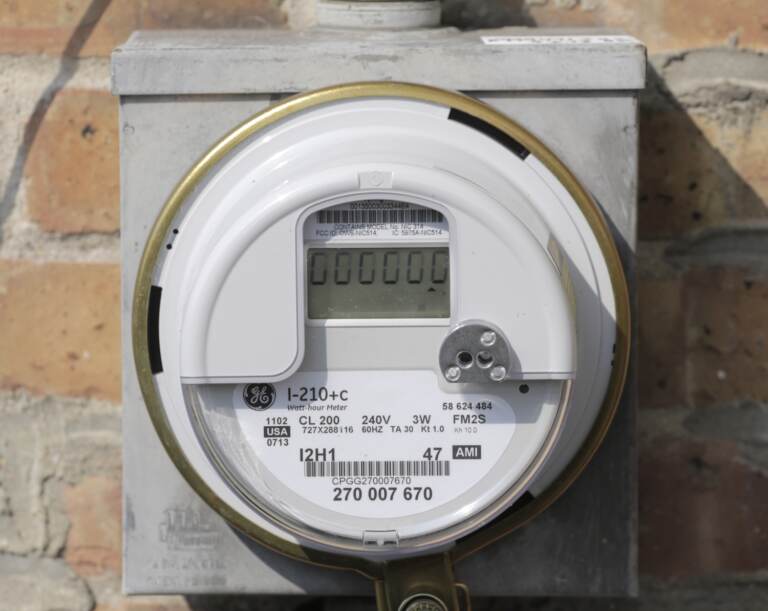
A utility meter is seen in a file photo. (AP Photo/M. Spencer Green)
Have a question about Philly’s neighborhoods or the systems that shape them? PlanPhilly reporters want to hear from you! Ask us a question or send us a story idea you think we should cover.
North Philadelphia resident Ashley Coles has struggled to pay her electricity bills since her epilepsy worsened and made it impossible for her to work more than a year ago.
The single mother of two said she has received repeated shutoff notices from PECO despite trying hard to conserve energy and get on an appropriate payment plan.
“The bill is extremely high,” Coles said. “More than $700 each month.”
Coles was one of several utility ratepayers who testified Tuesday alongside advocates and experts during a City Council hearing on rising energy bills and what the city can do to help. Council is exploring ways to curb energy costs amid growing calls for a transformation of the utility system that would protect households from skyrocketing costs.
Rising energy bills squeeze low-income Philadelphians
The average PECO electricity bill increased by more than a third, or roughly 8% when adjusted for inflation, between 2020 and 2025, even though the average household’s monthly electricity usage decreased over that time, according to data published by the Pennsylvania Public Utility Commission. An additional PECO rate hike, phased in this January, pushed bills even higher.
The average Philadelphia Gas Works bill increased 16% between 2020 and 2025 despite a decrease in usage, but did not outpace inflation.
Juan Peralta, a father of three and volunteer with the environmental advocacy coalition HERE 4 Climate Justice, testified that it cost him around $3,000 to keep his family warm this winter.
“It feels like the system is failing us,” Peralta said.
The typical low-income household in the Philadelphia metro area spends more of its income on energy bills than the typical household nationally, according to the American Council for an Energy-Efficient Economy. Black and Hispanic families in the region face disproportionately high energy cost burdens.
Related Content
How to save a few dollars on your electricity bill in the Philadelphia region
From switching to LED light bulbs, to turning down your hot water heater, here are a few things you can do to save on your electricity bill.
4 months ago
Listen 6:08Why are bills going up?
Electricity bills are rising for several reasons, including increasing demand for power on the regional grid driven by data centers, more manufacturing and electrification, said Jamie Van Nostrand, a senior fellow at the University of Pennsylvania’s Kleinman Center for Energy Policy. Utilities are building more grid infrastructure and being forced to harden it in the face of extreme weather, Van Nostrand said.
“After decades of relatively flat electric loads nationwide, U.S. electricity demand is experiencing an unprecedented surge,” he said.
Tom Bonner, director of policy, advocacy and external affairs at PECO, said he has sympathy for Coles’ situation and thinks her bills are high because her home may need repairs to keep her energy usage down.
Bonner said recent electricity bill increases have been driven by higher capacity costs. Utilities pay these fees to power generators to ensure the electricity supply meets peak demand, then pass the costs on to customers without a markup. The rising costs reflect the supply and demand crunch on the regional grid.
PECO also made record profits in 2025 following distribution rate increases for its electric and natural gas customers. The utility withdrew a request for an additional rate increase last month after Pennsylvania Gov. Josh Shapiro called the request “pure greed.”
“While the proposed rates were designed to support long-term safety and reliability investments, customer affordability concerns have certainly risen to the top,” Bonner said. “Basically, there’s a balance we’re always trying to strike between reliability and affordability.”
Peralta sees it differently.
“That profit is theft,” Peralta said. “That’s profit that’s being taken out of the pockets of families, out of my pocket.”
Denise Adamucci, senior vice president for customer and regulatory affairs at PGW, defended the utility, noting that it is municipally owned and lacks shareholders. While PGW bills have gone up in the last few years, Adamucci said that the average yearly bill for a residential customer has actually fallen since 2014.
“Every dollar that we collect then goes back into serving our roughly 500,000 customers,” she said.
Related Content
Philadelphia utility bills surged in 2025, and more increases are coming in 2026. Here’s why
Philadelphians’ electric, gas and water bills all increased in 2025. Together, the typical household is paying around $30 more per month.
8 months ago
What can the city do about rising bills?
Most of the factors contributing to energy bill increases are out of the city’s control, Van Nostrand said, but there are some things the city can do.
Electric distribution rates, which utilities charge customers to deliver power to their homes, are approved at the state level by the Pennsylvania Public Utility Commission. The cost of supplying the electricity itself is shaped by broader economic forces and the markets run by regional grid operator PJM Interconnection, which is regulated by the Federal Energy Regulatory Commission.
Van Nostrand recommended the city get involved when utilities ask the Public Utility Commission for approval to raise distribution rates.
“While the proceedings are complex, … the city could have an impact in shaping the outcomes by thoughtfully weighing in,” he said.
The city could have more control over residents’ gas bills, said state Rep. Elizabeth Fiedler, D-Philadelphia, who chairs the House Energy Committee. The mayor and City Council appoint members of the Philadelphia Gas Commission, which approves PGW’s annual budgets, and the city contracts with the nonprofit Philadelphia Facilities Management Corporation, which manages the utility’s operations.
“That ownership gives the city unique responsibility and authority to protect our residents,” Fiedler said. “I urge the city to look at strengthening consumer protections to the best of your ability, improving billing practices and ensuring that shutoff policies prioritize health and safety.”
Advocates asked council members to find ways to increase enrollment in the utilities’ low-income assistance programs, including by making enrollment automatic for eligible customers.
Others pushed council members to strengthen energy efficiency standards for new buildings so they use less energy, and to invest more in existing programs that help residents produce their own electricity.
Patrick Houston, another member of the HERE 4 Climate Justice coalition, pointed to the Philadelphia Energy Authority’s Built to Last home repair and energy efficiency program, which currently has a multiyear wait list, and the Solarize Greater Philadelphia program, which connects homeowners with vetted solar installers.
“Keep on bolstering things that work,” Houston said.

Subscribe to PlanPhilly
WHYY is your source for fact-based, in-depth journalism and information. As a nonprofit organization, we rely on financial support from readers like you. Please give today.
Brought to you by PlanPhilly

PlanPhilly
In-depth, original reporting on housing, transportation, and development.
North Philly development will bring 129 affordable rentals to Temple University area
The six-story project represents the final phase of a yearslong effort to redevelop Norris Homes, a traditional public housing site that was demolished between 2011 and 2019.
1 day ago
Listen 1:04
Mayor Parker vows to help preserve hundreds of subsidized rentals in the West Philly area
The announcement comes more than a year after the owner of Neighborhood Restorations told the city he planned to sell his portfolio of affordable units.
1 week ago
Listen 1:34
Why Philly’s public housing costs an average of $315,000 per unit
PHA’s $6.3 billion plan would remake its aging housing portfolio. Its per-unit estimate, which rivals the value of many Philadelphia homes, doesn’t tell the full story.
2 weeks ago
Listen 1:59