

‘Pepperpot’ in Philly’s ‘What Now: 2026’ festival celebrates the Black women who made the liberating soup
The multi-disciplinary “Pepperpot” performance brings to life the 18th-century peddlers' songs from Philadelphia’s cobblestone streets.
Listen 3:10
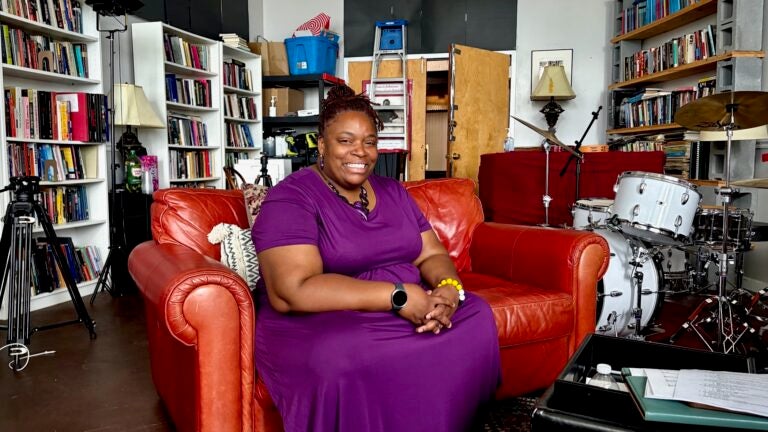
Composer Kendrah Butler-Waters wrote a suite of songs about the historic Black women who sold pepperpot pot soup on the streets of 18th century Philadelphia. (Peter Crimmins/WHYY)
From Philly and the Pa. suburbs to South Jersey and Delaware, what would you like WHYY News to cover? Let us know!
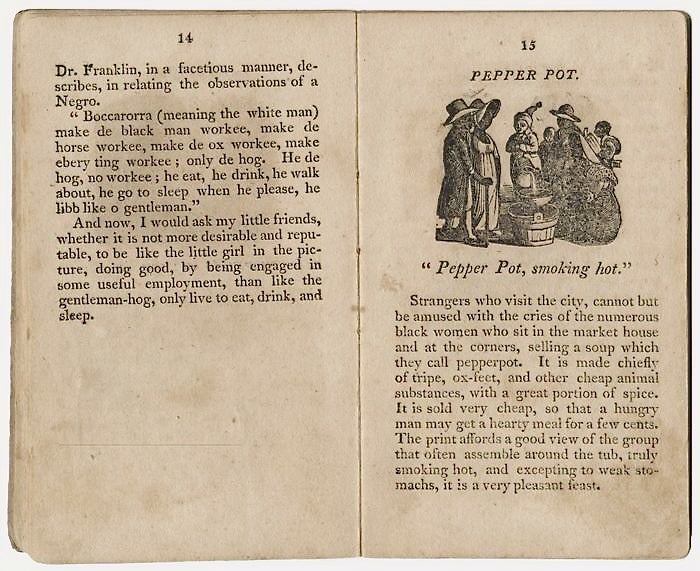
“Pepperpot, smoking hot!”
That is what Black women reportedly sang in the streets of 18th-century Philadelphia, ladling out cups of pepperpot soup from a bucket to customers on the cobblestones and in taverns.
Composer Kendrah Butler-Waters imagined those peddlers’ cries as a suite of modern, jazz-infused songs as part of “Pepperpot,” a multidisciplinary performance debuting this weekend on Cherry Street Pier as part of ArtPhilly’s “What Now: 2026” festival.
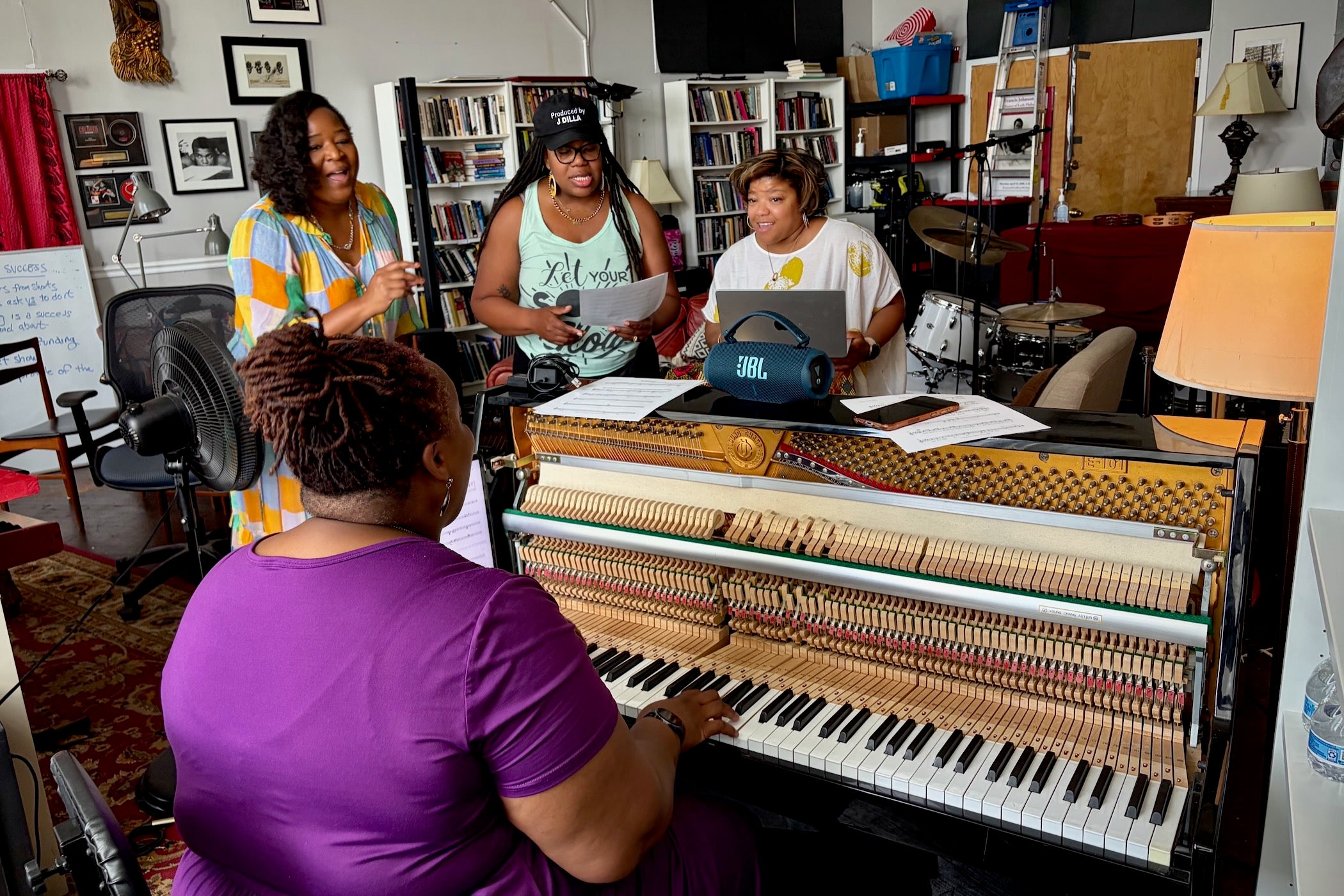
“The music mixes jazz, Caribbean elements of reggae, soca. There are elements of R&B,” she said. “I’m drawing on the African American experience of music, trying to convey a story through not only the lyrics but through the melodies.”
We only have a hint of the peddlers’ songs from the 1810 publication, “The Cries of Philadelphia,” a contemporaneous book of street peddlers in the Historical Society of Pennsylvania archives. But that was enough to start Butler-Waters’ imagination.
It’s hot! (It’s hot!)
It’s fresh! (It’s fresh!)
I’m calling you to taste it.
Taste the best around!
The best in town!
Related Content
A Philadelphia arts festival asks: ‘What Now’? as the U.S. approaches its 250th birthday
“What Now: 2026” features 34 original premieres in visual and performing arts to “interrogate” America ahead of its semiquincentennial.
3 months ago
Listen 1:50What will the performance entail?
“Pepperpot” features original music by Butler-Waters, spoken word poetry, storytelling, visual art and, of course, soup. A few variations, including an ahistorical vegetarian option, by Chef Valerie Erwin will be ladled out for spectators at Cherry Street Pier on Saturday.
The hearty soup of leafy greens, root vegetables and cheap cuts of meat was heavily seasoned with Caribbean spices and was typically cooked and sold by free Black women in Philadelphia.
Even though several colonial cities had substantial free Black populations, for some reason, pepperpot was a uniquely Philly jawn.
“You could imagine it becoming a similar thing in other coastal cities, places like Charleston and Savannah, because Philadelphia was not unique in terms of receiving materials and people from the Caribbean,” said Adrienne Whaley, director of education and community engagement at the Museum of the American Revolution. “I do not know exactly why it became so Philadelphia. Maybe it’s because tripe became so associated with it and tripe became a thing that was very associated with Philadelphia cuisine.”
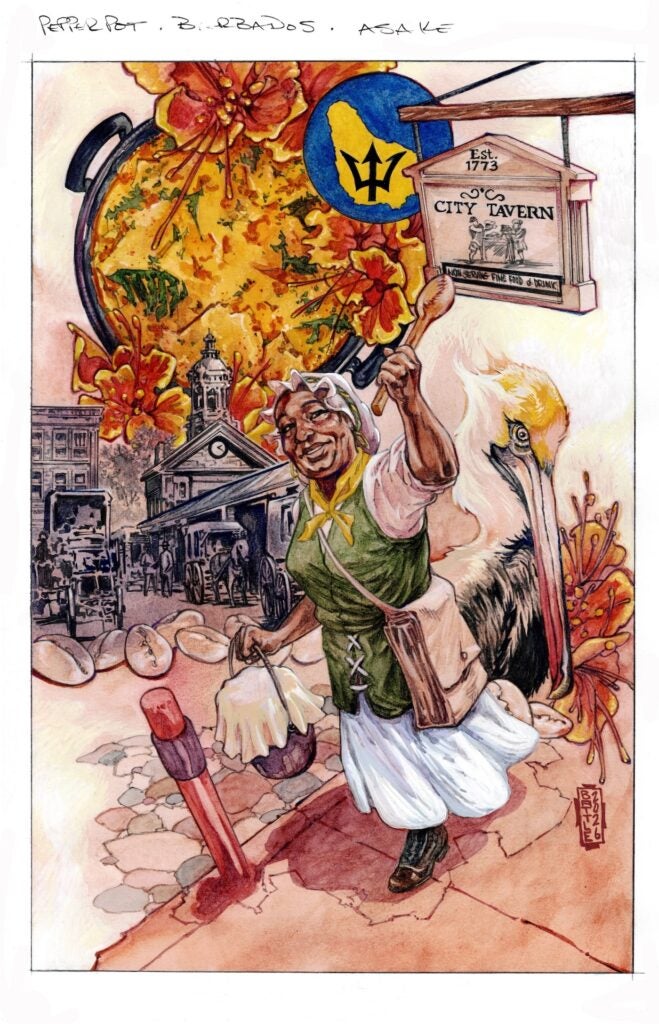
The idea of turning pepperpot soup into an interdisciplinary experience was conceived by the artist Homer Jackson, who pitched it to ArtPhilly. But shortly after “Pepperpot” was green-lighted, Jackson died of cancer.
“I submitted it in April, he passed away in July,” said V. Shayne Frederick, one of ArtPhilly’s curators. “I wanted to carry it on, keep his legacy alive because that was one of his concerns. I was talking to him as his health was failing and he was, like, ‘So you’re going to take care of my project?’ I said, ‘Of course, I’m going to take care of your project.’”
Part of Frederick’s attraction to “Pepperpot” is the opportunity to portray 18th-century Black women as entrepreneurial “agents of change” who roamed freely throughout the city and interacted with almost every race and social stratum in Philadelphia.
How pepperpot set Philly free
An 1812 painting, “Pepper-Pot: A Scene in the Philadelphia Market” by John Lewis Krimmel at the Philadelphia Museum of Art, shows a Black woman in the center of the canvas selling soup to a multi-generational crowd of what appears to be different socio-economic backgrounds.
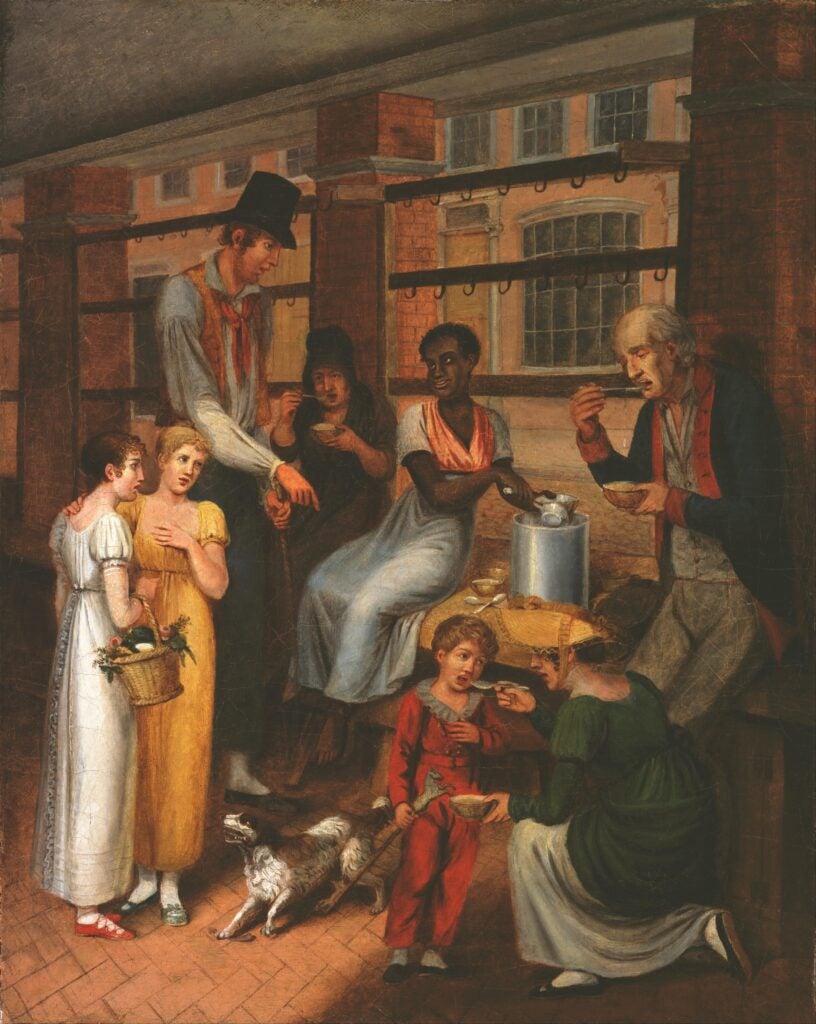
“This is much deeper than just soup,” Frederick said. “They would serve these soups in taverns and places, so they heard things and said things. Thinking historically about these Black women in the early United States, what they’d be talking about: Probably things like slavery. Politics. These women literally had their ears to the streets.”
“Pepperpot” will also feature contributions from fiber artist Asake-Denise Jones, who created a series of aprons depicting the stories of women who sold pepperpot soup. She said she believes they not just nourished Philadelphians, but were also part of the Underground Railroad, shuttling Black people running away from slavery.
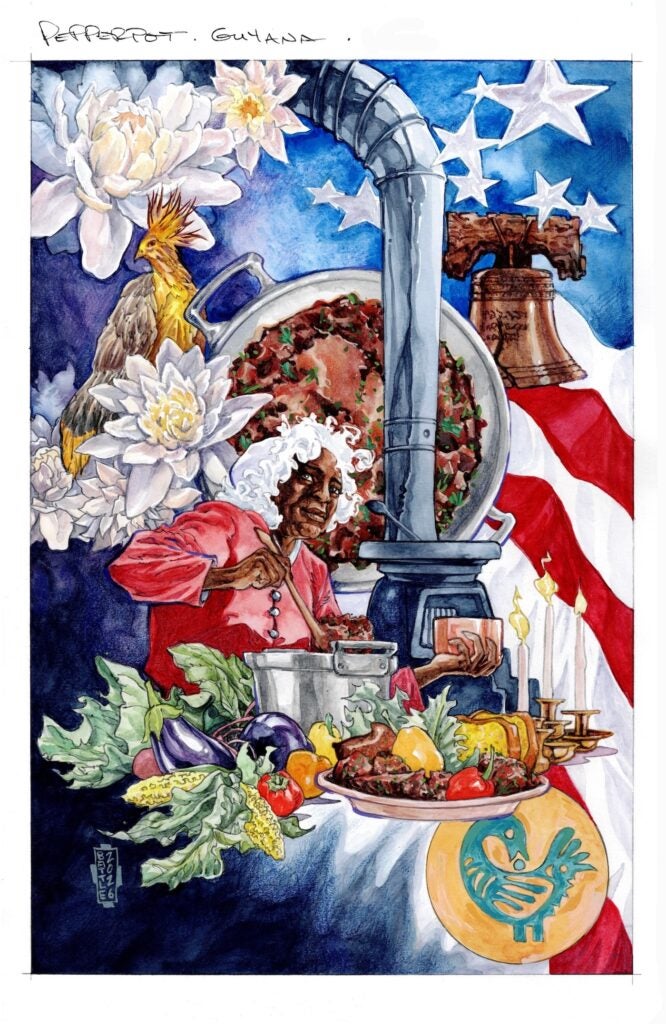
“Imagine you’re an African American person, you’re escaping, you come to a city and see these Black women selling and talking to both Black and white people,” she said. “They would be the people you would feel safest to have a conversation with about where to get food, where to get clothing, where’s the next place to go.”
“Pepperpot” will be performed once during the “What Now: 2026” festival on Saturday.

Get daily updates from WHYY News!
WHYY is your source for fact-based, in-depth journalism and information. As a nonprofit organization, we rely on financial support from readers like you. Please give today.
Anandibai Joshee came to Philly in 1883 to study medicine. Her tragic life is the grit of a South Asian American Digital Archive songwriting project.
6 months ago
Listen 3:39
An 1859 fantasy of Black material culture is manifested as a “funhouse” of art and cultural criticism at Winterthur.
1 year ago
Listen 1:12
Moore, who died last year, championed Black artists and left an indelible mark on the art world. His collection numbered in the "hundreds, maybe thousands."
2 years ago
Listen 1:06