Philadelphia plans to renew controversial contract with Reworld trash incinerators
The company runs a facility in Chester that burns household trash, releasing unhealthy air pollution.
Listen 1:13
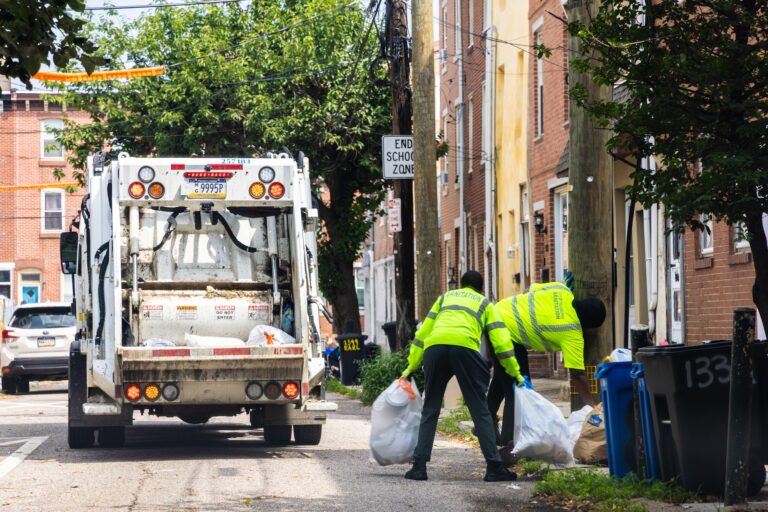
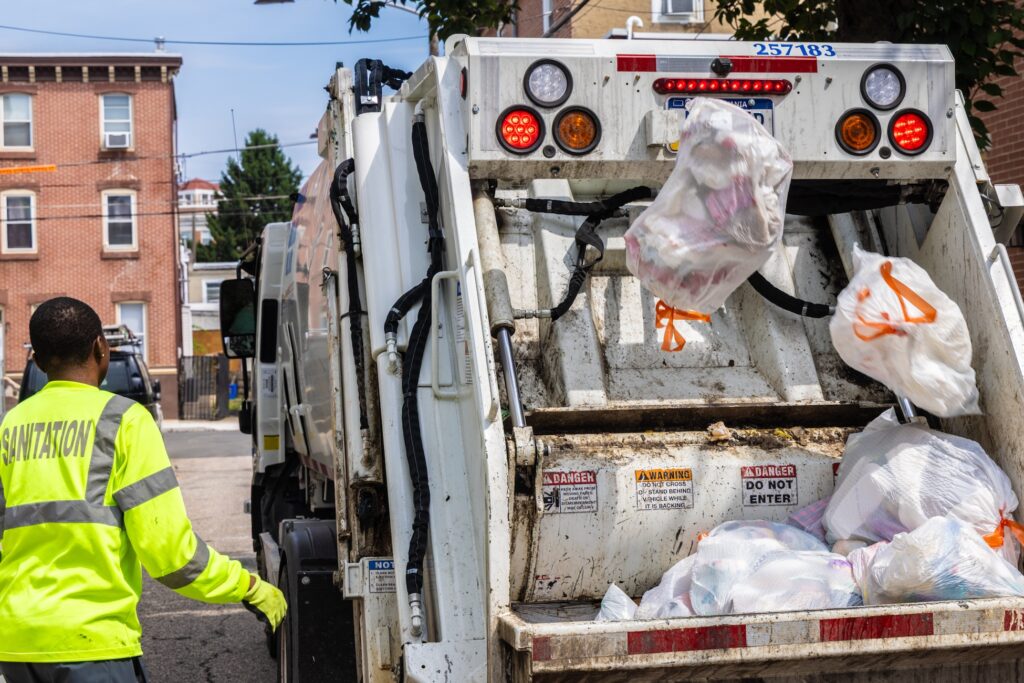
Philadelphia sanitation workers clear trash on collection day in the city’s Fishtown neighborhood. (Kimberly Paynter/WHYY)
From Philly and the Pa. suburbs to South Jersey and Delaware, what would you like WHYY News to cover? Let us know!
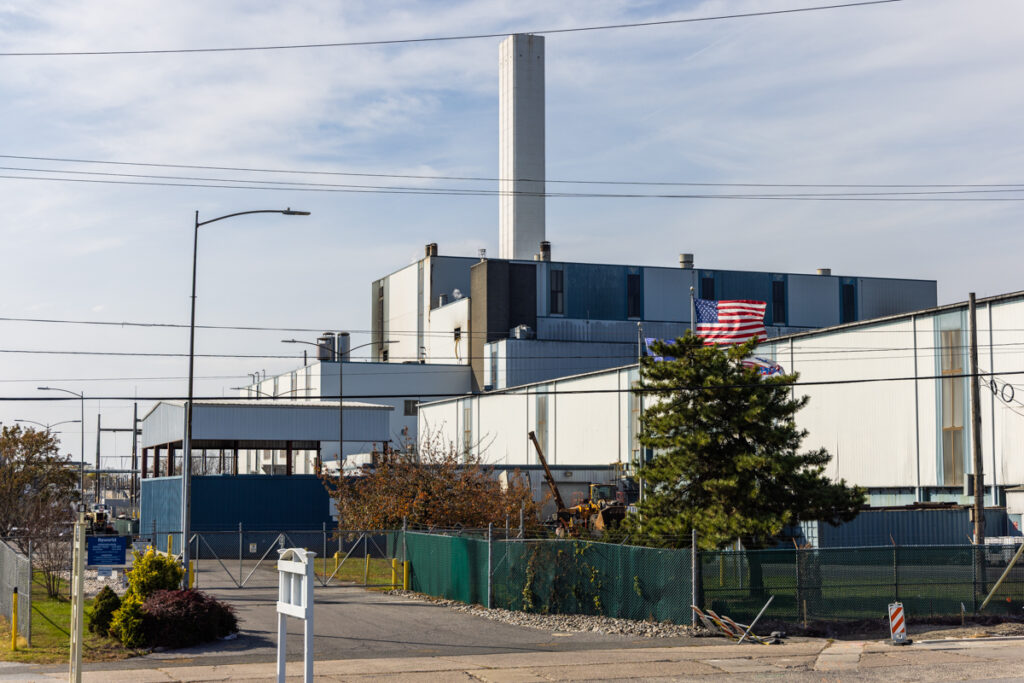
Philadelphia could continue sending its trash to be burned in Chester, despite accusations from advocates and some City Council members of environmental racism.
The Sanitation Department plans to award a new contract for municipal waste processing and disposal to Reworld, the company that runs waste-to-energy plants, including the Delaware Valley trash incinerator in Chester. The city also plans to award contracts to WM, formerly Waste Management, and Republic Services. The four-year contracts, with optional extensions of up to three additional years, must be approved by City Council.
Carlton Williams, director of Philadelphia’s Office of Clean and Green Initiatives, said that for the first time, city officials from the Department of Public Health and Office of Sustainability, as well as outside experts, considered the environmental impacts of the waste disposal bids.
“We think this contract here was historic,” Williams said during a news conference Friday, in which city officials described their process for evaluating bids but did not disclose which companies had won the contracts.
Philadelphia’s waste disposal contracts have come under scrutiny in recent years over concerns that burning the city’s waste contributes to unhealthy air pollution in places including Chester.
Under the city’s last seven-year contracts with Reworld and WM, which expired June 30, the city sent roughly 40% of its trash to be burned, mostly at Reworld’s Delaware County facility. Because the city did not fully award the new contracts by the end of June, the Sanitation Department extended its existing contracts by six months.
The city received bids from five waste disposal companies for the new contracts, said city Sanitation Commissioner Crystal Jacobs Shipman. The city considered cost, disposal capacity, operational capability and environmental performance when evaluating them, she said.
Elizabeth Lankenau, director of the city’s Office of Sustainability, said her team conducted a literature review and spoke with experts about burning waste compared to landfilling it.
“There is not a clear consensus of the relative health and environmental impacts between incinerating and landfilling,” she said at Friday’s news conference.
Palak Raval-Nelson, the city’s health commissioner, said that because of “logistical constraints” and the “complexities” of the waste management landscape in southeastern Pennsylvania, it is a “very responsible approach” for the city to use a combination of waste management methods and facilities.
Scott McGrath, environmental planning director for the Department of Sanitation, said a consultant, Civil & Environmental Consultants, Inc., added questions to the city’s request for proposals covering environmental justice, climate resilience and greenhouse gas emissions. He said the consultant compared the sustainability of landfilling and incineration, and found the two methods to be “essentially equal.”
Related Content
Philadelphia could extend its controversial trash incineration contract amid criticism
The city is still evaluating the environmental impacts of burning trash versus landfilling it, the Office of Clean and Green director said.
6 months ago
Listen 1:04City officials framed reducing and diverting waste as the real solution to the environmental and health harms of landfilling and incineration. McGrath said the city hopes to launch pilot projects to explore turning food waste into biochar or “bioslurry” that can be processed through wastewater treatment plants. Elliott Gold, vice president of corporate planning at PGW, said the gas company plans to explore capturing methane from food waste.
“We certainly are excited about the potential for the future of our solid waste industry here in Philadelphia,” Williams said.
Councilmember Jamie Gauthier spearheaded an effort last year to ban the city from burning its trash. A bill she sponsored would have prevented city contractors from burning waste. Gauthier pulled the bill from a vote at the last minute in January after Reworld employees and union officials testified that the bill could jeopardize up to 120 jobs. Gauthier said her fellow councilmembers had asked for more time to consider the bill.
City sanitation leaders opposed the measure, saying more data was needed to compare the environmental harms of incineration and landfilling. They argued that limiting the city’s waste disposal options would likely raise costs for taxpayers and could even increase truck pollution from transporting the waste farther to landfills.
Reworld, which stood to lose a contract worth tens of millions of dollars, spent over $100,000 on lobbying City Council and Mayor Cherelle Parker’s administration between October 2025 and March 2026, according to city lobbying records. The company’s political action committee made a $3,700 donation to Parker’s political committee, People for Parker, in December.
The company has painted its incinerators as a sustainable alternative to landfills, which release methane, a powerful greenhouse gas. The company also notes that incineration produces electricity and recovers recyclable metals.
Reworld did not immediately respond to a request for comment Sunday.
Sintana Vergara, an environmental engineer at Swarthmore College who studies waste management, told WHYY’s “Studio 2” that waste incineration tends to release heavy metals and carcinogenic pollutants, and therefore poses a greater risk to human health than landfilling.
Mike Ewall, director of the nonprofit Energy Justice Network, attended Friday’s news conference. He said the city consultant’s reliance on an EPA tool designed to estimate greenhouse gas emissions associated with different waste management practices is flawed. He said it doesn’t account for pollutants that harm health, such as fine particulate matter, heavy metals or dioxins, which can be released when trash is burned. Ewall called the city’s decision “unjustifiable from a health and environmental perspective, from a racial justice perspective.”
“What they’re doing is just wrong on every level,” he said.

Get daily updates from WHYY News!
WHYY is your source for fact-based, in-depth journalism and information. As a nonprofit organization, we rely on financial support from readers like you. Please give today.

As more voter-registration problems arise, New Jersey Gov. Sherrill announces new safeguards
As the governor announced new errors — some dating back a decade — reforms to the system will include a daily audit at the Motor Vehicle Commission.
16 hours ago
Shania Bennett is the first candidate to launch a 2027 mayoral campaign against Cherelle Parker.
1 week ago
Philly Streets Commissioner: City can’t afford hazard pay for sanitation workers
Philadelphia sanitation workers have joined their peers in cities across the U.S. in the call for hazard pay.
6 years ago