

‘Always watching’: Furor grows over Flock’s automated license plate readers in Delaware as police laud AI-powered cameras
Foes decry them as warrantless mass surveillance but 20 police agencies statewide use them. The ACLU says “Get the Flock Out.”
Listen 3:12
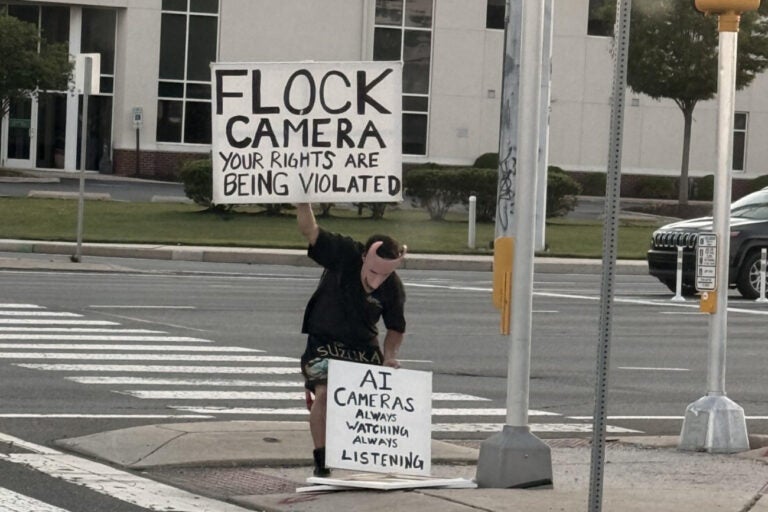
Joshua Pyle protests on Kirkwood Highway in Millcreek, between Wilmington and Philadelphia. (Courtesy of Joseph Pyle)
What are journalists missing from the state of Delaware? What would you most like WHYY News to cover? Let us know.
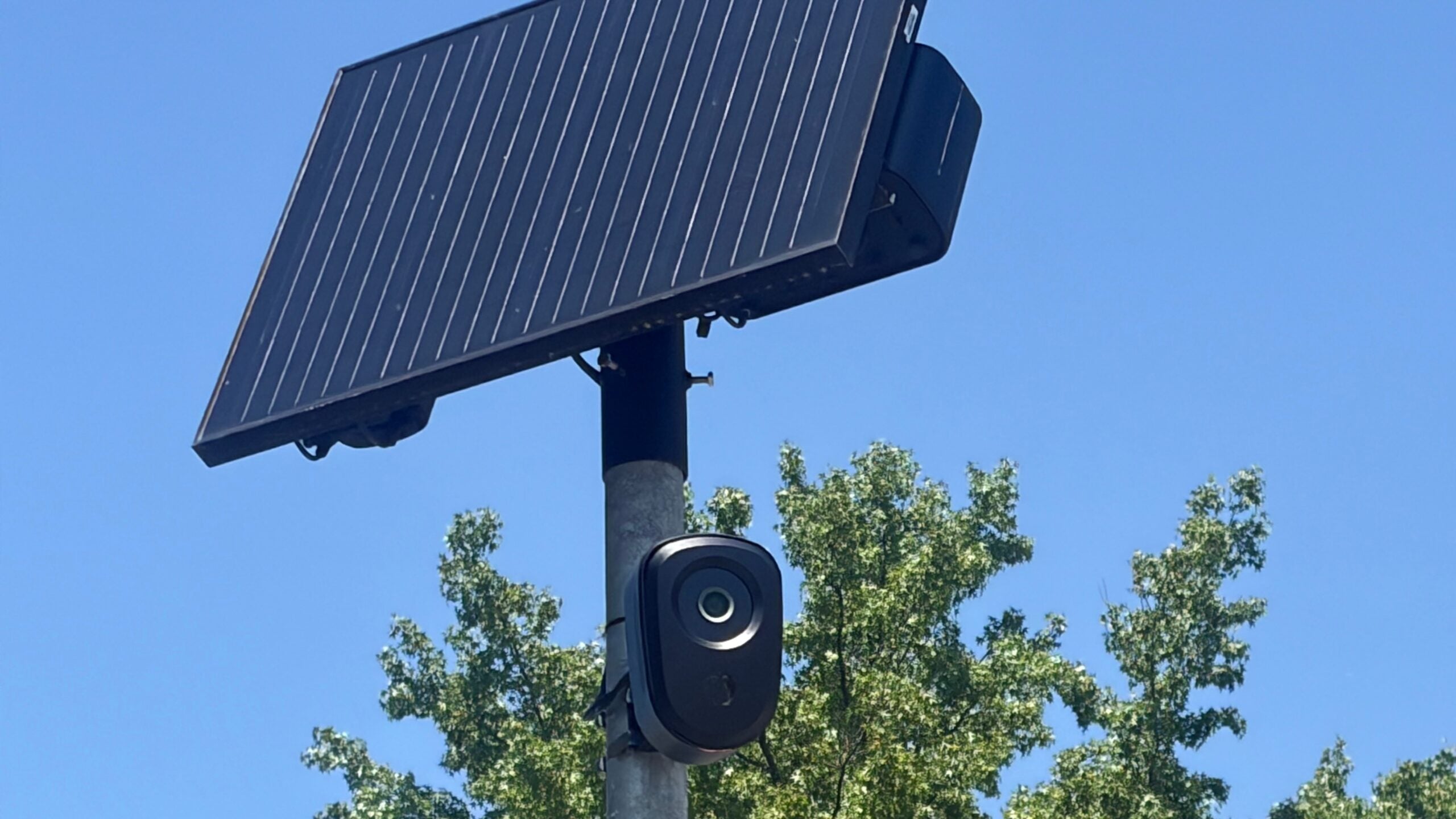
When you’re driving on roads in Delaware, there’s a decent chance a pole-mounted camera is snapping photos of your car and zeroing in on your license plate.
The devices, equipped with artificial intelligence software, are the silent agents of several police agencies and others with properties to protect. They’re automated license plate readers, known as ALPRs.
The cops in Delaware have dozens, perhaps hundreds of them, to help investigate crimes such as carjackings, vehicle thefts and hit-and-runs, as well as missing persons cases. Some unidentified businesses and neighborhood associations have them too.
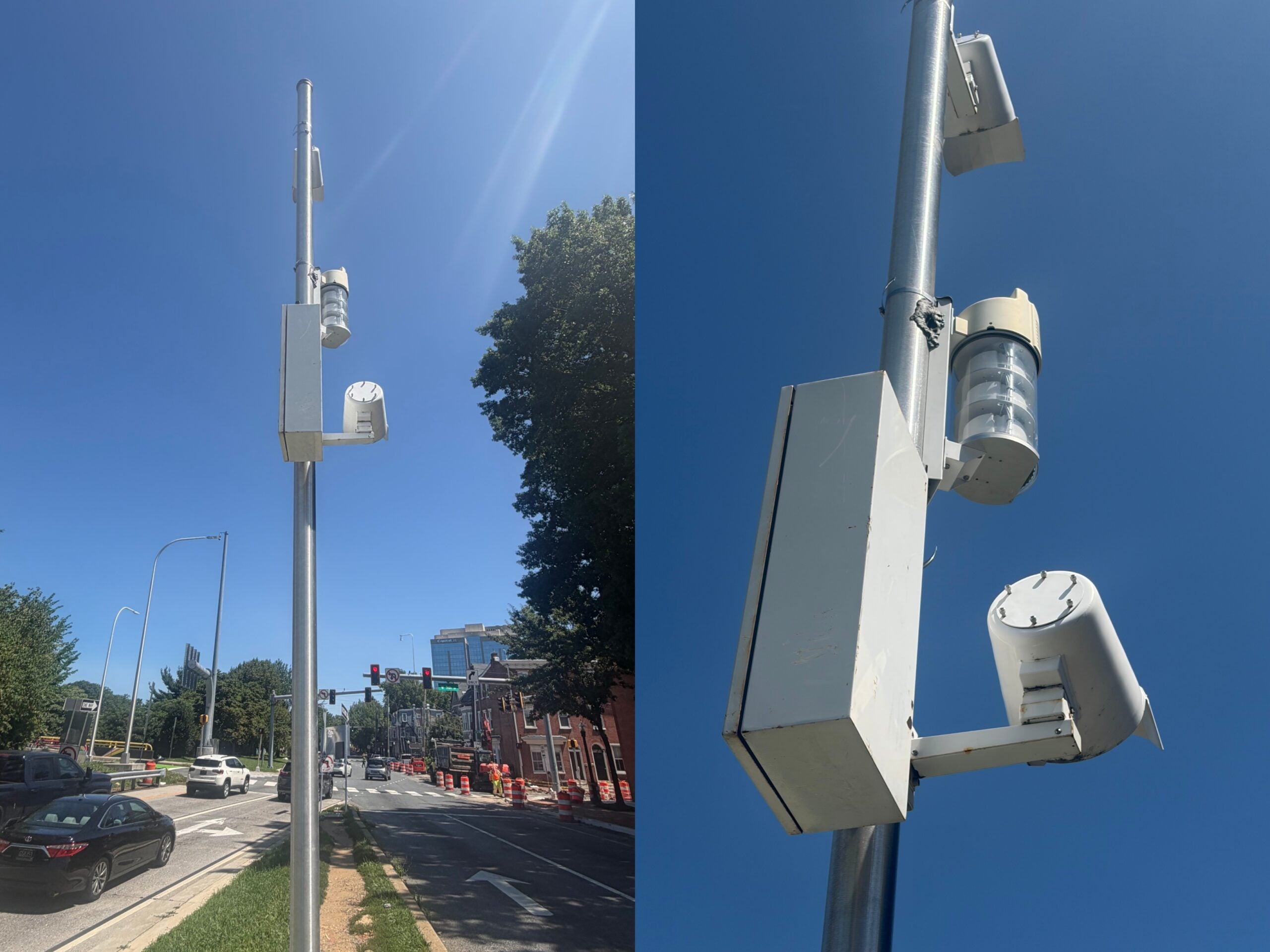
But in recent months the cameras and their best-known maker — Atlanta-based Flock Safety — have come under heavy fire in Delaware and across the nation.
That’s because federal immigration agents use their data to track and detain undocumented immigrants, according to published reports. Dozens of cops have used them to stalk their girlfriends or ex-lovers, a CNN expose found. Innocent drivers whose cars were mistakenly identified by misread plates have been pulled over, even held at gunpoint and jailed, according to the nonprofit Institute for Justice.
Privacy advocates in Delaware warn that ALPRs constitute warrantless mass surveillance of law-abiding people. They argue that agencies share the data with federal agents and local law enforcement officials outside of their own jurisdictions.
Beyond the fact that signs don’t identify the location of cameras and people can’t opt out of having their vehicles photographed, detractors say unscrupulous officers could track someone going to the doctor, church or even a protest.
Around Delaware, no flagrant abuse has been documented, but that hasn’t stopped protesters from railing against Flock.
“Your rights are being violated,” read one sign waved by Joshua Pyle, whose mask with horns was the same one worn by the mischievous child Lock in “The Nightmare Before Christmas” while demonstrating alone on Kirkwood Highway in Millcreek. The cameras are “always watching,” his other sign said.

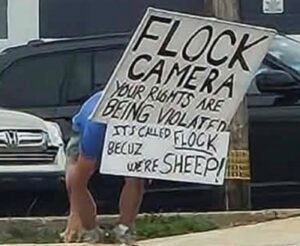
During another solo protest, Pyle saved a sign that proclaimed, “It’s called Flock becuz we’re sheep.”
“There’s so many problems,” Pyle told WHYY News. “But my biggest gripe is that it’s footage that is being always used, always monitored and always running.”
This month, the American Civil Liberties Union waded into the fight, launching the “Get the Flock Out” campaign. The nationwide initiative aims to raise awareness of all ALPRs and their potential misuse, and to spur agencies or lawmakers to enact policies or legislative limits on how the technology, which can take hundreds of photos a minute, is utilized.
“This type of surveillance is creepy, is not making our communities meaningfully safer and, in some instances, is actually making them less safe and represents a significant government intrusion,” said John Reynolds, an attorney with the ACLU’s Delaware chapter.
“These cameras are capturing information about people, packaging it, selling it, using basically Big Brother surveillance of people at that camera,” said Reynolds, adding that the possibilities of abuse are “terrifying.”
In addition to the ACLU’s campaign, the website, www.DeFlock.org, documents where suspected ALPR cameras are located across the country. There’s also the www.haveibeenflocked.com website, where users can put in their tag number to check if their own plate has been scanned by a camera.
No legislative guardrails have been put in place in Delaware, as they have in other states. Nationally, however, two Republican congressmen have announced bills specifically targeting Flock Safety at the federal level.
U.S. Rep. Thomas Massie, R-Kentucky, has introduced legislation that would strip federal funding from any local governments or police departments that use Flock cameras — a provision that would jeopardize several forces in Delaware.

U.S. Rep. Tim Burchett, R-Tennessee, wants to block purchasing and federal funding of what he called “draconian” Flock cameras, taking to the social media platform X to call the camera use “unconstitutional.”
“We gotta ban these dadgum things,” Burchett said.
Ban FLOCK cameras! Call your Congressman. pic.twitter.com/cPv9007C1a
— Tim Burchett (@timburchett) July 23, 2026
Related Content
‘Photo enforced’: Speed cameras are proliferating along Delaware highways, neighborhood streets
DelDOT is using the cameras along I-95 work zones, and now local governments have begun putting them in neighborhoods to slow down traffic.
4 months ago
Listen 1:59‘Some of the best progression of technology since DNA’
Automated license plate readers are not the same as speed enforcement or red light cameras that capture images and generate tickets for violations.
They’re also different from surveillance cameras sold by Flock and other companies that take continuous video of a specific area. For example, Rehoboth Beach has a handful of Flock cameras above sections of its boardwalk, which is visited by thousands of people on a typical summer day.
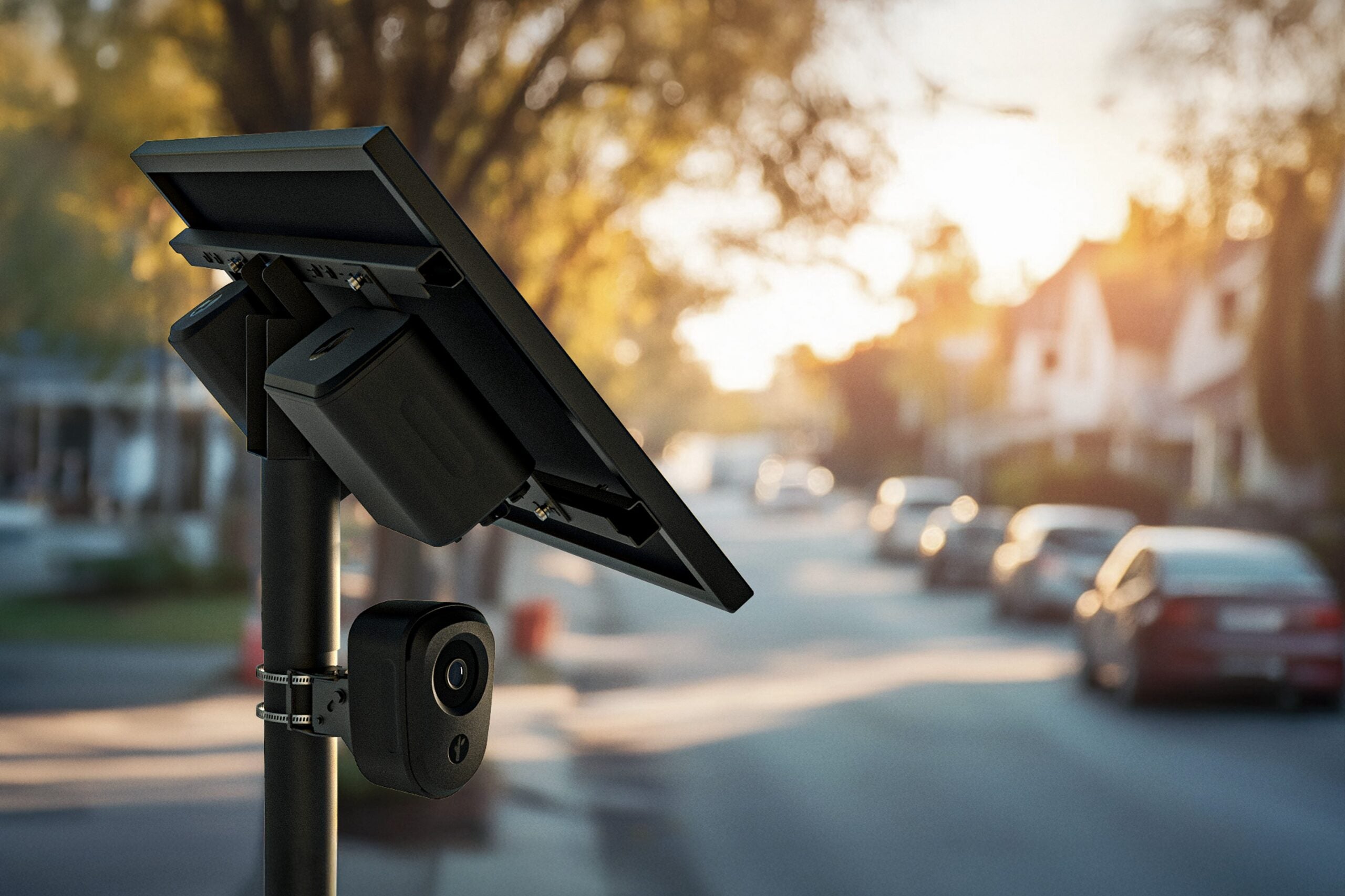
Flock Safety Public Relations Manager Paris Lewbel defends the company’s more than 120,000 ALPR cameras, calling them a vital law enforcement tool. In Delaware, 20 law enforcement agencies use them, he said.
“Many police chiefs have told us this is some of the best progression of technology since DNA, where they’re being able to solve the amount of crimes that they’re being able to solve,” Lewbel said. “And again, find missing people at a level that is really helping them reunite people with their families.”

Authorities in Providence, Rhode Island, have credited Flock’s ALPR data with helping police find the suspect in December’s mass fatal shooting at Brown University and the killing of a Massachusetts Institute of Technology professor.
The technology identified a gray Nissan with Florida plates and tracked its movements. Five days after the shooting at Brown, the car was located outside a storage facility in New Hampshire, where the suspect was found dead from a self-inflicted gunshot wound.
Lewbel said Flock has prevailed in lawsuits that have alleged their license plate readers violate the Fourth Amendment right against unreasonable search and seizure. Other lawsuits are pending in courts across the nation.
The company supports thoughtful limitations on their use to safeguard against abuse, but lets agencies decide whom they want to share their data with, Lewbel said. He added that a recent innovation lets police do better auditing of how their data, which is generally stored for 30 days, is managed internally.
“Misuse cases are very rare, but we believe it’s completely unacceptable,” Lewbel said. “We continue to build into our platform to make it easier for command staff, for law enforcement agencies, to have oversight on exactly how the tool is being used.”
But Bud Glassner, a retiree who lives in the suburban Hockessin area, said he doesn’t want police to have electronic sentinels taking photos of his and everybody else’s car, perhaps even building a profile of his travels, while he lives his law-abiding life.
“These technologies are frightening,” Glassner said. “Not to call that stuff out is the equivalent of being a German citizen and seeing what was going on in the 1930s and sitting on their asses, and then when the war was over going, ‘Oh gee, we didn’t know what happened.’”
Related Content
SEPTA to install AI cameras on trolleys to catch parking violations in Philadelphia
Philadelphia is the first city in the country to employ this enforcement approach on trolleys or light rail.
6 months ago
20 police forces in Delaware use license plate readers
License plate readers supplied by Flock Safety and other companies have been quietly proliferating across Delaware in recent years.
Flock did not identify its Delaware clients, but WHYY News found that its law enforcement customers include Delaware State Police and the forces in New Castle County and Wilmington — the three largest police agencies in the state of 1.05 million residents.
In addition, several smaller municipal forces, including Newark, Dover, Rehoboth Beach and Milford, as well as the University of Delaware police, have them.
Officials at several agencies provided information to WHYY News about their license plate readers, though the largest one, the 748-officer Delaware State Police, did not. The office of Attorney General Kathy Jennings, which prosecutes all felonies and most misdemeanors in Delaware, would not respond to requests for comment to discuss the cameras and the controversy surrounding them.
Keith Banks, Rehoboth Beach’s police chief, said the resort town has four Flock ALPR cameras at exit and entry points. The town also has a handful of Flock surveillance video cameras that don’t photograph vehicles and tags, but do provide overhead feeds of activities along the boardwalk and Rehoboth Avenue.
Banks understands the concerns of residents and visitors, so the town has a website that provides information about its surveillance program, whose virtues he extols, especially when a driver hits another car and leaves town.
“Hit-and-run accidents here in Rehoboth Beach over the last four or five years have just been crazy,” Banks said. “People used to always leave notes on cars to say, ‘Hey, I bumped into your car while trying to park.’ And now they’re just leaving, constantly.”
Banks explained how retrieving ALPR data works.
An officer with authority to search the Flock data must enter a complaint number and then information such as a full or partial plate number, the vehicle’s color and the existence of a rear bumper sticker.
That sometimes leads police to the camera’s photo of the car, its plate and the owner’s name. Then officers can try to track down the vehicle, alert other agencies and investigate further.
Banks said he’s sensitive to invasion of privacy fears and is aware of inappropriate acts by officers in other jurisdictions. But he said officers with access to the system in his town and elsewhere should know that “every keystroke is monitored” during data searches.
“You’re going to get caught,” he said of those who run afoul of proper uses. “There’s just too many checks and balances today.”
While New Castle County police did not provide information about its Flock cameras to WHYY News, Police Chief Jamie Leonard briefed some County Council members in February on the force’s program.
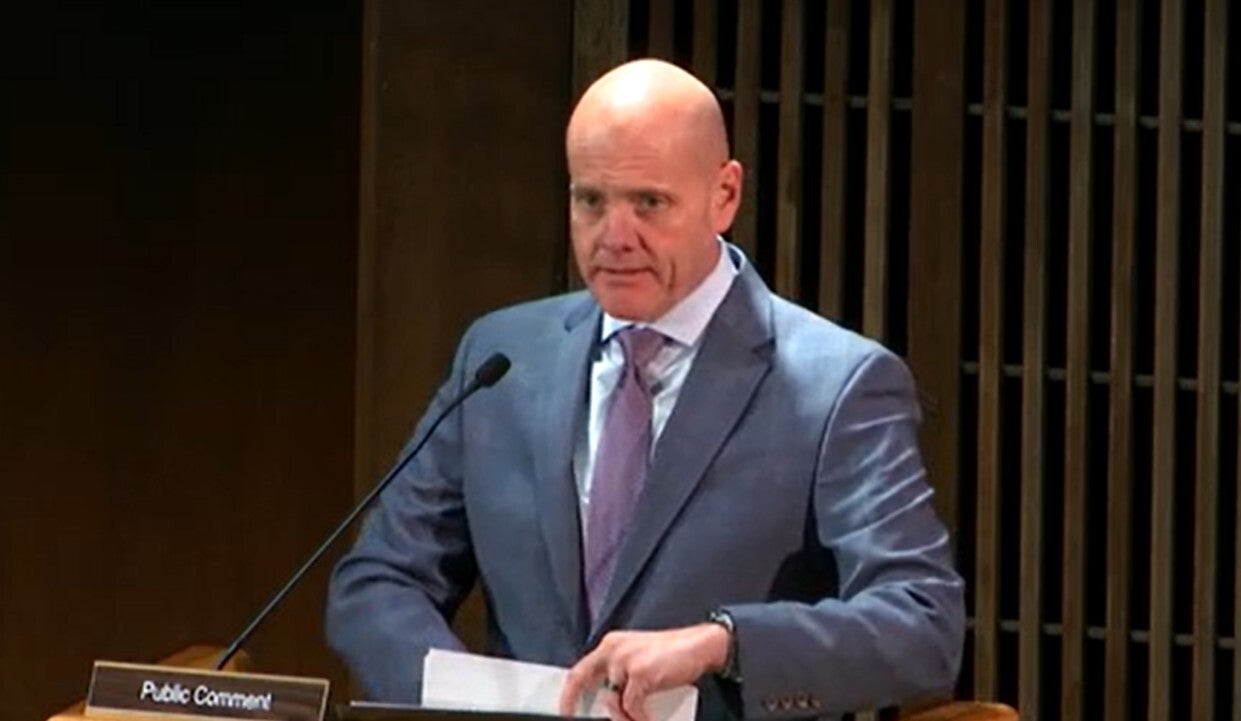
Leonard said during the recorded meeting of Council’s Public Safety Committee that the county currently has 14 Flock cameras that cost taxpayers about $20,000 a year.
“It does not identify people. It doesn’t do any type of facial recognition,” Leonard said. “It’s all just pictures of the tag and generally the rear of the car. It does capture car make, car model, the specific time and obviously the location of where it hit on that particular camera.”
Leonard said the tag readers have helped solve all kinds of crimes, primarily stolen cars and burglaries. He noted that the county shares data and receives data from other jurisdictions he did not identify, and stressed that only a handful of officers can search the data.
“Flock is not a free search system. You must justify, document and limit your search to a single license plate,” Leonard said. “We will never fully alleviate or dispel the privacy invasion concerns, but we’ve put guardrails up and framework in place to show that we are limiting our access to this information, our storage of this information, and treating it with the respect that it needs to be treated with.”
Wilmington has four Flock ALPRs that were donated by a nonprofit, as well as a handful of ALPRs from other vendors, said Daniel Walker, deputy chief of staff for Mayor John Carney.
“They’re helpful to allow us to identify vehicles that are tied to a crime or an action of concern,” Walker said. “They have been very helpful in helping us recover children that may be missing and are with an individual in a car, or in instances of people who are involved in activity that is dangerous or violent in nature, being able track their location and apprehend them.”
But Walker said the city is “decommissioning’’ the donated Flock cameras, in part because of the controversy around them and the fact that the city doesn’t have a contract with the company.
He also stressed that Delaware’s largest city “does not participate in immigration enforcement.”
Newark police Lt. Greg D’Elia said the force has “several” tag readers from Flock and another vendor but would not specify the number. He said they have helped detectives solve several crimes, including two robberies last year.
Officers conducted a search for a red Tesla seen near one of the robberies and got a hit near the crime scene, D’Elia said. Working with county detectives, they seized weapons and arrested two suspects who later pleaded guilty and received prison sentences.
“Without that ALPR from Flock, we wouldn’t be able to get the information from the system that led us to these people to begin with,” D’Elia said.
Related Content
In the AI era, New Jersey relies on humans and a 1911 invention to spot wildfires
Perched 100 feet above the Pine Barrens, a man in a tower uses a century-old system to stop fire in its tracks.
2 months ago
Listen 6:34License plate readers ‘may also be used to track innocents’
Foes of the license plate readers argue, however, that the crimes the cameras help police solve don’t justify the constant mass surveillance conducted by the government.
Glassner, a member of Indivisible Newark DE, supports the ACLU’s “Get the Flock Out” campaign and despises the tag readers.
Although the cameras helped find the suspected Brown University shooter, “there have been other serial killers that they’ve caught by other means,” Glassner said. “Just because that technology can be used to capture some clearly horrible, vicious criminal doesn’t cover and excuse the fact that it also may be used to track innocents.”
The use of the data for immigrant enforcement particularly irks Glassner.
“My concern is that [data] is shared with agencies like ICE, that then use that information to track individuals whose only crimes are misdemeanors, who live here and work here and pay taxes and then are tracked and hauled to detention facilities,” he said.
“It’s one thing if you’re tracking a specific criminal or suspect with a judicial warrant. But to just generally gather information about everybody and then mine that data for something you may be looking for seems to me to be a violation of privacy.”
The ACLU on Monday asked Gov. Matt Meyer and AG Jennings to create more guidance on when law enforcement should work with and provide information to ICE.
Julie Morris of Milford is concerned by her Sussex County town’s use of the technology.
“It’s too easy to abuse a live camera that is constantly taking in information and is capable of putting out things, including how often this person was there and this is when they go by all the time,” Morris said.
Newark transparency advocate Amy Roe said she’s disturbed by reports that police elsewhere have been caught “accessing the Flock database” to stalk people.
“If you’re going to have this kind of information and allow anybody to access it without a warrant, I have a concern about that,” Roe said.
The ACLU’s Reynolds said police agencies in Delaware have a duty to inform residents about how they are using the technology, so people can decide how they want to be governed.
“There is misinformation out there on exactly what the platform does, how it works, and we welcome those conversations at the community level, at the local level, the state level,” Reynolds said.
“Let communities know how this technology exactly works and the impact that it’s truly having. The important part is that we take privacy very seriously.”
While no legislative limits exist in Delaware, state House candidate Rae Krantz said there should be restrictions. She’s a Democrat running in the Fox Point area north of Wilmington, where eight-term Rep. Deborah Heffernan is not seeking re-election.
Krantz recently posted a video on Facebook of herself across the street from a Flock reader near Mount Pleasant High School.
In an interview with WHYY News, Krantz expressed her staunch opposition, pointing to police using the technology to target women.
“There’s not any information that will make me comfortable with them,” said Krantz, a software engineer. “I do not support increased surveillance as a rule. We’re being surveilled in so many ways already and I don’t want to keep adding to that.”

Krantz said she wouldn’t even want license plate readers to assist police if she was personally carjacked.
“I don’t want to lose my freedom because I’m afraid of something bad maybe happening to me,” she said. “I don’t think the benefits outweigh the cost, because the cameras are also used to hurt people, as we have seen so far.”

Get daily updates from WHYY News!
WHYY is your source for fact-based, in-depth journalism and information. As a nonprofit organization, we rely on financial support from readers like you. Please give today.
Part of the series


The zoning changes adopted back in December allowed for dense cottage communities to be built in town.
6 days ago
Listen 1:07
Supporters say it will allow voters to pick their representative, instead of elected officials picking their voters.
2 weeks ago
Listen 2:17
House Speaker Melissa Minor-Brown said she has not had a single conversation with Meyer about his creation of a state surgeon general.
2 weeks ago
Listen 0:57