

In the AI era, New Jersey relies on humans and a 1911 invention to spot wildfires
Perched 100 feet above the Pine Barrens, a man in a tower uses a century-old system to stop fire in its tracks.

This story is part of the WHYY News Climate Desk, bringing you news and solutions for our changing region.
From the Poconos to the Jersey Shore to the mouth of the Delaware Bay, what do you want to know about climate change? What would you like us to cover? Get in touch.
Each morning, Brian Gerber Jr. climbs up 150 metal stairs to a trap door that leads to his 7-by-7-foot office 100 feet above the Wharton State Forest in South Jersey. It’s here, in a painted red and white steel tower that he spends eight hours a day looking for smoke.
“It’s awesome,” said Gerber, a fire observer with the New Jersey Forest Fire Service. “I just love the view, it changes every morning you come up here. It’s always such a gorgeous view. You can see the Pine Barrens, and on a crystal clear day you can see smoke almost anywhere in the state and in our division.”
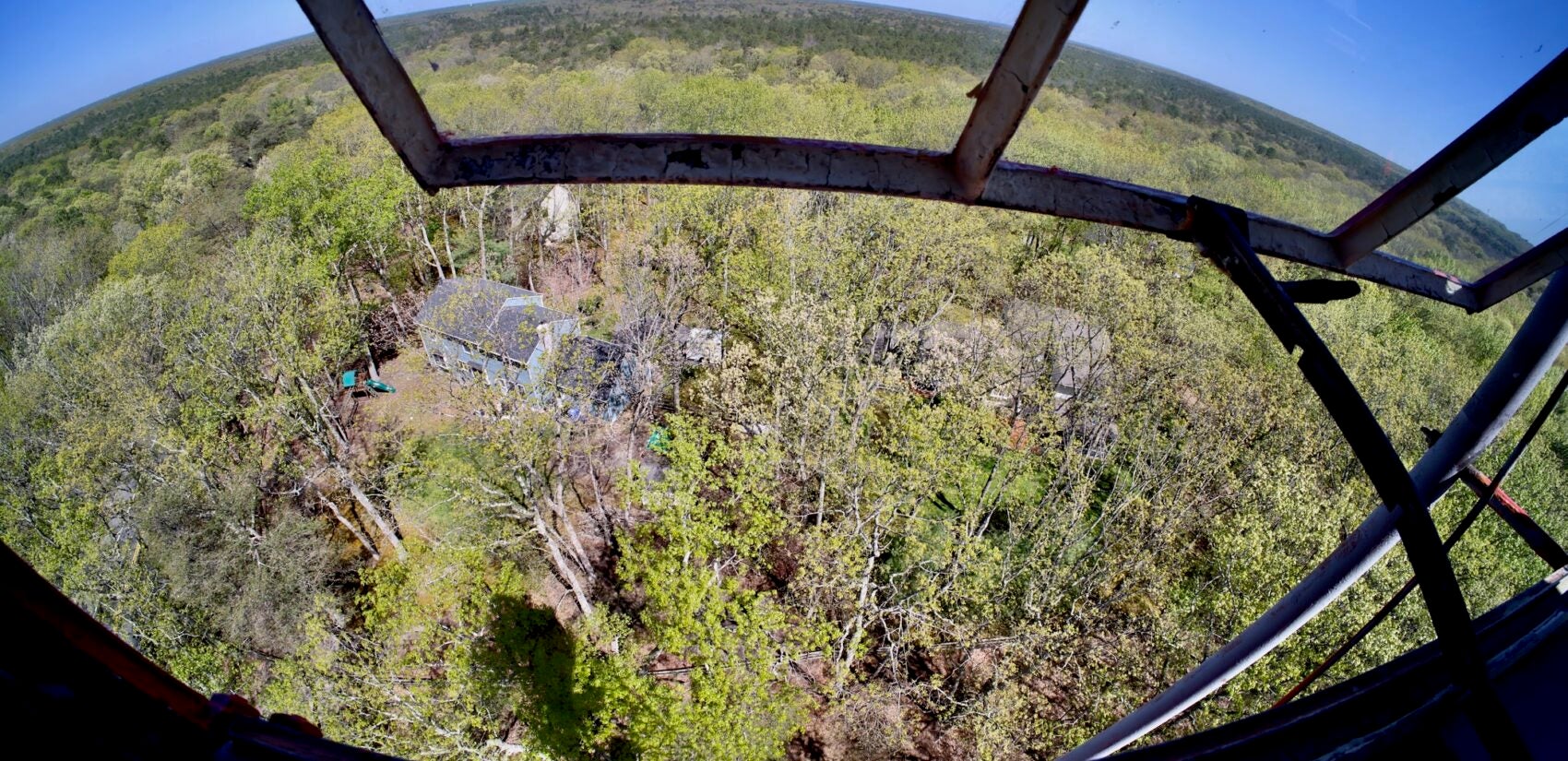
Turkey vultures float by the windows that line all four sides of his perch, which provides a 360-degree view of the pitch pine and oak forests below. On a clear day, he can see for 20 miles in all directions, including the Philadelphia skyline to the west.
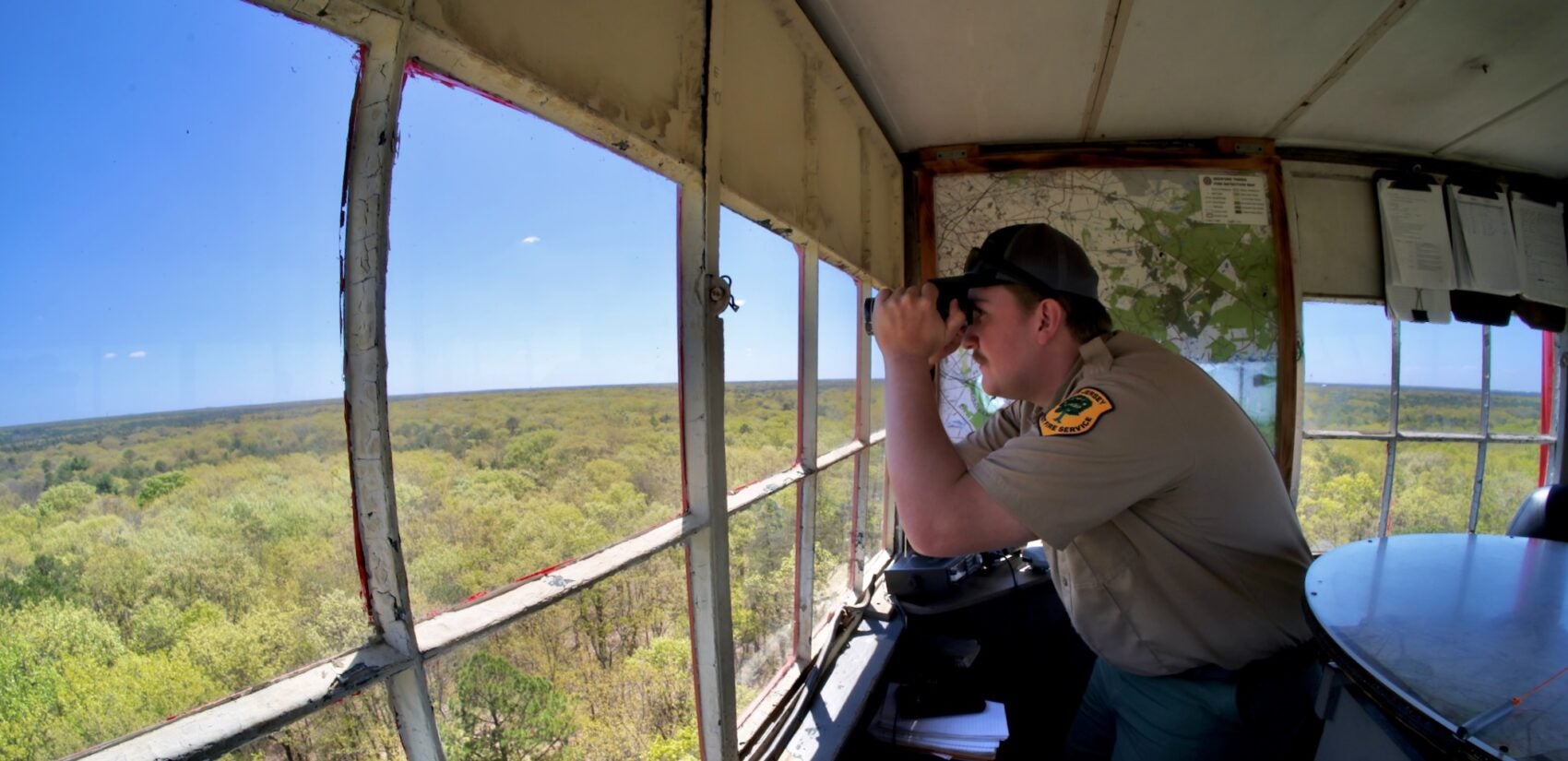
The Medford Fire Tower has been in service since 1948, and is one of 21 across the state. Like a modern-day lighthouse keeper, Gerber’s job is solitary, but one that suits him well. His father works as a district fire warden for the agency, and he grew up across the street from the Medford Tower.
“It’s very peaceful,” he said.
The place has its comforts. Gerber managed to lug a comfortable leather chair, an air conditioner and a microwave up the exposed staircase.
“I like my food warm,” he said.
And while he prefers to bring his own lunch, he said DoorDash does deliver to the site.
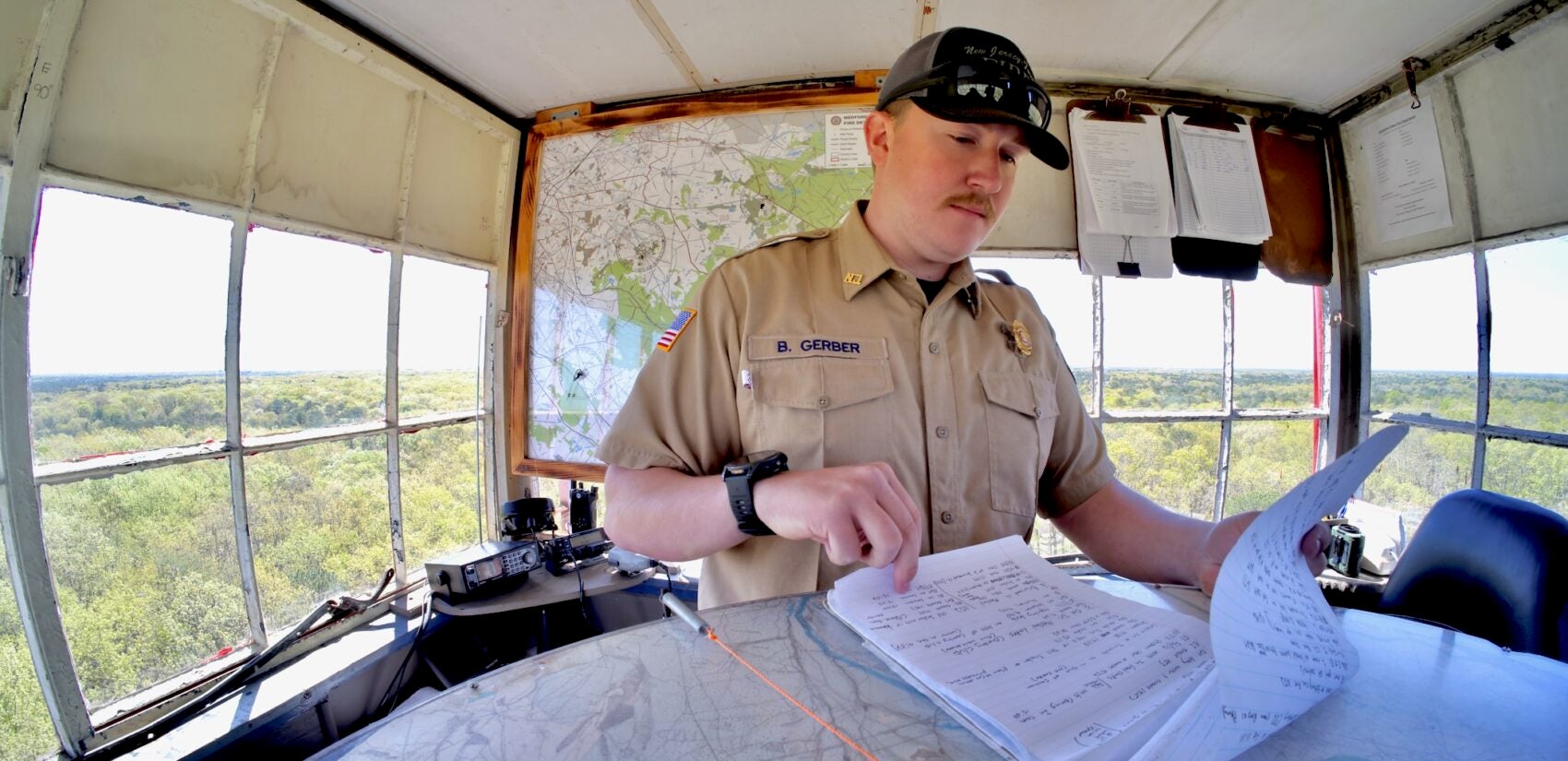
Sandy soil, ‘one hour fuel’
The Pinelands of South Jersey are some of the most fire-prone forests in the country.
The sandy soil does not retain moisture. The dry leaves on the ground are known as “one hour fuel,” meaning one hour after a rainstorm, the leaf litter is dry.
“Our leaf litter is very dry so if someone might accidentally throw out a cigarette out their window it could start a fire on a very dry day,” Gerber said.
New Jersey experiences on average 1,100 wildfires each year, burning 5,000 acres. So far this year, New Jersey has had only one major fire, the West Gate Wildfire burned 244 acres in West Deptford Township in April and led to voluntary evacuations but damaged no structures. The state has had about 470 wildfires in 2026, which have burned about 545 acres.
A century-old low-tech system continues to guide New Jersey’s Forest Fire Service
To spot these fires, the state uses a century-old system, which in an age of drones and artificial intelligence, Gerber said is remarkably effective.
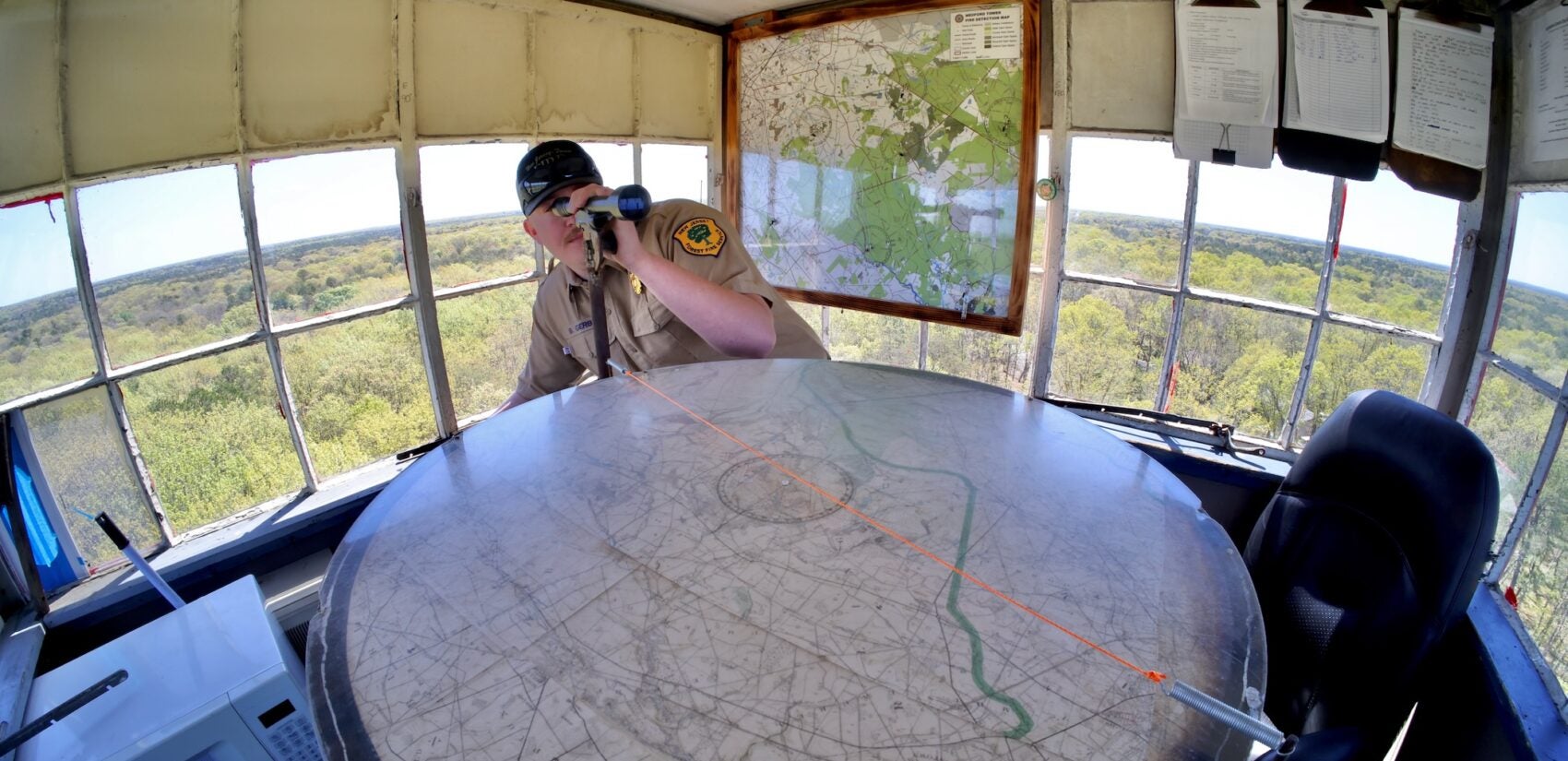
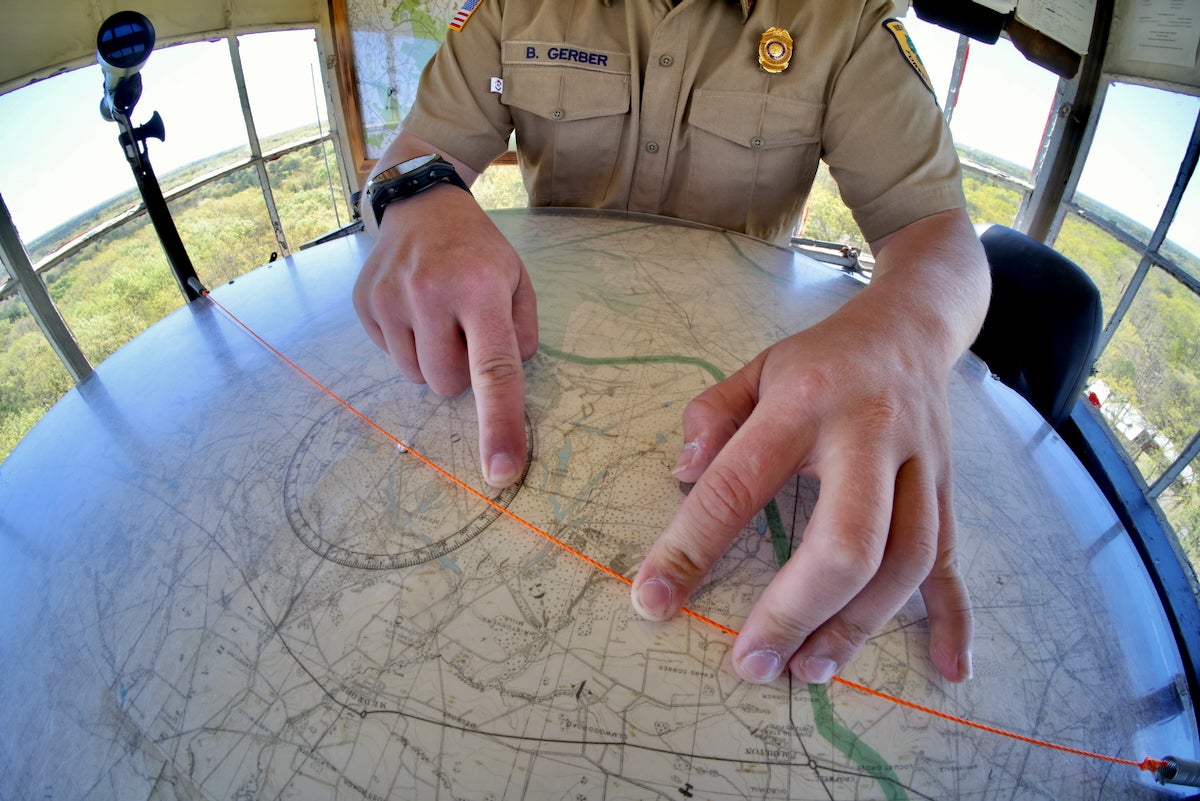
Gerber’s tower office is dominated by a large circular wooden table that is about 4 feet in diameter. Glued on top of the table is a detailed map of the 20-mile radius that can be seen from the tower. Around the map are 360-degree compass readings. A taut string attached to a rotating metal ring and rifle scope, allows him to pinpoint the exact degree of a column of smoke.
This is called an alidade, the earliest of which was likely invented in the 4th century. A rifle scope is attached to spot the exact location of the smoke.
The entire contraption is called an Osborne fire finder, invented back in 1911. No electricity is required.
“So if [I] saw smoke, I would use this tool right here to pinpoint it, and I would get a degree reading out of 360 degrees of a circle, and I would call another fire tower and see if they could see the smoke and get their degree reading, and I’d use my map and we would cross it out like triangulation,” he said.
The tower is equipped with a landline telephone and a radio transmission system.
From the ceiling, he unlatches a wooden board, glued to it is a map of the entire state plotted with all 21 fire towers. Each tower is marked by a metal ring attached to a pulley that he can stretch in the direction of the smoke and use in combination with the direction from another tower to triangulate the location of the fire.
“So I would use the crosshairs in the scope to pinpoint where the smoke is [from my perspective]. I use this map right here and this would be Medford Fire Tower and then say, I was crossing a smoke with Apple Pie Fire Tower, we could pinpoint exactly where it is, where the X marks the spot.”
Many states have abandoned the Osborne Fire Finder for cameras, drones and satellites. But Gerber said the human eye is best.
“You can use all the high-tech stuff, but it could [result in] false readings,” Gerber said. “We’re supposed to be up here reading the smoke. If it’s growing and it’s got color, it could be a forest fire.”
Gerber said he doesn’t want to be the guy who sends a fire warden to a backyard barbecue.
In the Pine Barrens, a forest fire starts as a dense column of gray smoke, and it may become gray and white. Most importantly, it grows.
“It’s not wispy like a barbecue pit or someone’s using a smoker. A forest fire continues to grow and the column expands.”
Gerber said if he sees smaller columns of smoke all lined up in a row along a road, it’s likely a driver whose car is backfiring, lighting up the brush at equal intervals. He’s spotted similar fires caused by freight trains along railroad tracks. Whatever it is, he said that 99% of the state’s forest fires are caused by humans.
“It could be someone lighting fireworks in their backyard like on the Fourth of July. It could be someone mowing their lawn and the leaves underneath their mower catch on fire,” he said.
The wildland urban interface
Looking down from the top of the tower, roofs of suburban homes sit right next to the fire-prone forest.
“The most important part is to protect, obviously, property and people. A lot of these homes are in the wildland urban interface here,” he said.
The wildland urban interface is where development meets forests – and it’s growing across the U.S., putting more people at risk of having to flee their homes.
Related Content
New Jersey Pine Barrens offer up answers to tough climate questions
Rowan University has teamed up with the state to figure out the balance between the amount of carbon emitted by New Jersey wetlands, and the amount that gets absorbed.
10 months ago
Listen 7:40Gerber said his most memorable day was Nov. 7, 2024, when he spotted the Bethany Run fire on his way up to his tower office at around 9 a.m.
“I was climbing up my fire tower when I saw the column of smoke and that was a very long day,” Gerber said.
The fire burned 360 acres in Evesham and Voorhees Townships, and prompted the evacuation of 12 homes.
Once a fire is spotted, Gerber said the pace of his job shifts into high gear.
“Your phones are off the hook,” he said. “I’m taking notes of everything because everything goes [to incident command] after action review.”
He has spiral notebooks filled with daily logs, still handwritten like the fire observers who sat here a century ago.
“I take notes of everything that’s going on,” he said. “When a truck is responding, when he’s on the location, when he gives a size up, when he clears. I watch the weather. I watch the smoke. I would dispatch aircraft if needed. So there is a lot of stuff that goes on here.”
Gerber said most of the fires he has detected are early and cause little damage.
“It just goes to show that our early detection rapid response is useful and it will be useful as long as we continue to do this,” he said.
“I think that’s the greatest part about this job, making sure everyone is safe and goes home.”

Get daily updates from WHYY News!
WHYY is your source for fact-based, in-depth journalism and information. As a nonprofit organization, we rely on financial support from readers like you. Please give today.
Part of the series
Researchers find microplastics in insects from Schuylkill River watershed
The researchers found that microplastics were as prevalent in forested parts of the watershed as they were in urban areas.
5 days ago
Listen 1:21
Vineland planning board approves 2nd phase of 300-megawatt data center plan
The plan would make way for the construction of a liquefied natural gas tank and fuel cell units.
1 week ago
Listen 1:13
Opposition to data center construction is rising sharply, survey says
Opposition has jumped significantly among both Democrats and Republicans, according to a recent Penn poll.
2 weeks ago
Listen 1:07