Plan to keep Chinatown Stitch alive after federal funding loss hits hurdle over design funding questions
Regional planners are questioning a proposal to redirect $12.5 million to complete the project’s design phase without construction funding secured.
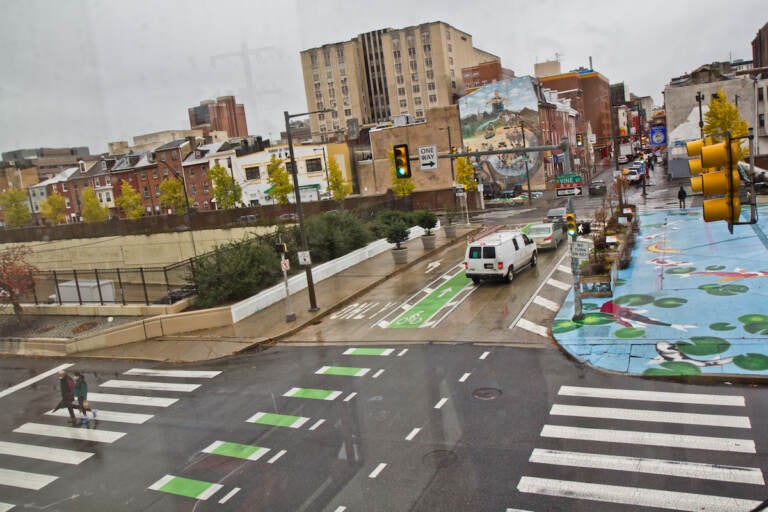
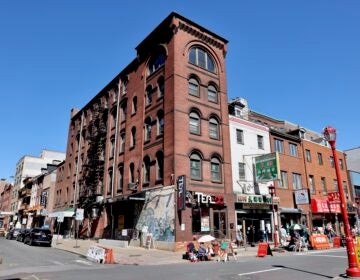
Chinatown has been separated by the Vine Street Expressway since the 1980s. (Kimberly Paynter/WHYY)
From Philly and the Pa. suburbs to South Jersey and Delaware, what would you like WHYY News to cover? Let us know!
The Chinatown Stitch, a proposal to cap a portion of the Vine Street Expressway and reconnect the two halves of Philadelphia’s Chinatown that it divided decades ago, has hit a major setback after its funding was rescinded. But organizers and community partners say they are determined to keep the project alive.
In March 2024, the city of Philadelphia was initially awarded a federal Neighborhood Access and Equity grant of nearly $159 million meant to fund the final design and construction phases of the Stitch project. But the passage of the Trump administration’s “One Big Beautiful Bill Act” rescinded nearly all NAE grants, leaving lawmakers and project partners scrambling to find alternative sources of funding for projects like the Chinatown Stitch.
For Philadelphia, the bill’s passage meant that the money dedicated to completing the Chinatown project suddenly vanished.
Last month, PennDOT asked the Delaware Valley Regional Planning Commission to reallocate $12.5 million in transportation funds within the region’s planning budget to complete the Chinatown Stitch’s final design phase. The proposal would shift $10 million from a federal highway improvement program administered by PennDOT and add $2.5 million from the city. But some representatives from suburban counties have questioned whether the region should commit design funding before construction money for the project is secured.
At a DVRPC board meeting in mid-February, Director of Regional Planning Mike Boyer said that having a project be awarded a federal grant that was then entirely rescinded is “very unusual [and] unprecedented.”
Christopher Puchalsky, director of policy and strategic initiatives for Philadelphia’s Office of Transportation and Infrastructure Systems who has also served as a principal manager for the Chinatown Stitch, said in an interview that the support from all corners of the region for the project has been “nothing short of overwhelming,” especially from those “who were around for the original highway construction.”
By the time it was finished in 1991, the Vine Street Expressway effectively cut Chinatown in two. Residents protested against the expressway at the time, marking the beginning of decades of resistance to urban development projects in the neighborhood, including the Pennsylvania Convention Center expansion, a proposed casino, and two defeated stadium proposals.
The Chinatown Stitch proposal, to build a 2 1/2-block green space over the sunken expressway between 10th and 13th streets and reconnect the northern and southern sections of Chinatown, was identified in 2017 as a priority for the neighborhood.
The Philadelphia Chinatown Development Corporation has been one of the driving forces behind the project.
“[Our] involvement with the Vine Street Expressway goes back to 1966,” PCDC Executive Director John Chin said. “PCDC has always been the visionary of what Vine Street could be.”
Chin said that the funding for the Stitch would represent the culmination of over 15 years of work to improve the area around the expressway, and the federal allocation was the “big pot of money that would really transform” it.
Related Content
In Philadelphia’s Chinatown, Gov. Shapiro talks tea and tariffs with business leaders
Gov. Josh Shapiro made a campaign-style stop in Philadelphia’s Chinatown, visiting local businesses and hearing concerns about rising tariffs.
1 year ago
Listen 1:14The DVRPC is scheduling a meeting of its technical committee to go over data from PennDOT and the city before bringing the funding proposal back up for discussion at its next meeting.
“DVRPC will continue to convene our partners, including the City of Philadelphia and the suburban counties, on next steps for funding the Chinatown Stitch,” said Executive Director Ariella Maron in a statement.
Chin said there is still strong moral and political support from the city for the project.
“Everybody sees the vision as a very impactful, powerful change to this area,” he said. “Everybody that’s been involved with the design and planning of this project feels very confident that, eventually, this gets built. The question is really the schedule and the timeline.”
Lauren Lowe, a solidarity movement organizer with nonprofit Asian Americans United, said her father was involved in protests against the Vine Street Expressway.
“No matter what ZIP code I live in, [Chinatown] has been home for a long time,” she said. “I kind of grew up with that specter of the Vine Street Expressway fight, and it was one of the first things that I learned about in terms of Chinatown’s history of resistance.”
That fight loomed so large in Lowe’s memory of Chinatown history that she said she didn’t think she would see the neighborhood reunited in her lifetime.
“To feel like there’s a proposal that’s actually coming from within the community … and to heal that openness, that chasm that separates Chinatown North and Callowhill from Chinatown’s core, that felt really positive,” she said. “It was equally disappointing when the funding was revoked.”
Even without construction funding secured, the work to reconnect Chinatown continues. Puchalsky said that the project’s environmental documentation — which, according to PennDOT’s environmental policy, needs to be approved before the final design stage can begin — is ready and should be submitted this spring.
As for new funding, Congressman Brendan Boyle, D-Philadelphia, introduced federal legislation in December that, if passed, would reverse part of the “One Big Beautiful Bill Act,” restoring the money for the Stitch project and other similar projects around the country.
“We’re not giving up. We’re not quitting,” he said in a release at the time. “I feel confident we have a very good plan B, and we’re going to keep working at it until we are here celebrating in a few years.”
Chin said that $10 million from the DVRPC proposal would push the project to construction readiness and cover part of the construction plan.
“The Chinatown Stitch is the ultimate big final project that realizes the vision” to heal and reconnect Chinatown, he said.
Editor’s note: This article has been updated to reflect the correct date of the Vine Street Expressway’s completion.

Get daily updates from WHYY News!
WHYY is your source for fact-based, in-depth journalism and information. As a nonprofit organization, we rely on financial support from readers like you. Please give today.
Henry Tetlow helped shape America’s cosmetics industry with more affordable — less caustic — face powders before his company collapsed into a family feud.
2 months ago
Sources: Sixers abandon plan to build new Center City arena, will remain in South Philly
The decision is rooted in a deal struck with Comcast Spectacor, which hopes to transform the South Philly sports complex over the next decade.
1 year ago

Changing city: How should Philly view its historical buildings?
As Philly grows, historical preservationists worry that the city is sacrificing its built heritage for the sake of development.
Air Date: May 9, 2019 10:00 am
Listen 49:47