

New Jersey reproductive and fertility clinics face new regulations for the storage of embryos and eggs
Reproductive medicine and fertility centers are required to meet specific safety standards and apply for state licensure under new rules.
Listen 1:21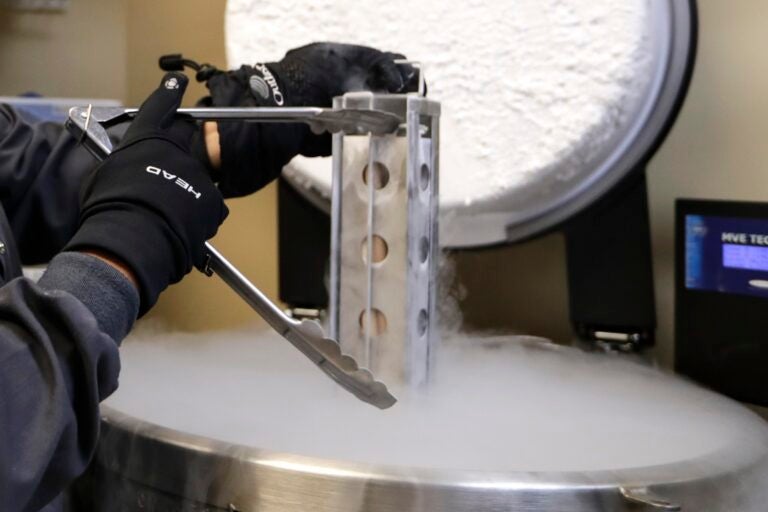
FILE - A container with frozen embryos and sperm stored in liquid nitrogen is removed at a fertility clinic in Fort Myers, Fla., Oct. 2, 2018. (AP Photo/Lynne Sladky, File)
From Philly and the Pa. suburbs to South Jersey and Delaware, what would you like WHYY News to cover? Let us know!
Reproductive medicine and fertility centers in New Jersey are now subject to new state regulations meant to create safety and quality oversight at facilities that store sensitive specimens often used for in vitro fertilization.
Laboratories that develop and store human embryos, eggs and other reproductive tissues are now required to get licensed by the state and accredited by national organizations that inspect and confirm the quality of these practices.
“The decision to pursue fertility treatment is deeply personal, and New Jerseyans deserve to know that the facilities storing their eggs and embryos meet rigorous standards,” Jeff Brown, former acting health commissioner, said in a statement when the new regulations were formally adopted in December.
Centers had to apply for licensure by Feb. 13 to be evaluated and cleared for clinical activities. The state Department of Health declined to provide the number of submitted and approved applications to date when requested by WHYY News.
The field of reproductive and fertility medicine has seen rapid growth and expansion in the last two decades. Nearly 96,000 babies nationally were born in 2023 as a result of IVF, representing about 2.6% of all births in the United States, according to the Society for Assisted Reproductive Technology.
As more prospective parents seek services, the number of centers and storage facilities has grown as well. Oversight has historically fallen on multiple federal agencies that regulate different parts of clinical activities. National professional organizations have also provided guidance and assistance in those efforts.
Related Content

Trump has signed an executive order on IVF. Here’s what you should know about the procedure
The executive order instructed the assistant to the president for domestic policy to give Trump a list of policy recommendations on protecting IVF access.
1 year ago
The New Jersey Legislature passed a law in 2019, which was amended in 2022, to create a state-level regulatory system. It came following high-profile cases in Ohio and California where embryos and eggs were destroyed and lost due to freezer failures and other equipment malfunctions.
Laboratories and clinics must get approval from one of two national bodies, including the College of American Pathologists’ Reproductive Accreditation Program, which assesses and inspects facilities to make sure they employ qualified staff, are safe to use and provide accurate and high-quality results.
Pathologist Dr. Earle Collum, who chairs the organization’s Council on Accreditation, said the program also makes sure laboratories are in compliance with state laws.
In New Jersey, that includes having backup power systems and oxygen sensors, remote alarm systems on cryogenic storage equipment, written policies for how and when to dispose of reproductive tissues, and reporting requirements for any errors, equipment failures and emergencies that can affect stored embryos and eggs.
The accreditation program is one of the strictest in the country, Collum said, which assures medical providers and their patients that they can confidently rely on these laboratories.
“There’s practically nothing as dear to anyone as their children. That’s how important it is,” he said. “That’s why this is such a specialized area where the personnel and the safety and the validation of testing, we as an organization want to make sure it’s done in the most efficient, safest and accurate manner.”
The organization’s experts provide guidance to state lawmakers and agencies on local regulations, and its members carefully monitor changes to requirements in different parts of the country.
They are then prepared to help laboratories that come seeking help in adopting new protocols and making any necessary changes and updates on site, Collum said.

Get daily updates from WHYY News!
WHYY is your source for fact-based, in-depth journalism and information. As a nonprofit organization, we rely on financial support from readers like you. Please give today.

Philadelphia Planned Parenthood centers say services are at risk following Medicaid cuts
The federal “One Big Beautiful Bill Act,” signed into law last July, blocks Medicaid funding to facilities that perform abortions.
5 days ago
Birth control and abortion pill requests have surged since Trump won the election
Anti-abortion advocates are pressing Trump for more restrictions on abortion pills.
1 year ago

Health providers and legal experts say changes to federal funding, insurance coverage and federal law during Trump’s first presidency could foretell what’s to come.
1 year ago
Listen 1:16