High property taxes, high prices — and still buyers: What New Jersey’s housing market looks like right now
The median price of a home in the Garden State last year was more than $500,000, recent data shows.
Listen 1:06
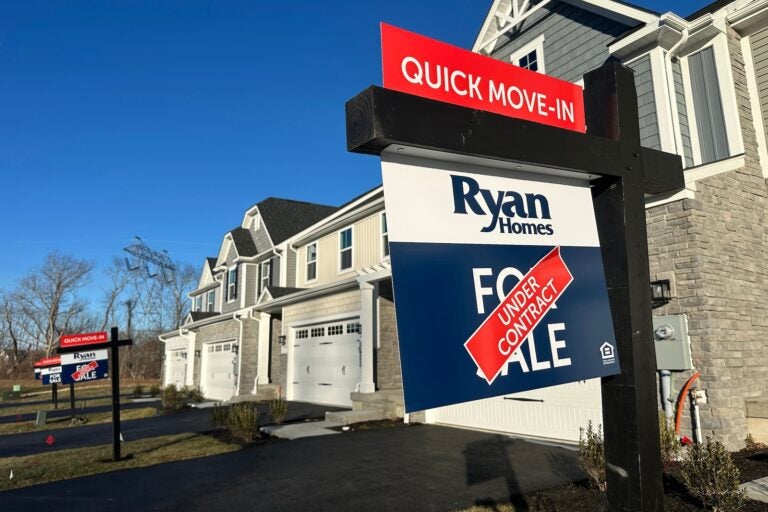
New homes, some completed and others under construction, in a residential development in Mount Olive, N.J., Saturday, Dec. 20, 2025. (AP Photo/Ted Shaffrey)
From Camden and Cherry Hill to Trenton and the Jersey Shore, what about life in New Jersey do you want WHYY News to cover? Let us know.
New Jersey’s property taxes and home values are among the highest in the nation. Nevertheless, data released in January shows demand for housing held steady in 2025, and many real estate experts expect demand to increase this year.
Jeff Otteau, chief economist for Otteau Group, Inc., said interest rates are expected to continue to drift lower, which will make it easier for people to buy homes. He said lower interest rates will also increase the number of homes being sold.
“Because the average interest rate for homeowners is around 4%, with interest rates that had risen as high as 7.8%, those existing homeowners, even though they wanted very much to sell their house and move on to whatever was next, they didn’t want to give up the advantage of that low interest rate on the home that they’re in now,” he said.
According to a report released by New Jersey Realtors, the median sales price across all property types rose by 5.4% last year to $525,000.
An affordability crisis
Beverly Brown Ruggia, the financial justice program director at New Jersey Citizen Action, said the Garden State’s home affordability crisis is significant.
“The gap between what is available and what people can afford is astronomical. We don’t have enough affordable homes for people to rent or purchase,” Ruggia said.
For many New Jerseyans there is no rational relationship between what they earn and what they have to pay for housing, she said.
“The cost of homes for purchase is so high that even when people are creditworthy and have down payment assistance or have down payment on their own, they can’t afford the properties that they want to purchase,” she said.
Ruggia said subprime lending is another significant issue that many families may face.
“If somebody’s credit is not at the top level they may be offered a mortgage, but at a much higher cost,” she said. “They may start out with an affordable mortgage payment and end up with a much higher payment requirement, and that’s when many people go into foreclosure.”
Related Content
Garden State residents spend more than 30% of their income on housing. The newly elected governor wants to make the state more affordable.
5 months ago
Listen 1:06Why aren’t more homes being built?
Jeff Kolakowski, CEO of New Jersey Builders Association, said New Jersey has a simple supply-demand imbalance, caused by multiple production and structural issues.
“We have a history of home rule and exclusionary zoning,” Kolakowski said, which puts limits on home construction.
“We have a high regulatory environment that not only increases costs here in New Jersey, but it leads to long development timetables,” he continued, “which leads to a lack of investment here in New Jersey. And we have high property taxes. We have a whole host of things we have to tackle if we’re going to create a healthy housing ecosystem here in New Jersey.”
Ruggia agreed that multiple factors are at play.
“There’s definitely a need to make the home development process more efficient,” she said. “A slow, inefficient process ends up with greater costs for everyone.”
She added that when new homes are built in New Jersey, most of the time they are high-end luxury dwellings.
“We don’t have enough affordable homes, either to rent or purchase,” she said.
New Jersey Realtors President Gloria Siciliano said that despite high housing costs, many people want to live in Jersey.
“I think it’s the fact that New Jersey is between Philadelphia and New York,” she said. “Single-family homes have increased, the adult community, the condo market — we’re still very active out there.”
Siciliano said the lack of predictability in Washington, D.C., has not negatively affected Jersey’s housing market.
“We have many people who may have been quiet for the last couple of years,” she said, “but they are now looking, with interest rates coming down a little bit.”
Otteau agreed that concerns about tariffs and unpredictability in the nation’s capital will not hurt Jersey’s housing market in the short term.
“The effect will be long term, nothing that would show up in the short term. It’s different from the stock market, which reacts very quickly to those types of uncertainties,” he said
Related Content

A new senior affordable housing complex in Camden comes with primary health care on site
The Oliver Station complex for residents 55 and older is part of a state-led initiative to expand affordable housing options in New Jersey.
11 months ago
Listen 2:05The road ahead
Otteau believes Gov. Mikie Sherrill has a difficult task ahead of her.
“On the positive side, New Jersey has a very active and healthy economy, but there are long-term challenges here that have not been addressed, the most significant one being affordability,” he said.
He said she faces a conundrum: “Does she raise taxes to cover increased costs and disappoint residents and businesses, or does she cut programs and disappoint those who rely on those programs?”
Kolakowski said he’s hopeful that things may change with a new governor and a new legislature.
“If we saw anything come out of the last election, it was that affordability was a key issue, in particular the shortage of affordable housing was top of mind for New Jersey voters,” he said. “I think elected officials have heard that call.”
Ruggia said there is no magic formula to encourage the development of affordable housing, but state officials can enact a community reinvestment law.
“It could be similar to the federal Community Reinvestment Act,” she said. “It would ask banks that do business in the state to invest equitably and sufficiently where they make money and invest in affordable housing development.”
Siciliano said that while New Jersey does have affordability challenges, 2026 looks promising.
“I think we’re resilient. The market is strong,” she said. “I think it’s going to be a steady year.”
Her advice for individuals waiting for lower prices to buy a home in New Jersey is simple: “We’ve seen a steady increase in the price of homes in our state. I think [residents] should buy the house, get themselves in and they can always refinance down the road when interest rates come down.”

Get daily updates from WHYY News!
WHYY is your source for fact-based, in-depth journalism and information. As a nonprofit organization, we rely on financial support from readers like you. Please give today.
Short-term rentals in Wilmington are in the crosshairs as city officials work to solve the affordable housing crisis.
1 year ago

U.S. homelessness up 18% as affordable housing remains out of reach for many people
The U.S. Department of Housing and Urban Development said that tallies taken across the country in January found that more than 770,000 people were counted as homeless.
2 years ago
Philly is among only 4 metro areas where buying a home is cheaper than renting
New research from Redfin compared the estimated median monthly mortgage payments to estimated median monthly rent payments.
3 years ago
Listen 1:11