
‘Staying level might be a win’: Arts education in N.J. set a standard but faces greater financial pressures and continued inequity
Nearly 1 million New Jersey students take arts classes by law. Advocates say sustaining those gains amid budget pressures is the next fight.
Listen 1:11
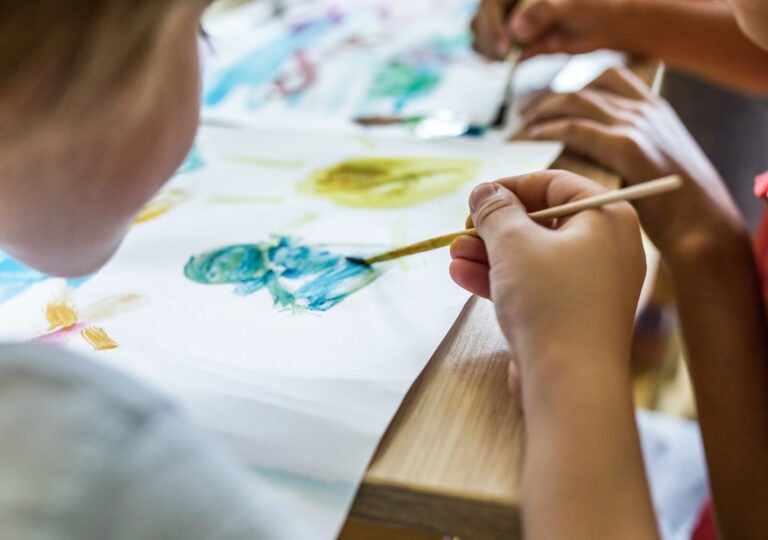
New Jersey state law requires public schools to teach the arts. (skynesher/iStock)
From Philly and the Pa. suburbs to South Jersey and Delaware, what would you like WHYY News to cover? Let us know!
New Jersey is often held up as a national leader when it comes to arts education, holding the distinction of first state to provide universal access. State law requires public schools to teach the arts, and nearly every district reports offering at least some form of visual or performing arts instruction.
The state now claims nearly 80% participation around the state, meaning more than 985,000 of the 1.2 million students in New Jersey take arts classes. Many districts boast 100% participation, including the Camden City School District and others in South Jersey.
That was the culmination of years of advocacy, working with policymakers, parents and even students, says Wendy Liscow, executive director of Arts Ed NJ, a nonprofit coalition founded in 2007.
“It’s a big challenge to increase arts education in our state and raise awareness, so you have to have everyone at the table,” Liscow said.
While various initiatives and standards regarding arts education in the state were implemented as early as 1996, the landmark achievement of universal access to arts education in all public schools was officially announced in September 2019.
New Jersey’s visual and performing arts standards are written into the state’s academic code, placing them on equal footing with subjects like math and English language arts. Students are required to earn five credits of arts instruction to graduate from high school, and those credits now count toward a student’s GPA.
That policy shift helped legitimize the arts in the eyes of students and parents, said Liscow, who joined Arts Ed NJ in 2022.
“In the past, arts courses didn’t always count the same way,” she said. “Now students who care about the arts can say, ‘This matters. This helps me get to college.’”
As elsewhere, visual arts and music dominate arts education in New Jersey. More than 820,000 students are in visual arts classes, and nearly 750,000 are taking music classes. There are nearly 4,000 teachers in each discipline. Fewer than 50,000 students are enrolled in either theater or dance, subjects for which there are only a few hundred teachers each.
However, some disparities in access to creative and performing arts classes still exist, with some school districts still falling below the legal mandates. About 3.4% of students, about 42,000, lack any such opportunity. Liscow said recent budgetary challenges at the federal and state levels have forced advocates to work harder just to preserve their earlier gains.
Liscow also noted that rising costs — from tariffs and other upward pressures — have been among the bigger challenges for districts, especially less wealthy ones. Tariffs may partly explain that, she said.
“The dollars that they have are getting 30 to 40% less,” she said. “So when they’re buying something, it’s costing them 30 to 40% more. So even staying level is going to get us less in this culture and each district will decide if staying level might be a win right now.”
That’s a sentiment shared by Craig Vaughn, superintendent of Springfield Township School District in Burlington County.
“My district has certainly taken it on the chin with the loss of state aid that’s caused some cuts in other areas,” he said. “But my board’s been supportive of making sure that we keep teachers in place that teach art and music. We’ve been really fortunate to get some grants that have grown our program and offered some things that are on more of the extracurricular basis.”
The Springfield district consists of only a single elementary school, for which Vaughn also serves as the principal. He added that they had to get “creative” in order to ensure continued access by hiring dual-certified teachers and joining a shared service agreement with a neighboring district.
“I think it’s more on the local side that we’re doing a lot to support these things than maybe the state is,” he said.
Liscow said she applauds such efforts, noting that early exposure is “critical” and that maintaining earlier gains is essential to the state’s future.
“You can’t suddenly become a dancer at 14 or 15,” she said. And “it’s very easy to cut a program, but it can take 10 years to get it back.”
Recently, Arts Ed NJ created a Youth Arts Ed Council in which students from 21 high schools around the states themselves learn to advocate for themselves.
“They learn the power of their voice and agency,” Liscow said. “And I think it’s been a really successful project, because policymakers, administrators listen to young people more than they might listen to an adult.”
Related Content
While state law mandates districts to make arts classes available, public education funding disparities have meant that some schools are still catching up.
3 months ago
Listen 1:12One of the young advocates, London Roman, a 16-year-old junior in Hamilton Township School District, wants policymakers and parents to know that art is more than just an easy class.
“Art is so important to society that we don’t realize art is more than just art,” she said. “Art isn’t just art. Art isn’t just performing. Art isn’t just music. Art is everywhere. Art is in sports, math, literature, in everything more than we think. Art is society. Art is what builds a person. It builds a character, it builds what you like, what you don’t like. It builds who you are, and it’s in way more than people think.”
Her council colleague, Ali O’Donnell, a 16-year-old junior in Hudson County School District, said her arts classes helped her become more confident in everything she does.
“I used to be very shy, and now I’m a bit more outspoken than I used to be,” O’Donnell said. “So much so, I would love to be an actress in movies and TV shows. I think that would be one of the coolest things ever, but I know that whatever it is that I end up doing in life, I’m going to need confidence in myself to even be able to move forward with what I’m doing.”
The fight for arts education can be especially acute in rural or less-resourced communities, where families may not be able to supplement school programs with private lessons or community arts programs. That, Liscow said, turns access into an equity issue.
“A lot of kids in New Jersey are exposed to theater or dance for the first time in school,” she said. “If they don’t get that chance there, they may never get it at all.”
Vaughn agrees, saying that many students don’t have the “opportunity to be exposed to different media and art or different genres in music outside of what we can provide for them at school.”
“What if it’s that one spark one kid needs? And if they never get that opportunity to be introduced to something, they don’t have that chance to just grow that spark into a flame,” he said. “I know that’s a little corny, but I just think that that’s kind of our job.”
Isabella Rodriguez, a junior at Roselle Park High School in Union County who just turned 17, exemplifies that sentiment. Her advanced placement drawing and graphic design classes helped her realize her goal of going into animation.
“I’m very into storytelling,” she said. “My favorite thing about art is that everyone has their own story to tell and that we can learn from each other.”
She said “Spider-Man: Into the Spider-Verse” is her favorite animated movie.
“It’s very inspiring to me,” she explained. “And I think [the filmmakers] just do that really well — capturing every principle of art, color and motion to tell a story.”
Her companion on the Youth Arts Ed Council, Melissa Napoli, a junior at Camden Diocese, said she’s not as sure about what she wants to do but that she “wants to create” and “take risks.”
“There are so many possibilities that I really want to implement into my learning,” she said. “I just want to have full creative freedom to create my own story.”
CORRECTION: This article has been corrected to reflect that Isabella Rodriguez is a junior at Roselle Park High School.
Editor’s Note: This story is part of a series that explores the impact of creativity on student learning and success. WHYY and this series are supported by the Marrazzo Family Foundation, a foundation focused on fostering creativity in Philadelphia youth, which is led by Ellie and Jeffrey Marrazzo. WHYY News produces independent, fact-based news content for audiences in Greater Philadelphia, Delaware and South Jersey.

Get daily updates from WHYY News!
WHYY is your source for fact-based, in-depth journalism and information. As a nonprofit organization, we rely on financial support from readers like you. Please give today.
Part of the series
Creativity Sparks Success
WHYY News explores the impact that creativity and arts programming has on the development on school-aged children.
While state law mandates districts to make arts classes available, public education funding disparities have meant that some schools are still catching up.
3 months ago
Listen 1:12
New Jersey is the latest state to ban cellphones during the school day in grades K-12
Gov. Phil Murphy signed legislation on Thursday requiring bans on non-academic use of internet-connected devices during the school day.
3 months ago
How nature is fostering kids’ creativity in Philadelphia
Studies suggest nature can help lower stress and boost attention. Researchers and educators say it can also help kids express creativity.
3 months ago
Listen 4:42