

Mikie Sherrill wants to convert New Jersey’s underused office parks and strip malls to affordable homes
Garden State residents spend more than 30% of their income on housing. The newly elected governor wants to make the state more affordable.
Listen 1:06

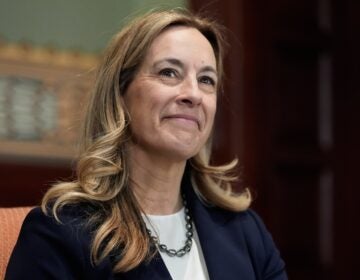
Democrat Mikie Sherrill smiles before the final debate in the New Jersey governor's race, Wednesday, Oct. 8, 2025, in New Brunswick, N.J. (AP Photo/Heather Khalifa)
From Camden and Cherry Hill to Trenton and the Jersey Shore, what about life in New Jersey do you want WHYY News to cover? Let us know.
New Jersey Gov.-elect Mikie Sherrill will begin her four-year term Tuesday as the state faces an affordable housing crisis. She said making the state more affordable does not happen without making housing more affordable.
During her campaign, she called on the state to “work collaboratively with local governments on the conversion of underused office parks, strip malls, and industrial properties into homes, transit-oriented development, and mixed-use projects, which increases housing inventory while minimizing sprawl.”
That strategy has worked well for other states, according to John Boyd Jr., principal of The Boyd Company, a corporate site selection firm.
“It’s going to create new development opportunities,” he said, adding that the company expects to see that trend “continue to occur in the months and years ahead.”
Adam Gordon, executive director of the Fair Share Housing Center, said he is “pretty hopeful” that Sherrill can oversee the conversion of underutilized commercial and industrial properties.
He said a 2024 law signed by Gov. Phil Murphy that required municipalities to update their master plan and zoning provided incentives to reuse office parks and strip malls.
The plans still must be compliant with a series of court decisions that ensures each municipality builds their “fair share” of affordable housing known as the Mt. Laurel Doctrine.
“We’re seeing a lot more compliance with the law a lot quicker,” Gordon said. “I’m very optimistic that we’re going to see a lot of that redevelopment happen under these plans.”
Boyd, however, points out that states like Texas and Idaho are able to build homes faster because they have fewer regulations, unlike New Jersey.
“You have 560 plus municipalities, that’s 560 plus zoning and permitting systems that companies and developers need to navigate and 560 plus tax climates that companies need to navigate through,” he added.
Boyd says streamlining regulations will help New Jersey build homes faster.
Gordon, who was a volunteer on Sherrill’s transition team, hopes that the Legislature takes that up in the new session. He said cutting red tape is a much-needed “bold action” to address the housing crisis.
“I think we have to shake up business as usual and this presumption that we can have endless regulatory processes and sacrosanct home rule,” he said. “A lot of those processes are 50, 100 years old and they’re not responding to the realities of how bad it’s gotten for so many New Jersey families.”
Related Content
The new housing opportunities coming to New Jersey
Boyd said the repurposing of office spaces alone will create new housing development “in the months and years ahead.”
“There’ll be some great opportunities for Atlantic City to repurpose some vacant or even some underutilized casino space, as well as vacant acreage and vacant lots and vacant sites, as well as underutilized commercial or casino properties,” he said, adding there are several other cities including Jersey City, Newark, Paterson, Trenton, which can replicate that.
Gordon also sees opportunities in South Jersey.
“There’s new development that has happened near the PATCO in Westmont, near Woodcrest Station and Cherry Hill that has included affordable housing in the last 10 years,” he said, adding that there are still significant housing needs in rural communities.
“A lot of these rural areas in New Jersey have these town centers where you can look at: How do you create affordable housing in those centers?” Gordon said. “And also looking at where you’re able to balance creating affordable housing and environmental preservation.”
Related Content
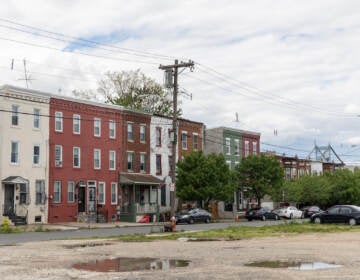
Camden officials tout $16M collaboration to provide affordable housing
The Camden Community Housing Collaborative aims to provide options for residents and people who want to move to the city.
4 months ago
Listen 0:53New Jersey needs more affordable housing over the next decade
Garden State residents are paying at least 30% of their incomes toward housing costs, according to a 2024 Harvard study. New Jersey ranked eighth worst in the nation in that analysis. Many financial planners suggest spending no more than 30% of their gross income on housing.
In their recent calculations, the state Department of Community Affairs, found that more than 146,000 residences for people with low incomes will be needed over the next decade.
Gordon said he was encouraged when Sherrill tackled the issue on the campaign trail last year.
“I think really making sure that we are both creating more affordable housing and preserving the affordable housing that we’ve got needs to be top of mind as the governor elect takes office,” he said. “We really need bold action to address how people just are facing individual affordability crises on their own.”
In addition to converting unused commercial and industrial space, Sherrill’s “Affordability Agenda” also called for increased access to loans and tax credits to incentivize “strategic” development, strengthen first-time buyer programs and crack down on those who buy up rental properties and “jack up” prices or collude to raise rents above market levels.

Get daily updates from WHYY News!
WHYY is your source for fact-based, in-depth journalism and information. As a nonprofit organization, we rely on financial support from readers like you. Please give today.
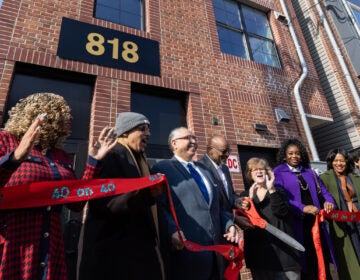
The 40-unit property, on the border with the Belmont section of West Philadelphia, is expected to open in a couple months.
6 days ago
Listen 0:48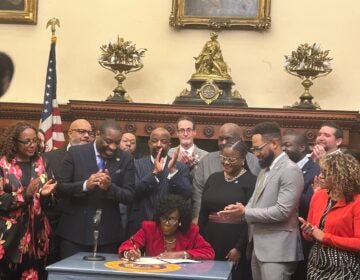
Philly City Council vote unlocks $800M for housing, shifting more aid to lowest-income residents
The legislative hurdle was cleared after intense pressure from Mayor Cherelle Parker opposing the changes to the H.O.M.E initiative's first phase.
4 weeks ago
Listen 1:06
New Pennsylvania loan program seeks to expand affordable rentals for at-risk populations
The $35 million initiative comes courtesy of the American Rescue Plan. The funding will be distributed by the Pennsylvania Housing Finance Agency.
4 weeks ago
Listen 1:07