
What is Kwanzaa? And how can you celebrate in Philly?
Here is a look into Kwanzaa – its roots in community and family, and how you can celebrate in Philly.

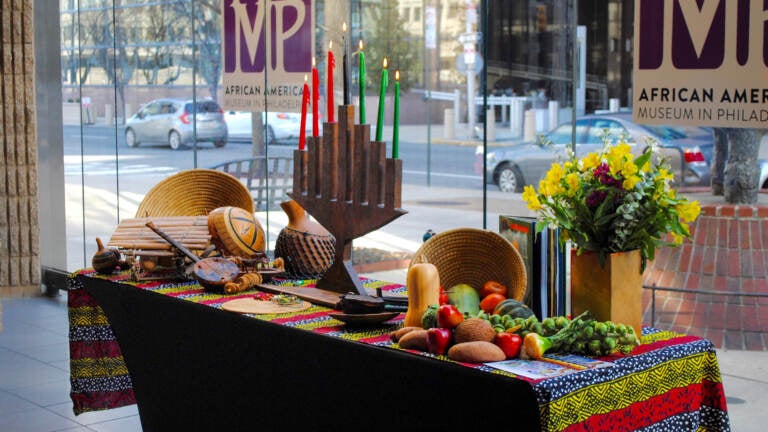
FILE - Kwanzaa table at the African American Museum in Philadelphia. (Cassie Owens/Billy Penn)
From Philly and the Pa. suburbs to South Jersey and Delaware, what would you like WHYY News to cover? Let us know!
Philadelphia does not take celebrations lightly – and this includes activities around the winter holidays. There are plenty of options to commemorate Christmas and Hanukkah, but Kwanzaa has a strong presence in the city, too.
Kwanzaa was created to help African Americans connect to their families, culture and community, said Morgan Lloyd, a program coordinator at the African American Museum in Philadelphia.
“It is an opportunity for not only African Americans, but people all across the diaspora, as well as several allies, to celebrate the cultural unity and self-determination of the African peoples,” she said.
The holiday was created in 1966 by Dr. Maulana Karenga to “address cultural disconnection” of African Americans.
Lloyd said the holiday’s origins are cultural.
“It’s a non-religious holiday,” she said. “So anyone can celebrate. Kwanzaa is observed not only in the United States, but also in Canada, throughout the Americas, and I’ve even seen a Kwanzaa celebration in Japan. So anyone can really join in.”
The holiday is based on a set of principles, she said.
“Since Kwanzaa runs from December 26 through January 1, each day has a Nguzo Saba, or a guiding principle, assigned to it,” she said.
- Umoja – Unity
- Kujichagulia – Self-Determination
- Ujima – Collective Work and Responsibility
- Ujamaa – Cooperative Economics
- Nia – Purpose
- Kuumba – Creativity
- Imani – Faith
Each of the principles is represented by seven candles, which are also colored to represent the pan-African flag. The festivities of the holiday end with Karamu – a communal feast.
There are several ways that Philadelphians can celebrate.
Related Content
At some Philly restaurants, Christmas isn’t a holiday — it’s the ‘Super Bowl’
While many restaurants shut down over the holidays, for others working on the 25th is tradition.
2 months ago
Celebrations
The Free Library of Philadelphia will host Kwanzaa programming throughout the celebration. On December 25 and 26, there will be an all-ages celebration at Parkway Central Library with presentations, dancing and Kwanzaa historical discussions.
On December 27, there will be an all-ages event with the Keepers of Culture, Philly’s Afrocentric Storytelling group, with crafts, food and story sharing at Haverford Library.
The Children’s Department at Parkway Central Library will also host a Kwanzaa celebration this day, where program leaders will teach about the seven principles and explore African culture and identity.
Finally, children of all ages can color kinaras, or candleholders for seven candles used to celebrate Kwanzaa, at an event at The Northeast Regional Library on December 29.
The African American Museum in Philadelphia will also host daily programs to commemorate the seven guiding principles of the holiday. Lloyd said the celebrations kick off on the first day of Kwanzaa by celebrating unity.
“For Umoja, which means unity, it is our annual unity celebration and ceremony,” she said. “We invite the community to come into the museum, break bread, light the kinara, and we will have live drumming, music, dancing, and curated performances to bring folks together during this holiday season and also ignite Kwanzaa itself.”
Lloyd said another highlight is the museum’s programming on the second day of Kwanzaa, which celebrates Kujichagulia, or self-determination. She said this year’s programming focuses on how Black people across the diaspora are “able to maintain identity through food and culinary pathways.”
“We have our annual program called ‘Skillets and Skill Sets,’ and this year, it is a live cooking show over at the Free Library in their Culinary Literacy Center,” she said.
She emphasized this program sells out fast and encouraged advanced registration.
Lloyd highlighted two other nights during the celebrations – an open mic night on Sunday, December 28, celebrating Ujima — or collective work and responsibility — and an evening bazaar and quizzo night at Franklin Square Park on Monday, December 29, celebrating Ujamaa — or cooperative economics.
“It is a black-owned vendor market that we have at Franklin Square, and on top of that, in our partnership with them, we also take over their wonderful heated tent and bar area, where we have quizzo, line dancing, and live music that’s playing,” she said.
Lloyd said she is grateful for the programming at the museum, as it gives everyone the opportunity to participate.
“It’s wonderful to know that people can come here and experience Kwanzaa for the first time and have it be an experience where no matter who you are, you’re extremely welcome,” she said.
Beyond the museum’s programming, there are several other events in the city.
This includes KwanzaaFEST, which will take place from 12-5 p.m. at the Lucien Blackwell Center on Saturday, December 27th. The event will include arts and crafts, live performances, a panel discussion, vendors and wellness resources. The focus of this year’s festival is Kujichagulia, or self-determination.
The principle, which encourages people to create and speak for themselves, will be reflected with arts and crafts activities, a small business marketplace, and a free, fresh produce market.
The Penn Museum will also host a Free Community Day/Kwanzaa Celebration. The celebration, which honors African culture and community, will feature a marketplace with local artists, storytelling, music and dance.
Lloyd emphasized that everybody can celebrate and appreciate Kwanzaa.

Get daily updates from WHYY News!
WHYY is your source for fact-based, in-depth journalism and information. As a nonprofit organization, we rely on financial support from readers like you. Please give today.
Wilmington’s Kwanzaa tradition highlights unity and the power of community
Kwanzaa returns to WIlmington with free community events rooted in culture, unity, and the seven principles of Nguzo Saba.
2 months ago
Listen 1:22
Winter wonderland at the shore: Here’s what to do in Cape May this holiday season
Cape May has become one of the Jersey Shore’s busiest winter destinations. Explore the town’s top holiday events.
2 months ago
Philadelphia region celebrates holiday season with festivities for all
The Philadelphia area comes to life as people celebrate Christmas, Hanukkah and Kwanzaa with a wide variety of activities.
1 year ago