
How PECO’s profits impact your electricity bill
Electricity rates are rising along with profits for investor-owned utilities.
Listen 6:59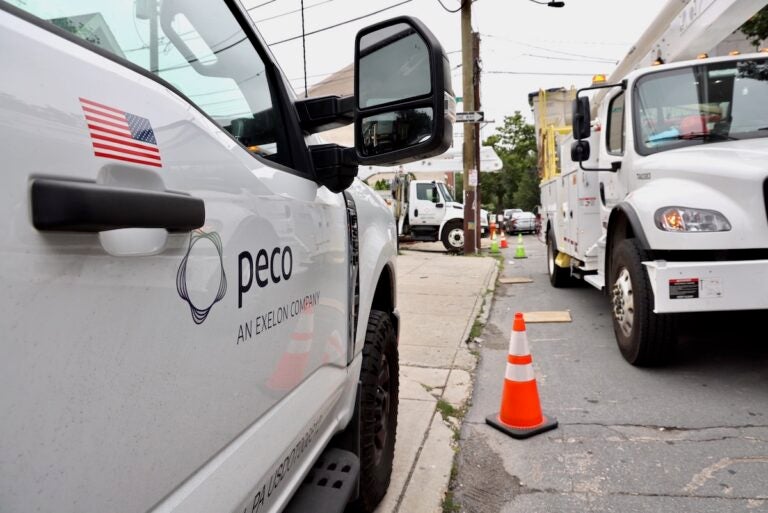
An electrical repair crew work on West Thompson Street in Fishtown. (Emma Lee/WHYY)
From Philly and the Pa. suburbs to South Jersey and Delaware, what would you like WHYY News to cover? Let us know!
Profits are way up at PECO, Pennsylvania’s largest electric and natural gas investor-owned energy company, a subsidiary of Exelon.
PECO’s net profit after all expenses, taxes and deductions shot up 47.7% between 2024 and 2025 to $814 million.
Pennsylvania Gov. Josh Shapiro criticized utility profits in his annual budget address in February. The area also had a really hot summer and cold winter, which led all of us to use more energy.
WHYY News’ senior climate reporter Susan Phillips joined WHYY’s Morning Edition host Jennifer Lynn to take a deeper dive into how PECO’s profits impact utility bills.
Listen to their full conversation above.
Editor’s note: The following transcript has been edited for clarity.
Jennifer: I imagine consumer advocates are saying this profit leap is not a good look at a time when energy consumers are coping with higher energy bills in sour economic times.
Susan: The news is hard to swallow for customers who are facing skyrocketing bills.
Here’s some background: PECO’s most recent rate hikes included a 10% increase that kicked in for electricity ratepayers in January 2025. The Philadelphia-based company also provides natural gas to suburban customers, who endured a 12.5% increase as part of the same rate hike case. There were rate hikes that kicked in this January, as well.
Jennifer: Well, I’ve pulled up my recent PECO bill. It looks like I’m paying for a number of things — not just my electricity usage.
Susan: That’s right. The rate hikes are only for the distribution charges, so what is that? Well, that includes transporting the energy through the wires to our home, or the gas through pipelines. So, that rate hike also covers the cost of building new infrastructure — we all pay for that and that’s how the investor-owned utilities make their money — on building new infrastructure.
Related Content

Trump said data centers should build their own power source, but offers few details
President Trump said in his annual State of the Union address that he made deals with data centers to tamp down electricity costs for consumers. But there are few details.
1 month ago
Listen 1:02Jennifer: In your most recent story, you spoke with people, some of whom used to work in the industry and called that a perverse incentive: Spend more to make more.
Susan: Yes, so the company has an incentive to build more infrastructure. The argument in favor of that is we need new infrastructure, and we need upgraded infrastructure to ensure both safety and reliability. But that brings us to two questions: One, how do we know how much of this infrastructure we need? And number two, how much of a profit should the company’s shareholders be making off of this? This is something we all have to pay for because these companies enjoy a monopoly.
Jennifer: I want to talk about that. These are monopolies, and they enjoy that monopoly in exchange for regulation. If they want to raise our rates, they have to get approval from state regulators.
Susan: Yes, in Pennsylvania, that’s through the Public Utility Commission. But critics say regulators across the country are either not well informed or are too cozy with industry to really scrutinize the numbers. These rate cases are very complex, and one of the things I found in my reporting is that even insiders had a hard time explaining it all to me.
Jennifer: So, for this recent rate case, how much profit did PECO make in the year since the rate hikes?
Susan: So net profits jumped almost 50% for PECO from the previous year. There’s a number everyone was talking about when I first started looking into this. It’s called return on equity. Basically, it’s the profit investors earn. So, you would want some profit to encourage investment in infrastructure. But in this case, it was about 10%, which is a pretty good rate of return. The consumer advocate in Pennsylvania says they should really earn between 8.5 and 9.5%. This is not a risky investment, and we are all paying for it.
Jennifer: In addition to distribution and infrastructure, our bill also includes the cost of fuel and power generation. This can fluctuate quite a bit, based on the amount of energy used and the cost of energy.
Susan: Yes, so here’s the thing. The utilities pass on the fluctuating cost of energy to customers, and that went up in 2025 — and they don’t make a profit off of that. The electricity generators make that profit. However, if you use more electricity during a heat wave or a cold snap, for example, the utilities will make more money off of that distribution service because they’re delivering you more. So while the power plants make the money off the generation, utilities like PECO, or PPL or Atlantic City Electric also make more money during extreme weather. In their earnings report to investors, Exelon, PECO’s parent company, called this “favorable weather.” But it’s not favorable for the rest of us.
Jennifer: You’ve been following the impact of data centers as well.
Susan: Yes, so that’s about supply and demand. If data centers are squeezing supply, costs for everyone go up as well. Also, there’s something called the capacity markets – it’s complicated, but data center demand is driving up the capacity costs, and that’s also making our bills go up.
Jennifer: What can people do?
Susan: Well, the best thing is to put solar panels on your roof. But if you can’t afford that, there’s not much to do except conserve energy. There’s been a lot of talk in the Legislature regarding reforms and reining in data centers, having data centers provide their own power. Gov. Shapiro wants regulators like the Public Utility Commission to do a better job of scrutinizing these rate hikes. But, these increased rates aren’t going away.
Jennifer: Which brings us to this point: investor-owned electric utilities don’t grow by selling more electricity; they grow by building more infrastructure.
Susan: Yes, one big reason our bills are higher is because of infrastructure spending by the utilities. The same things are happening in New Jersey and Delaware.

Never miss a moment with the WHYY Listen App!


WHYY is your source for fact-based, in-depth journalism and information. As a nonprofit organization, we rely on financial support from readers like you. Please give today.

From firewood to solar: This Philly rowhouse has seen over 250 years of energy transitions
A rowhouse built around 1760 in Old City was once heated with firewood. Now, it has solar panels on its roof.
3 months ago
Listen 1:22
As electric bills rise, evidence mounts that data centers share blame. States feel pressure to act
It’s not clear that any state has a solution and the actual effect of data centers on electricity bills is difficult to pin down.
8 months ago

New Castle County residents fight back against proposed data center
An investor owned firm says its proposed Delaware City data center will bring jobs. Residents say it will use too much energy and water.
9 months ago
Listen 1:14