

Democracy summit marks America’s 250th anniversary by looking beyond the celebration
From trust in elections to political polarization, experts shared what they believe Americans should understand about democracy's future.

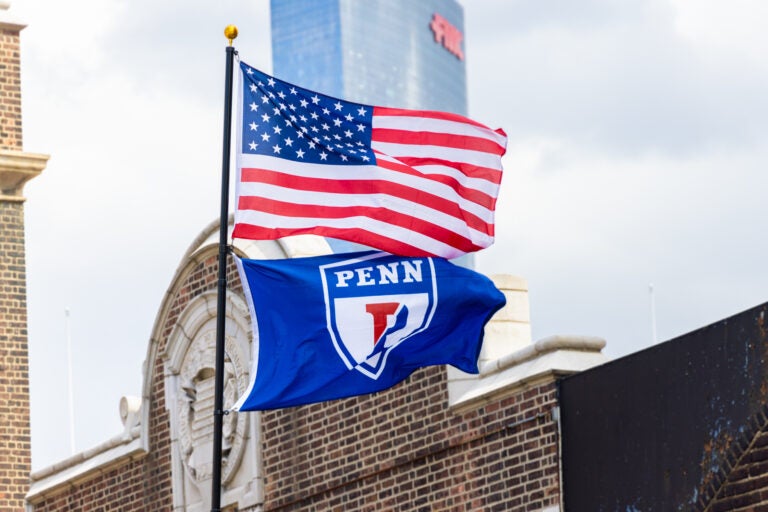
Flags fly at the University of Pennsylvania’s athletic stadium and sports medicine center. (Kimberly Paynter/WHYY)
From Philly and the Pa. suburbs to South Jersey and Delaware, what would you like WHYY News to cover? Let us know!
As Philadelphia marks the nation’s 250th anniversary, civic leaders, elected officials, judges, journalists and scholars gathered for two days to debate one question: What does American democracy need to survive its next 250 years?
Hosted by the Committee of Seventy, “The Promise of Democracy: 250 Years and the Path Ahead” brought together experts on elections, media, government and civic engagement.
Here are the major takeaways from the summit.
1. Democracy isn’t collapsing — but too many Americans no longer trust it
Again and again, panelists argued that the greatest danger isn’t simply political conflict, but declining public confidence in the institutions that underpin American democracy.
David Becker, founder and executive director of the Center for Election Innovation & Research, said many Americans have been convinced elections are unreliable despite evidence to the contrary.
“I think the greatest threat is that people might feel despair and fear about upcoming elections and ongoing elections,” he said. “Our elections are actually as safe, convenient, as secure as they’ve ever been. And I think we’re going to see the highest turnout we’ve ever seen in 2026.”
Mary Smith, CEO of the Task Force for American Democracy and former American Bar Association president, referred to an ABA study that showed the largest share of Americans believe it’s up to the populace to maintain Democratic norms.
“It’s a responsibility of all of us to safeguard our precious democracy and make sure it endures,” she said.
Author Roxane Gay in a later panel echoed the sentiment given that Congress appears to have abdicated their power to keep the executive in check.
“With the rise of Donald Trump and his brand of populism, we are seeing just how many flaws there actually are in our democracy,” she said. “And more importantly, that there are very few people who are willing to do the work of holding up that democracy.”
David Brooks, a writer for The Atlantic, argued that lasting political change begins locally.
“A community is a group of people who are joined by a common project,” he said. “Then a village compact. We make promises to each other. We will live up to this. This is our story. These are our promises to each other.”
Related Content
Historic ‘March of America’s Mayors’ commemorates independence and celebrates local democracy
Local leaders from across the country marched from Independence Mall to the Museum of the American Revolution, highlighting the role of cities in sustaining democracy.
2 months ago
2. Facts alone no longer persuade people
The summit’s discussion of media focused less on misinformation itself than on why it spreads. University of Delaware professor Dannagal Young argued that people often seek information that reinforces their existing beliefs.
“There wouldn’t be so much BS if there were not a market for BS,” she said. “We actually do have a penchant for wanting to be exposed to information that confirms our priors.”
She added people seek out information that satisfies basic human needs “for comprehension, control and community,” even when those needs are fulfilled by false or misleading claims.
Meanwhile, Georgetown researcher Renée DiResta said journalism now competes with influencers, creators and social media personalities for public attention.
“Media at this point is one side of an ecosystem,” she said. “The other side is influencers, creators, and the fact that all of us can be creators.”
Rachel Lobdell, executive director of News Creator Corps, which trains influencers in journalism skills, added that journalism must adapt to a world in which people pay attention to social media personalities.
“Instead of romanticizing the era in which people picked up a physical newspaper and read it front to back, I decided that investing in creators is where I could have real impact,” she said.
Related Content
What Thomas Jefferson meant by "the pursuit of happiness" may be very different from what Americans mean today.
3 months ago
Listen 1:183. Americans may not be as divided as they think
While political conflict dominates headlines, several speakers argued that social media and partisan media exaggerate the country’s divisions.
University of Pennsylvania political scientist Matt Levendusky said Americans routinely overestimate how extreme members of the opposite party are.
“Most people are relatively politically moderate,” he said. “They don’t actually care that much about politics.”
Global Refuge President and CEO Krish O’Mara Vignarajah said she regularly sees communities with very different politics united around common concerns like housing, jobs and public safety.
“I see a lot of commonality at the grassroots,” she said, arguing that people’s day-to-day concerns often transcend party labels.
U.S. Rep. Chrissy Houlahan, D-Chester County, said voters in her politically divided district consistently reward pragmatism over ideology.
“They are looking for somebody who’s reasonable and pragmatic and who’s trying to reach across the aisle,” she said.
She further urged people to have more one-on-one conversations with neighbors whose views differ from their own.
Max Stier, president and CEO of the Partnership for Public Service, argued that Americans frequently agree on policy goals until those issues become framed through a partisan lens.
“Politics isn’t how most people think about the issues,” he said.
Related Content
Can democratic socialists go mainstream?
Democratic socialists are on a winning streak in Pennsylvania, New York and Colorado but will the movement help or hurt Democrats chances in November?
Air Date: July 6, 2026 12:00 pm
Listen 51:144. Frustration and disengagement present the biggest barriers to voting, not apathy
Voter turnout in the U.S. hovers around 50%, with a few more people turning out in presidential elections. However, several panelists rejected the idea that low voter participation reflects indifference.
“The word apathy gives me the heebie-jeebies,” League of Women Voters CEO Celina Stewart said. “I think apathy is an outcome.”
National Urban League President Marc Morial said most nonvoters are caught in a “self-defeating cycle.”
“When I talk to voters who don’t vote, who are not enthusiastic about voting, it’s because they believe that what voting has produced has not worked for them,” he said. “When people do not vote … politicians pay attention to voters who vote.”
Pollster Rich Thau, creator of the Swing Voter Project, shared findings from focus groups he conducted just two days earlier with Pennsylvania swing voters, saying that many of whom cited practical obstacles rather than ideology. He used the example of Anabel, a Montgomery County resident who worked in a different town from where she would vote and wasn’t aware she could vote by mail.
“Part of it is education,” Thau said.
Schmidt argued that the government should focus on removing barriers rather than blaming voters.
“It’s our job to reduce frustration,” he said. “We can’t force people to vote.”
The discussion focused less on convincing people to vote than on reconnecting politics to their daily lives.
Morial argued that despite the rise of digital campaigning, personal outreach remains one of the most effective ways to increase participation.
“There is nothing like your neighbor knocking on your door,” he said. “There’s nothing like going to a barbershop, a beauty salon, a community hall, and there’s a discussion about voting.”
Stewart said civic organizations have found greater success by talking first about the issues people care about rather than elections themselves.
“I don’t ask people to vote,” she said. “I ask, ‘What are you pissed off about?'”
By starting with concerns such as housing costs, schools or public safety, she said that organizers can help people understand how local elections shape the issues affecting their everyday lives.
Related Content
Selection committee for DNC tours Philadelphia as potential 2028 site
The city, which hosted the 2016 Democratic National Convention, is one of five on a list to be reviewed by the party.
4 months ago
Listen 1:095. The Constitution can only protect democracy if people protect the Constitution
Although panelists frequently invoked the Constitution, many argued that the document itself cannot preserve American democracy. Its survival, they said, depends on whether elected officials, judges and ordinary citizens are willing to uphold the principles it embodies.
David Becker said the Constitution has proven remarkably durable over nearly 2 1/2 centuries, but only because people continue to defend it.
“The Constitution is incredibly resilient,” Becker said. “But ultimately it’s still just a piece of paper and it requires hard work to enforce.”
Current and former members of Congress who participated in the conference argued that the legislative branch also bears responsibility for the move away from constitutional norms.
U.S. Rep. Mary Gay Scanlon, D-Delaware County, said Congress has ceded its own constitutional role.
“There’s been growing abdication of congressional authority to the executive,” she said.
Conservative commentator Ramesh Ponnuru called Congress “the sick man of our constitutional system.”
“It tempts the courts and the executive to fill the vacuum to take the power, but it wouldn’t be possible if Congress had the institutional self-respect to insist on its own prerogatives,” he said.
As for the judiciary, Jeh Johnson, who served as the secretary of Homeland Security under President Barack Obama, said federal judges have shouldered much of that responsibility in recent years, calling them “the real heroes of our democracy in these challenging times” for continuing to “call balls and strikes” despite political pressure and threats.
However, Dickinson College President John E. Jones III, a former U.S. District Judge warned that the increase in attacks on judges threatens not only individual jurists but the judiciary’s independence.
“We are going to get a judge killed,” Jones said. “We’ve got to dial down the toxic rhetoric.”
The summit concluded with author Roxane Gay returning to the same theme from a broader perspective.
“Checks and balances only exist if people are willing to live by those guidelines,” she said.
The discussions were moderated by University of Pennsylvania law professor Kermit Roosevelt, The 19th Editor-at-Large Errin Haines, veteran political journalist Heidi Przybyla, CNN and SiriusXM host Michael Smerconish, WHYY Vice President of News and Civic Dialogue Sarah Glover and WHYY’s Cherri Gregg. Other panelists included League of Women Voters CEO Celina Stewart, Partnership for Public Service President and CEO Max Stier, former U.S. Reps. Jim Gerlach and Glenn Nye, National Review editor Ramesh Ponnuru, and author David Brooks. Together, they explored topics ranging from the rule of law and election administration to misinformation, civic participation, congressional authority and political polarization.

Never miss a moment with the WHYY Listen App!


WHYY is your source for fact-based, in-depth journalism and information. As a nonprofit organization, we rely on financial support from readers like you. Please give today.
The judge paused his own order, writing that while the university is unlikely to win its appeal, the delay will not harm a federal investigation.
4 months ago
Listen 0:57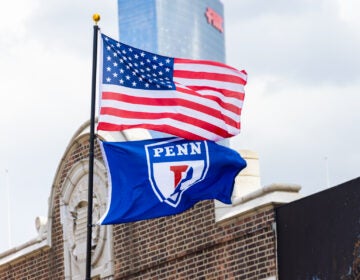
Trump administration says Penn violated sex discrimination laws after transgender swimmer competed
The U.S. Education Department wants Penn to strip swimmer Lia Thomas of awards and apologize to female swimmers. The school has said it followed NCAA and Ivy League policies.
1 year ago
Earlier this month, the Trump administration suddenly terminated student status for more than 1,000 international college students.
1 year ago
Listen 1:24