

250 years later, Americans are still wrestling with democracy’s promise and the ‘pursuit of happiness’
What Thomas Jefferson meant by "the pursuit of happiness" may be very different from what Americans mean today.
Listen 1:18
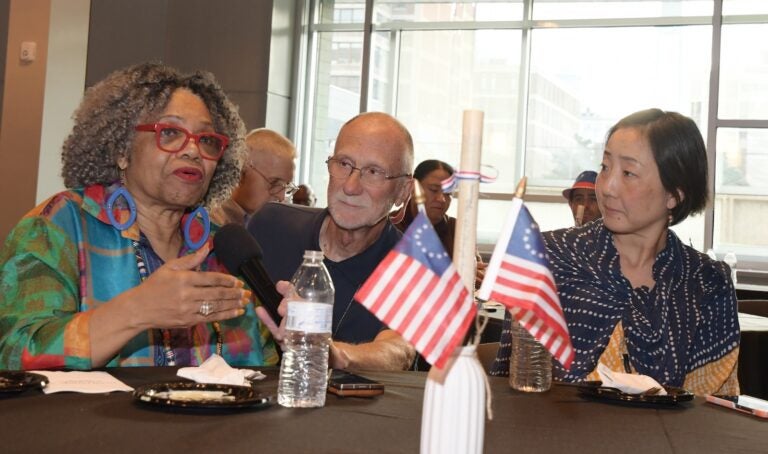
Event attendees engage in Q&A with the panel discussing the pursuit of happiness and the Declaration of Independence at WHYY. (Marissa Weekes Mason for WHYY)
From Philly and the Pa. suburbs to South Jersey and Delaware, what would you like WHYY News to cover? Let us know!
As the nation prepares to celebrate the 250th anniversary of the signing of the Declaration of Independence, historians, civic leaders and community members gathered at WHYY on Tuesday evening to examine one of the country’s most enduring promises: the pursuit of happiness.
“Life, Liberty & the Rocky Pursuit of Happiness” brought together scholars from the University of Pennsylvania’s McNeil Center for Early American Studies, researchers studying well-being in modern Philadelphia and community engagement leaders from WHYY for a discussion about the ideals that helped shape the United States — and the challenges of extending those ideals to all Americans.
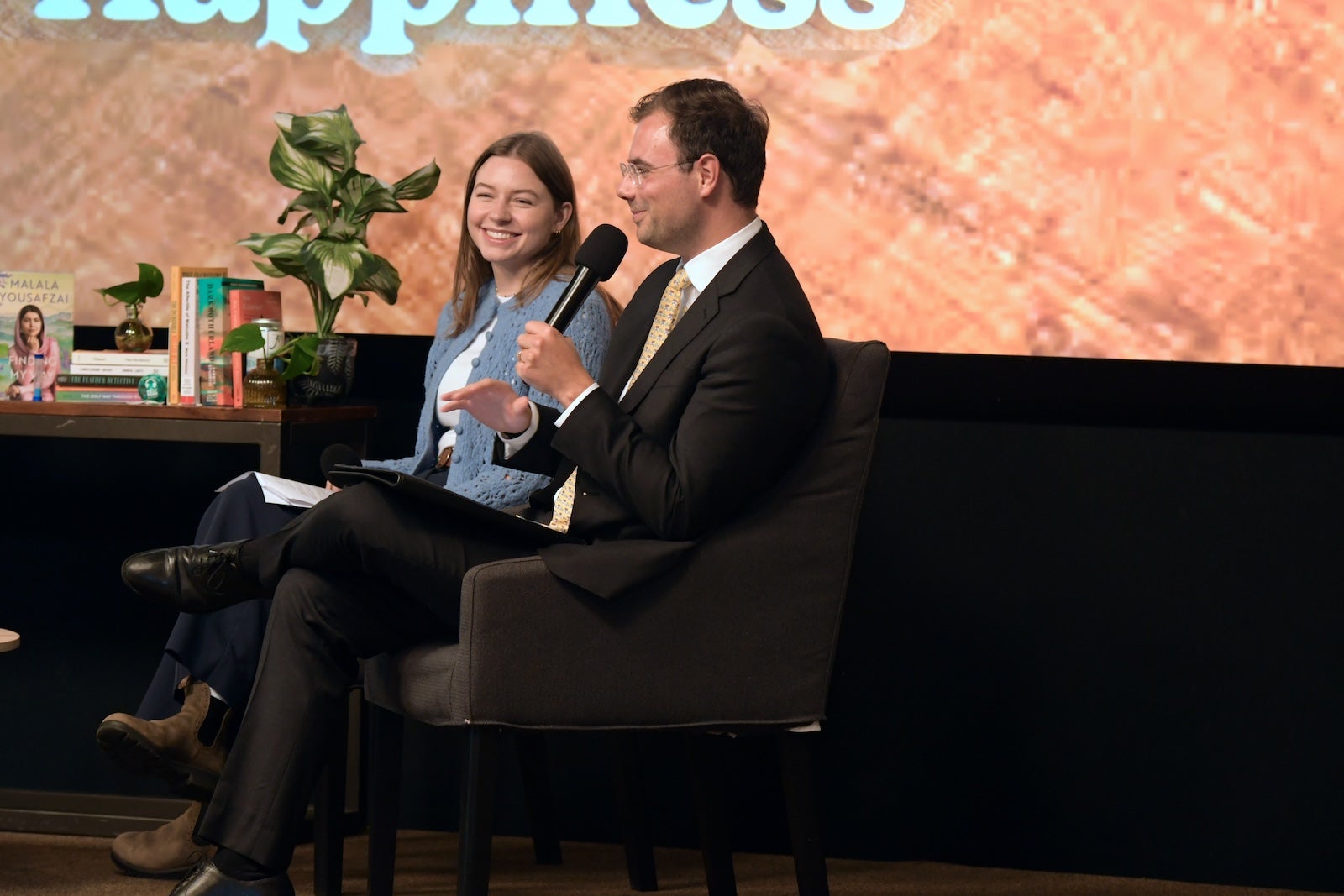
Moderated by WHYY Vice President of News and Civic Dialogue Sarah Glover, the program explored how the Declaration of Independence’s famous assertion that all people possess the unalienable rights to “life, liberty and the pursuit of happiness” has inspired generations while simultaneously falling short.
“Across generations, Americans have pursued, challenged, and redefined these promises in different ways,” Glover told attendees. “Yet from the nation’s earliest days, access to those ideals have been shaped by circumstances, status and struggle. As America celebrates its 250th anniversary, the tenets of democracy are being rigorously debated and challenged as they were during the revolution.”
Defining ‘happiness’
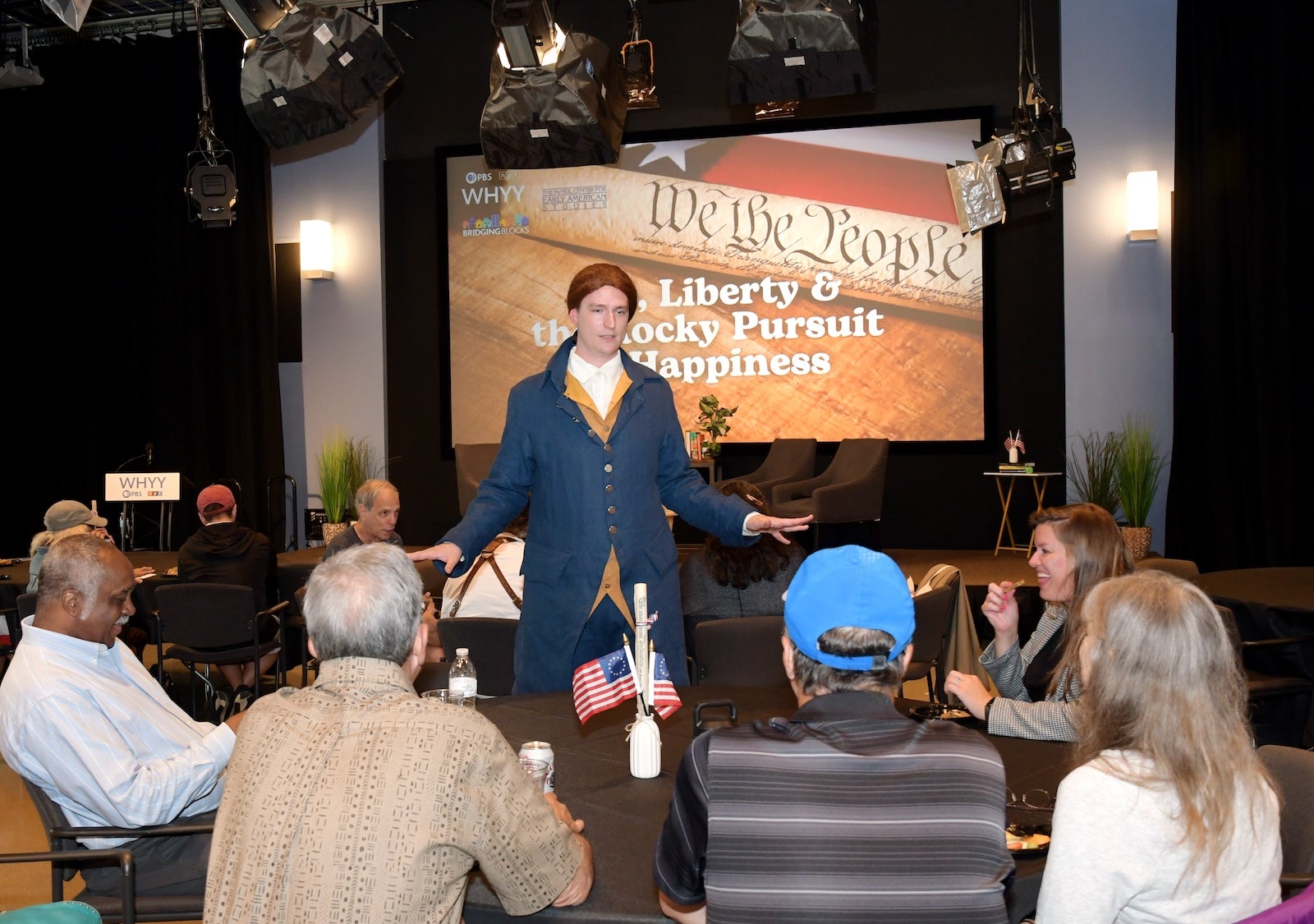
The evening blended historical analysis with contemporary perspectives on civic life and community well-being. Revolutionary-era reenactors helped transport audience members back to the nation’s founding, illustrating how ordinary colonists experienced the political upheaval that culminated in independence.
A highlight of the evening was a first-person portrayal of Thomas Jefferson, bringing one of the Declaration of Independence’s principal authors into conversation with a modern audience. Speaking in character, the reenactor read the Declaration of Independence, which makes “the pursuit of happiness” central to the document.
“It is the right of the people to alter or abolish it and to institute new government laying its foundation on such principles and organizing its powers in such form as to them shall seem most likely to affect their safety and happiness,” the reenactor said.
Peter Jakob Olsen-Harbich, associate director of the McNeil Center for Early American Studies at the University of Pennsylvania, explained that the Declaration of Independence emerged after years of escalating tensions between the American colonies and the British Crown. Colonists had repeatedly petitioned King George III to address their grievances, including over taxation and government regulation without local representation, but those efforts were rejected.
“The document is by and large a product of Jefferson’s mind and it is seen that way at the time,” he said.
Olsen-Harbich explained that Jefferson’s use of the word “happiness” differed from how modern Americans often understand its meaning.
“It is important to understand that Jefferson, although he would’ve been familiar with this concept of happiness, is distinctly not referring to that when he uses the term happiness in the declaration,” Olsen-Harbich said. “What Jefferson means is the activity of undergoing the self-cultivation of good character, the moral character, the virtuous character.”
Related Content

How Philly is celebrating Juneteenth, the Fourth of July and the 250th in 2026
Block parties, fireworks and a star-studded concert on the Ben Franklin Parkway are on the calendar for a celebratory summer.
3 months ago
Democracy, and the road to happiness
Amanda Moore, program director of Drexel University’s Happiness Lab, connected those historical debates to modern research on well-being. Drawing on findings from the lab’s Philadelphia Happiness Map project, Moore discussed how access to happiness is often shaped by various factors, including individual freedom.
“If you feel free to do the things you want to do in your life, you’re going to feel happier and a democracy provides that for people,” Moore said.
However, Moore pointed out that, according to the World Happiness Report, which the Happiness Lab uses from some of its research, the U.S. has “room for improvement,” given its 16th-place ranking on the scale. She pointed to other countries where walking, healthy lifestyles and community play more prominent roles in society.
“There’s lessons we can take from these other countries where they prioritize the simple things — connecting with others, spending time in nature, eating good food — and they’re doing it right,” she said. “They’re living long, happy lives.”
Glover asked Olsen-Harbich whether he thought the U.S. has come close to actualizing the pursuit of happiness as Jefferson laid out. He responded that the broadening of public education and the access to higher education have been important tools in achieving that.
“Those things have obviously been very productive in expanding who is able to participate in pursuing happiness and who has access to the educational resources that are necessary to acquire happiness,” Olsen-Harbich said.
However, he added that Jefferson would have found the way modern Americans view pursuing happiness as “very narcissistic” and “selfish.”
“The way that happiness has become this consumable entertainment thing in our culture, that would be recognized, I think, as an enormous backsliding,” he said.
Moore added that some communities also have greater obstacles in the way of their own pursuits.
“Economic inequality is definitely something that hinders happiness and is definitely something Americans are experiencing today,” she said.
Who should vote?
The evening concluded with an interactive session led by WHYY’s Bridging Blocks initiative, a civic dialogue program that brings residents together for face-to-face conversations about hot-button issues. Community engagement leaders Anthony Cuffie and Brisa Luzzi Castro explained that the program was created to help people engage respectfully despite their differences and move beyond the often-polarized exchanges found on social media.
Participants then took part in a “lightning debate,” in which audience members weighed in on a series of questions. When asked whether 16-year-olds should be allowed to vote, opinions varied widely. One attendee argued that today’s teenagers are often more informed than previous generations.
“The youth are coming up,” she said. “The ones that I’ve been around are much more alert.”
Another participant said lowering the voting age could encourage lifelong civic engagement, arguing that “if they thought through the process, I’m going to register, I have something to say, I think I can make a change and make my vote count — gosh, let them.”
Others disagreed, with one attendee arguing that many teenagers have not yet developed the maturity needed to make informed decisions and suggesting the voting age should be raised rather than lowered.
The audience also debated whether incarcerated people should retain the right to vote. Several participants argued that voting is a fundamental right that should not be lost because of incarceration.
“Every vote counts in this nation,” an attendee said. “Regardless of what you have done, the crime you’ve done, your rights should not be infringed.”
Others suggested voting rights should depend on the severity of the offense, while another participant argued that allowing incarcerated people to vote could help reinforce their connection to society.
“They do have an accountability to the country in which they have citizenship,” he said.
The conversation later turned to military service, social media restrictions and the state of American democracy. During a discussion about whether the United States has the world’s best democracy, one participant urged the audience to focus less on international comparisons and more on improving civic institutions at home.
“The real question is, is our democracy serving our needs to the best possible extent?” he said. “Clearly it’s not, and it can be improved.”

Get daily updates from WHYY News!
WHYY is your source for fact-based, in-depth journalism and information. As a nonprofit organization, we rely on financial support from readers like you. Please give today.
Part of the series
Philadelphia 250
The United States is marking its semiquincentennial — or its 250th anniversary — in and around the City of Brotherly Love.
After days of oppressive heat, thunderstorms cut Philly’s July 4th concert short
After storms forced attendees to evacuate, the concert resumed around midnight with a shortened performance by The Roots, followed by fireworks.
1 month ago
Listen 0:55
Patriotic Pet Parade at Betsy Ross House in Old City celebrates America’s 250th birthday
The competition boasted 22 pets donning a range of red, white and blue attire.
1 month ago
Valley Forge National Historical Park, born on the Fourth of July, celebrates America250
The pivotal Revolutionary War site in the Philly suburbs hosted hundreds of people for live readings of the Declaration of Independence, a cannon fire demonstration and more.
1 month ago
Listen 1:45