

Norwegian Cruise Line and Port of Philadelphia celebrate completion of new Delaware River cruise terminal
Cruises restarted departures from Philadelphia in April after a 15-year break, offering trips to Bermuda and Canada and creating 2,200 jobs.

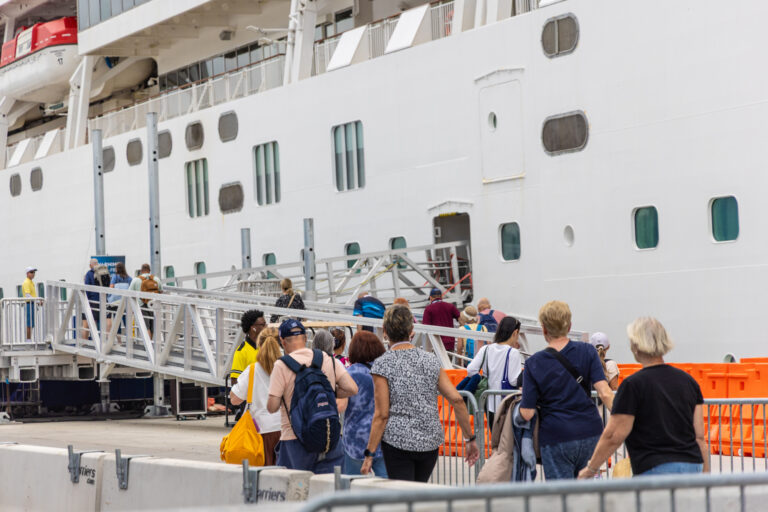
Passengers board the Norwegian Jewel cruise liner in Philadelphia on Aug. 27, 2026. (Kimberly Paynter/WHYY)
From Philly and the Pa. suburbs to South Jersey and Delaware, what would you like WHYY News to cover? Let us know!
Margarete James of Hilton Head, South Carolina, goes on a cruise every few months, which usually involves driving several hours to get to a port in Charleston or in Jacksonville or Port Canaveral, Florida.
But this week, for the first time, she and her husband Ken flew to Philadelphia, spent the night at a hotel near the airport, and took a brief ride to a new cruise ship terminal on the Delaware River. Despite the distance from home, it was actually an easier trip, she said.
“We never took [a cruise] out of Philadelphia, so that’s the first time I’d seen it. I said, ‘Oh, let’s take it,’” she said, as they walked from their shuttle to the terminal entrance. “Plus, the hotels are more reasonable here. We get the free airport transportation and free transportation to the cruise ship. They can’t beat that.”
Norwegian Cruise Line and the Port of Philadelphia, known as PhilaPort, are betting that convenience will draw a steady stream of cruisers to the $60 million facility, which held a ribbon-cutting ceremony Thursday attended by Mayor Cherelle Parker, Pennsylvania Secretary of Transportation Michael Carroll and other officials.
As hundreds of travelers packed an adjoining terminal space waiting to board the Norwegian Jewel, speakers touted the recent resumption of cruises from the port after a 15-year hiatus and the projected economic benefits to the city and region.
-
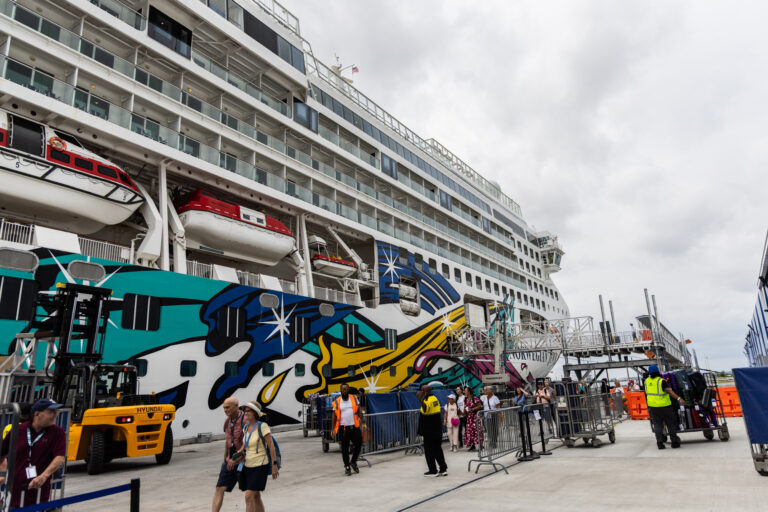
Passengers and workers in Philadelphia get ready to depart on the Norwegian Jewel cruise liner. (Kimberly Paynter/WHYY) -
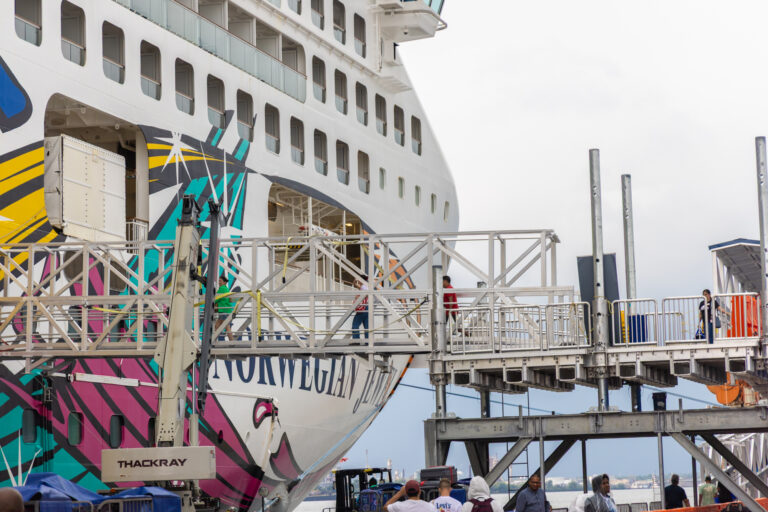
Passengers board the Norwegian Jewel cruise liner in Philadelphia on Aug. 27, 2026. (Kimberly Paynter/WHYY) -
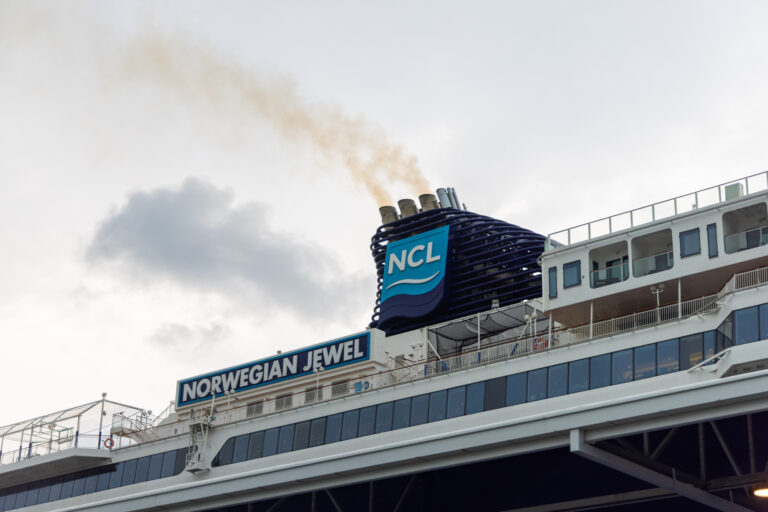
The Norwegian Jewel departs from the Philaport Terminal in Tinicum, Pennsylvania. (Kimberly Paynter/WHYY)
The terminal supports 2,185 direct and indirect jobs, officials said, and is projected to generate $108 million in wages and $12 million in state and local tax payments.
“For generations, you know that our port has connected Philadelphia to the world, supporting good-paying jobs and driving economic growth,” Parker said. “We are opening another door to opportunity along our waterfront.”
Related Content
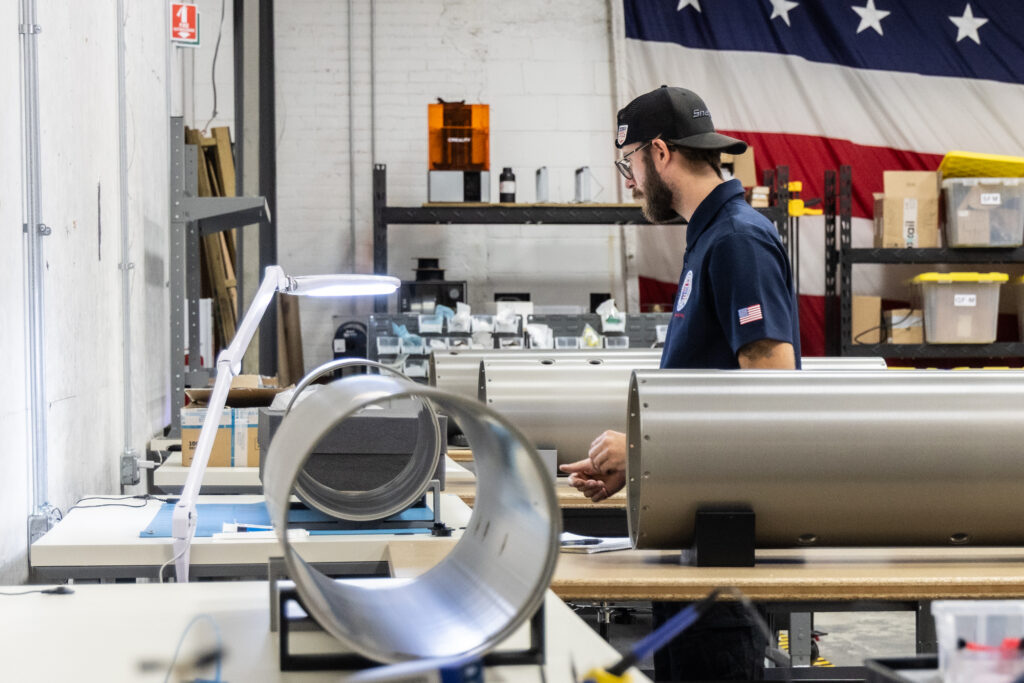
Less than two years after a Wharton dropout co-founded it, Albacore has $10 million in investments and a contract to supply the U.S. Navy.
1 month ago
Listen 1:18A port close to home
In the 2000s, Philadelphia hosted a busy cruise terminal at the Navy Yard, but the recession, rising fuel costs and long trip down the Delaware River to the ocean sharply reduced demand. The Delaware River Port Authority shut down the lightly used terminal in 2011, in part to avoid renovation costs.
But with cruising booming again since the pandemic, PhilaPort became the beneficiary of an industry trend called homeporting, said Robert Kwortnik, a Philadelphia native and cruise industry expert who teaches at Cornell University’s Nolan School of Hotel Administration.
Cruise operators now operate out of more ports close to large population centers, rather than requiring customers to travel to a small number of ports, many of them in Florida. In effect, they’re “bringing the ship closer to the market,” Kwortnik said, in this case the I-95 corridor.
From Ithaca, New York, for example, it’s a manageable four-hour drive to Philadelphia, he said.
“I would sail out of Philly in a heartbeat, because it’s just easy. I could drive to Bayonne, New Jersey, but I’d much rather drive to Philadelphia, spend a night, and so I think you’ve got that drive market that’s going to pick up,” he said.
-
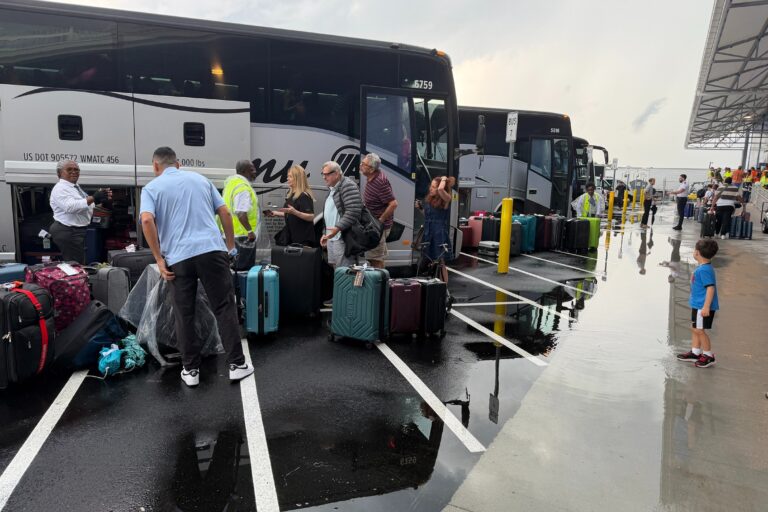
Travelers arrived by tour bus at Philadelphia's new cruise terminal. (Meir Rinde/WHYY) -
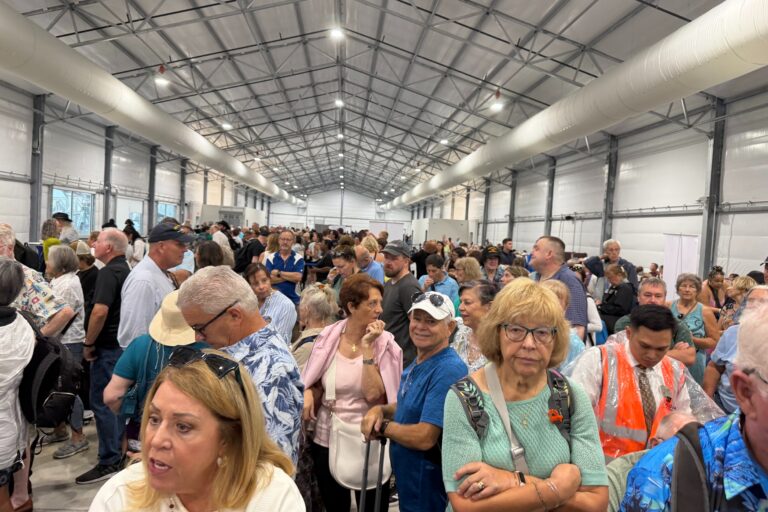
Travelers waited to go through security at PhilaPort's new cruise terminal before boarding the Norwegian Jewel cruise ship. (Meir Rinde/WHYY) -
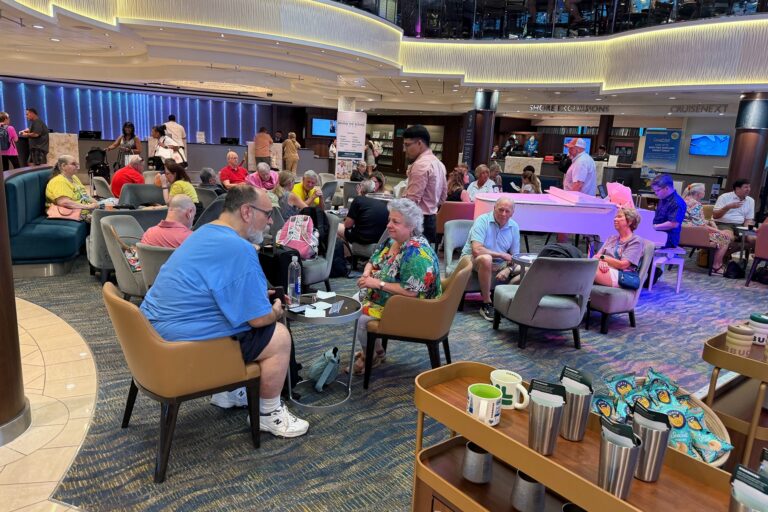
Passengers relaxed in the central atrium of the Norwegian Jewel cruise liner as they waited to depart from Philadelphia's new cruise terminal. (Meir Rinde/WHYY) -

Steve Levin of South Jersey, left, and Lucinda and Michael Oates of Hubbardston, Mass., sat in the Spinnaker Lounge of the Norwegian Jewel cruise liner as they waited to depart from Philadelphia's new cruise terminal. (Meir Rinde/WHYY)
PhilaPort and Norwegian Cruise Line began planning the resumption of cruises four years ago, port officials said. The company signed a seven-year agreement with the port and committed to 41 sailings per year to destinations such as Bermuda, the Bahamas and Canada.
In December, contractors broke ground for a new terminal on Hog Island in Tinicum, alongside Philadelphia International Airport, but work was slowed by harsh, icy conditions on the river, and the project cost jumped from $40 million to more than $60 million.
Norwegian began welcoming passengers aboard the Norwegian Jewel at the partly completed terminal in April. The Jewel is a 20-year-old mid-size ship that can accommodate 2,330 guests.
“It’s kind of a low-risk opportunity to see how well they can do selling it,” Kwortnik said. “What’s the ticket revenue look like? Are people going on board, and do they spend a lot of money in the bars and casino and things like that?”
Kwortnik said the Caribbean is very competitive. “So [they’re] looking for an opportunity to maybe to get to a different home market and offer a different product when they don’t have any competition doing it … It’s an interesting play for them,” he said.
Norwegian Executive Vice President Daniel Farkas said the Norwegian Pearl will take over for the Jewel in November and offer five- and 15-day cruises to Bermuda, the Caribbean, the Bahamas, Canada and New England through April 2028. The Norwegian Gem will start sailing from Philadelphia to Bermuda and the Atlantic Coast in summer 2028, he said.
Related Content

A futuristic, hybrid-electric aircraft took flight at a test demo in Philadelphia
As a next-generation aircraft is tested at the Tioga Marine Terminal in Port Richmond, entrepreneurs and elected officials hope to reap economic benefits.
1 month ago
Listen 2:19‘Family-sustaining jobs’
Parker and other officials on Thursday touted the expected job-creation benefits of the new terminal and cruises and the broader rejuvenation of the city’s ports and waterfront.
“Every ship that comes through here brings thousands of people into the region, staying in our hotels, visiting our restaurants and attractions, and supporting jobs right here on the waterfront,” said PhilaPort CEO Rich Lazer, who said his grandfather and other family members worked on the city’s docks.
“I grew up in a working-class neighborhood where the port provided family-sustaining jobs and opportunity for generations. This port and the diversification of the work we do here helps support families for the next generation,” he said.
PhilaPort released an economic impact analysis by the firm Parker Philips in 2024 that projected that a new cruise terminal that provides 40 calls, or sailings, a year would generate $295.9 million in economic output from employment, hotel stays, ship supplies and other activity, as well as $1.1 million in county tax revenue and $11.1 million in state tax revenue.
If the number of departures increases to 52 a year, the number of jobs would rise to 2,322, wages to $114.9 million and economic output to $315.5 million, according to the projection.
-
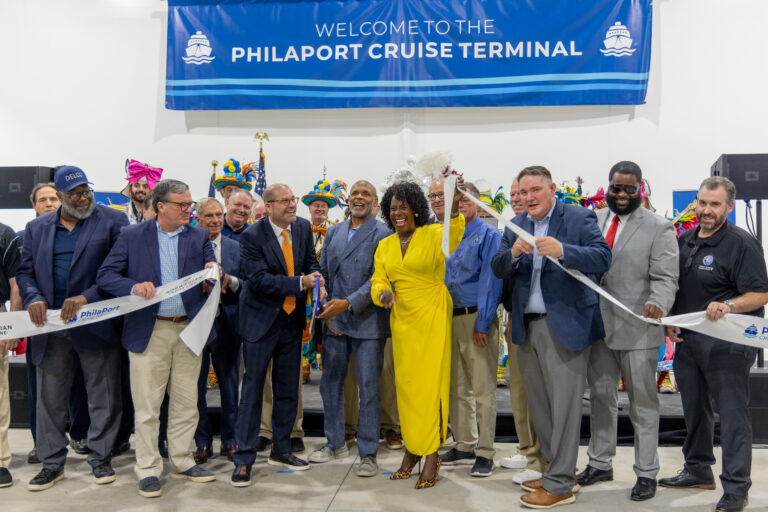
Philadelphia Mayor Cherelle Parker and other officials helped cut the ribbon at the newly opened Philaport Cruise Terminal in Tinicum, Pa., on Aug. 27, 2026. (Kimberly Paynter/WHYY) -
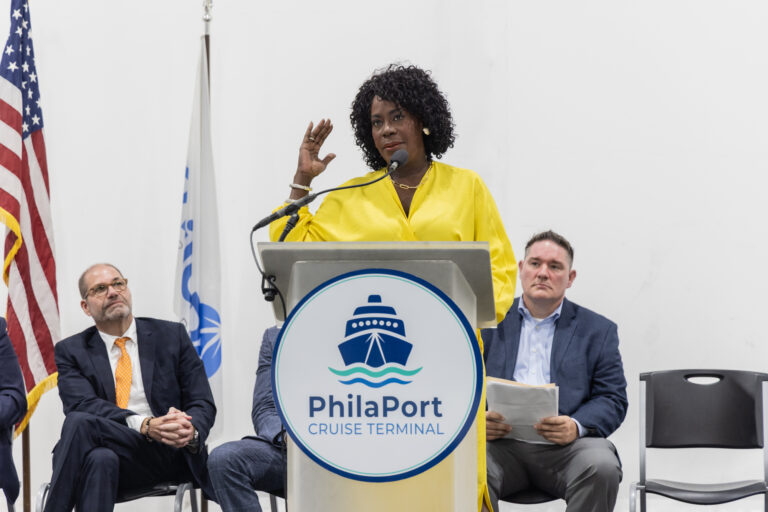
Philadelphia Mayor Cherelle Parker speaks at the grand opening of the PhilaPort Cruise Terminal in Tinicum, Pa., on Aug. 27, 2026. (Kimberly Paynter/WHYY) -
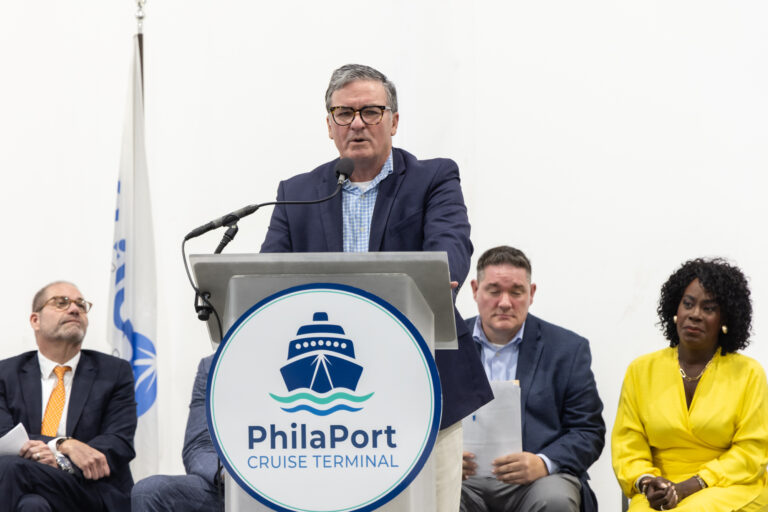
Michael Carroll, Pa. Secretary of Transportation spoke at the grand opening of the PhilaPort Cruise Terminal in Tinicum, Pa., on August 27, 2026. (Kimberly Paynter/WHYY) -
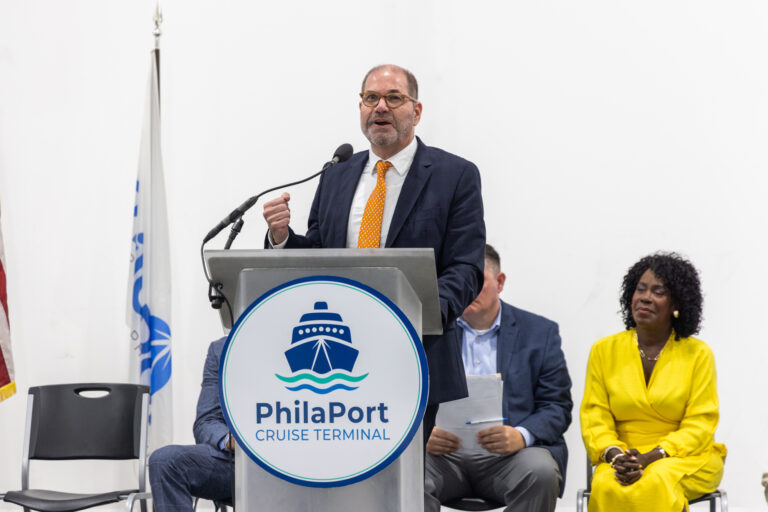
Dan Farkas, EVP and General Counsel at Norwegian Cruise Line, speaks at the grand opening of the PhilaPort Cruise Terminal in Tinicum, Pa., on Aug. 27, 2026. (Kimberly Paynter/WHYY) -
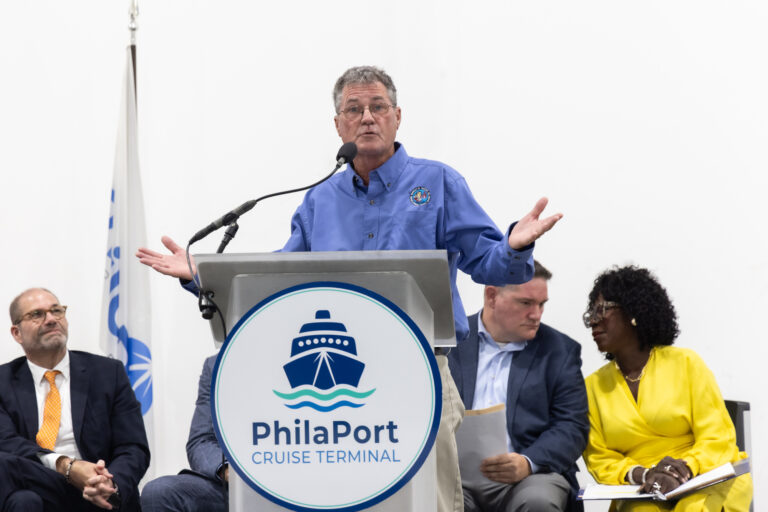
Pat McCarthy, president of the Tinicum Township Board of Commissioners, speaks at the grand opening of the PhilaPort Cruise Terminal in Tinicum, Pa., on Aug. 27, 2026. (Kimberly Paynter/WHYY) -
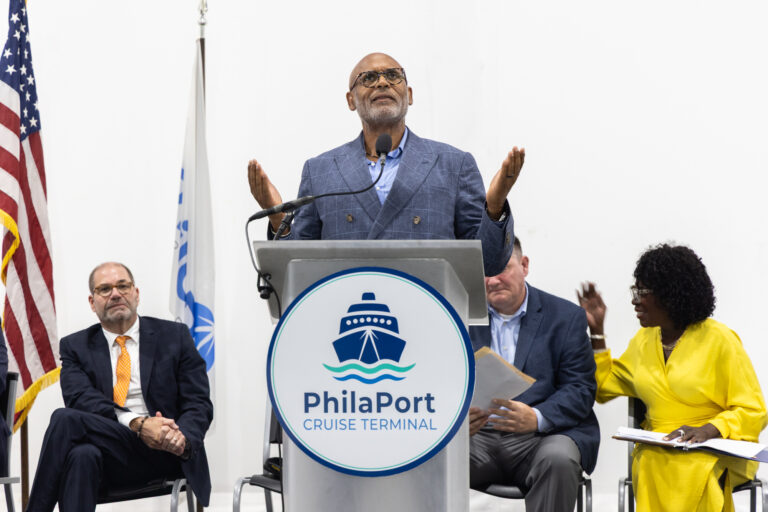
Michael Pearson, chairman of PhilaPort, speaks at the grand opening of the PhilaPort Cruise Terminal in Tinicum, Pennsylvania, on Aug. 27, 2026. (Kimberly Paynter/WHYY) -
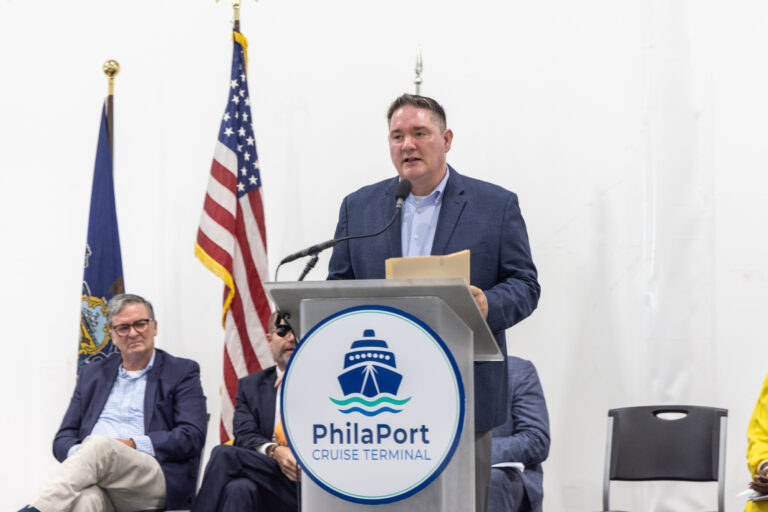
Rich Lazer, executive director and CEO of PhilaPort, speaks at the grand opening of the PhilaPort Cruise Terminal in Tinicum, Pa., on Aug. 27, 2026. (Kimberly Paynter/WHYY)
However, Kwortnik said the figures appear to assume that the terminal alone will generate about 1,700 jobs and $85 million in wages regardless of the number of calls, which “seems high for a cruise port that will see just 40 to 50” sailings per year.
That suggests the total impact on wages will be lower than $108 million a year, he said, and would result in a lower overall economic output figure.
“You’re going to get some benefit to hotels, restaurants, rideshare, things like that, but it’s not going to necessarily be really that big,” Kwortnik said.
“For Philadelphia, and the waterfront in particular, the publicity benefit is probably more important. I’ve been seeing a lot of media attention to this in the travel trade. They’re talking about Philadelphia being the newest of the older ports being developed again,” he said. “It’s putting Philadelphia on the map once again as a destination.”

Get daily updates from WHYY News!
WHYY is your source for fact-based, in-depth journalism and information. As a nonprofit organization, we rely on financial support from readers like you. Please give today.

A day spent doing demolition work offers volunteers a firsthand look at Philadelphia’s housing challenges — and how communities respond to them.
2 hours ago
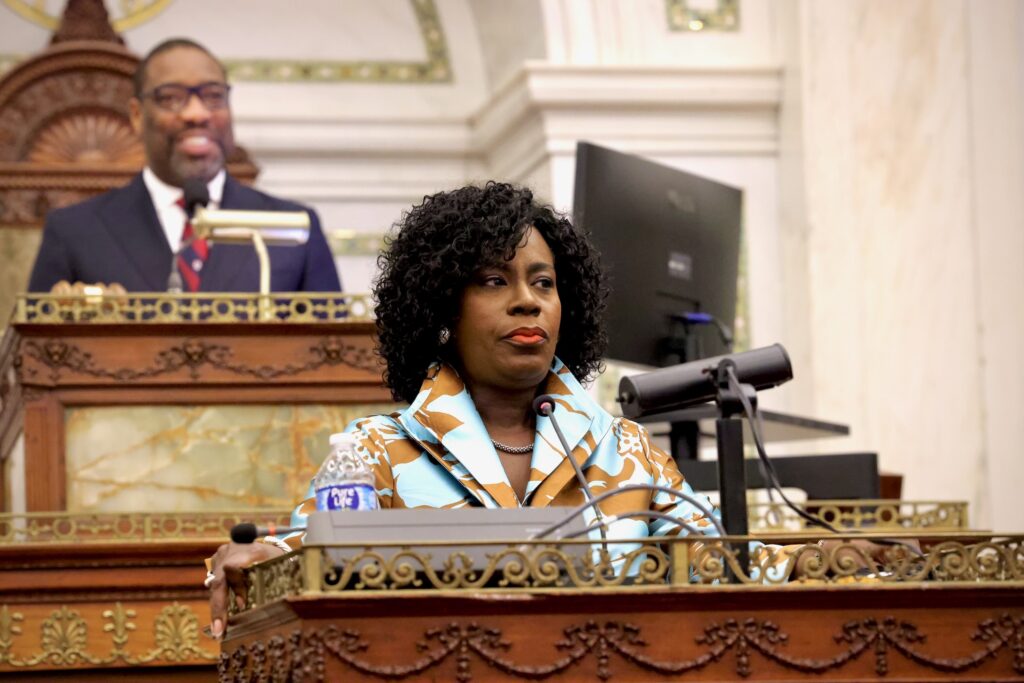
The total is more than half of the plan’s 30,000-unit goal. The milestone comes as the administration prepares to submit its first report on the plan.
1 week ago
Listen 1:02
SEPTA unveils wishlist for improvements and upgrades, but no sign of funding to make it happen
SEPTA’s blueprint for “best-in-class” service includes new vehicles and shorter wait times, but it all hinges on consistent funding, which doesn’t exist yet.
1 week ago
Listen 1:16