

A South Philadelphia startup is making underwater military drones in a former kitchen countertop showroom
Less than two years after a Wharton dropout co-founded it, Albacore has $10 million in investments and a contract to supply the U.S. Navy.

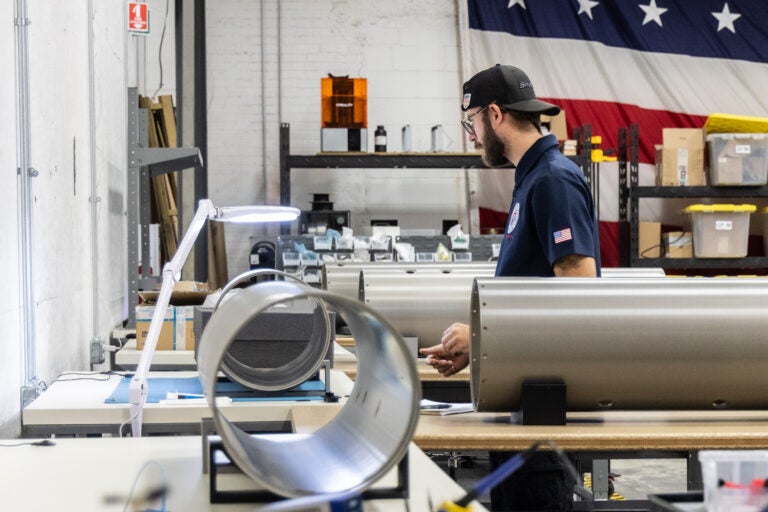
Submarine drone manufacturer Albacore currently has about 25 full-time employees. (Kimberly Paynter/WHYY)
From Philly and the Pa. suburbs to South Jersey and Delaware, what would you like WHYY News to cover? Let us know!
Past the grand staircases and displays of countertop slabs in a former marble and granite showroom on Washington Avenue, a worker sat bent over a cylindrical metal device about 6 feet long, poking at electronic components attached to its surface.
It was the partly built innards of an undersea drone, a sort of remote-controlled micro-submarine capable of traveling 1,000 nautical miles and carrying a 250-pound weapons payload designed to destroy military ships.
“The technology that we are developing here is basically a scaled-down version of what was used in World War II submarines,” said Dante Vaisbort, a cofounder of Albacore, the company that makes the drones. “We have basically the shrunk-down version of what was used in World War II, but in a mass-producible, autonomous form factor.”
Initially tested in the Schuylkill River and more recently in Florida, the devices will soon be delivered to the U.S. Navy, Taiwan and other buyers the company declined to identify.
-
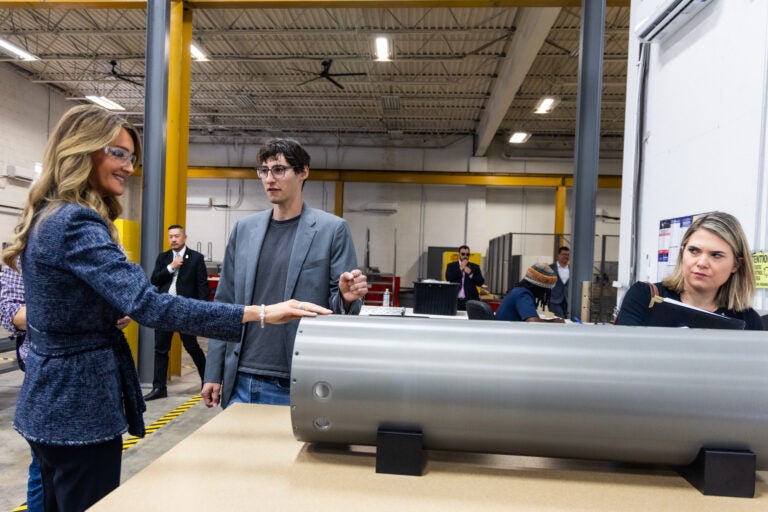
Dante Vaisbort, one of Albacore’s founders (center), shows building materials to Kelly Loeffler, U.S. Small Business Administration administrator (left), during a tour of Albacore’s submarine drone manufacturing facility in Philadelphia on Aug. 25, 2026. (Kimberly Paynter/WHYY) -
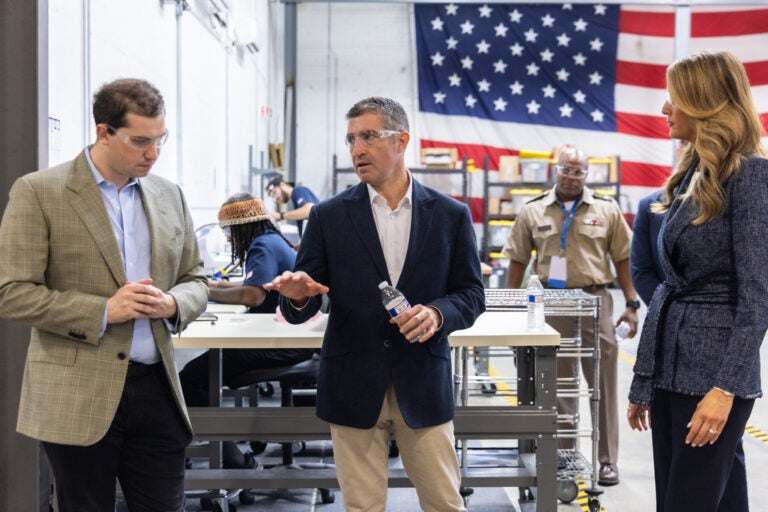
John Huddleston, one of Albacore’s founders (left), talks with Michael Cadenazzi, assistant secretary of war for Industrial Base Policy (center), and Kelly Loeffler, U.S. Small Business Administration administrator (right) during a tour of Albacore’s submarine drone manufacturing facility in Philadelphia on Aug. 25, 2026. (Kimberly Paynter/WHYY) -
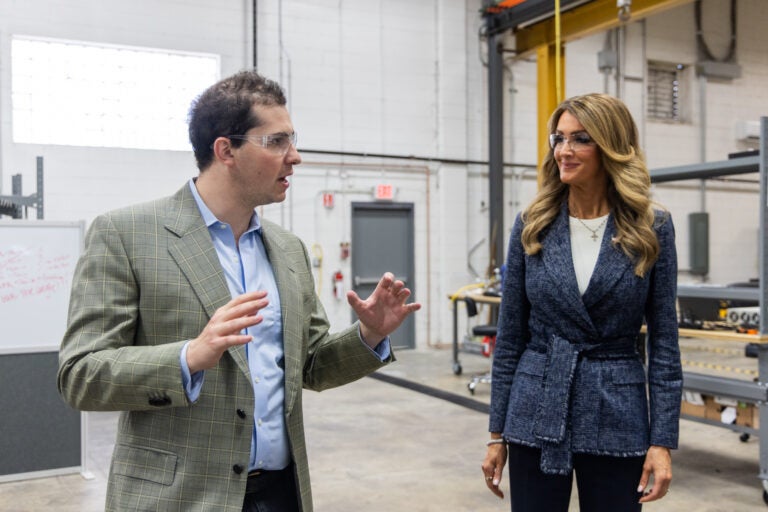
John Huddleston, one of Albacore’s founders (left), gives a tour of their Philadelphia manufacturing plant to U.S. Small Business Administration Administrator Kelly Loeffler (right) on Aug. 25, 2026. (Kimberly Paynter/WHYY) -
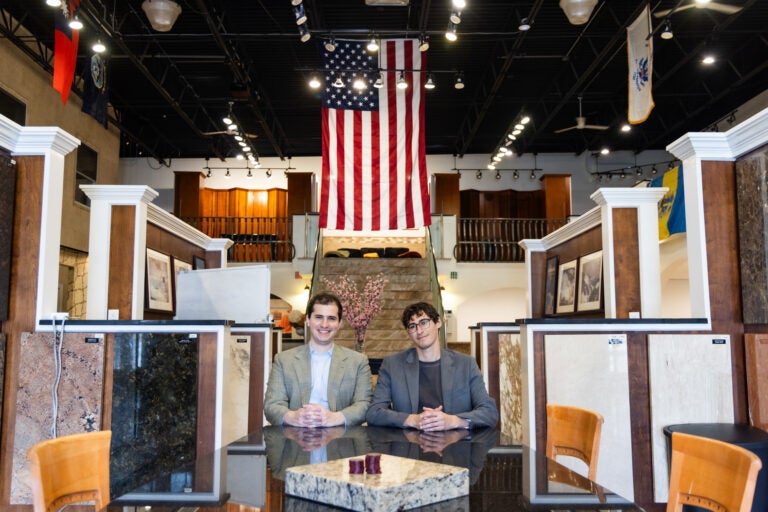
Founders John Huddleston (left) and Dante Vaisbort (right) inside Albacore, a submarine drone manufacturer in Philadelphia which took over a warehouse that was home to a marble and granite showroom. (Kimberly Paynter/WHYY) -
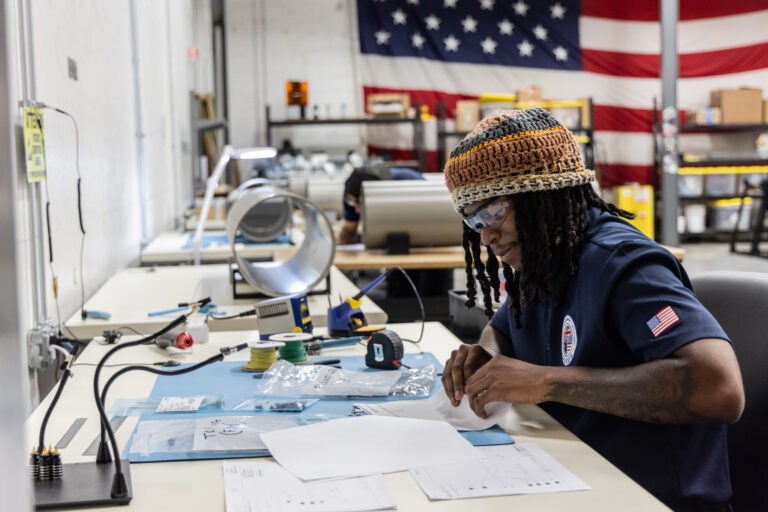
Submarine drone manufacturer Albacore currently has about 25 full-time employees. (Kimberly Paynter/WHYY)
Officials from the federal Small Business Administration and the Department of War toured the facility Tuesday to tout the economic impact of the defense industry and the government’s efforts to boost home-grown production of weaponry and military equipment.
“We’re here at a small business just to show what small businesses mean to our defense industrial base,” SBA Administrator Kelly Loeffler said during the tour. “This is happening in Pennsylvania, in downtown Philadelphia. This is what’s possible in America when we put in resources, get the government out of the way, and let our innovators build in America.”
Related Content
A futuristic, hybrid-electric aircraft took flight at a test demo in Philadelphia
As a next-generation aircraft is tested at the Tioga Marine Terminal in Port Richmond, entrepreneurs and elected officials hope to reap economic benefits.
1 week ago
Listen 2:19Filling a ‘massive gap’ in technology
Albacore was founded just 20 months ago, in early 2025, after Vaisbort moved from Los Angeles to Philadelphia and teamed up with cofounder John Huddleston, who was attending the University of Pennsylvania’s Wharton School’s master of business administration program and lived near Rittenhouse Square.
“We started building prototypes, and all of a sudden we had taken over my entire apartment. I took my couch out of the apartment, and it became a wall of 3D printers and parts,” said Huddleston, who subsequently dropped out of school. “We started assembling this prototype on my kitchen table.”
They soon got backing from Y Combinator, a startup accelerator and venture capital firm, and attracted additional investment led by Outlander VC and several other U.S. and foreign investors, Tectonic Defense reported in October. The company says it has received more than $10 million in investments.
Four months ago, Albacore moved into the 20,000-square-foot former Colonial Marble & Granite showroom building at 20th Street and Washington Avenue.
-
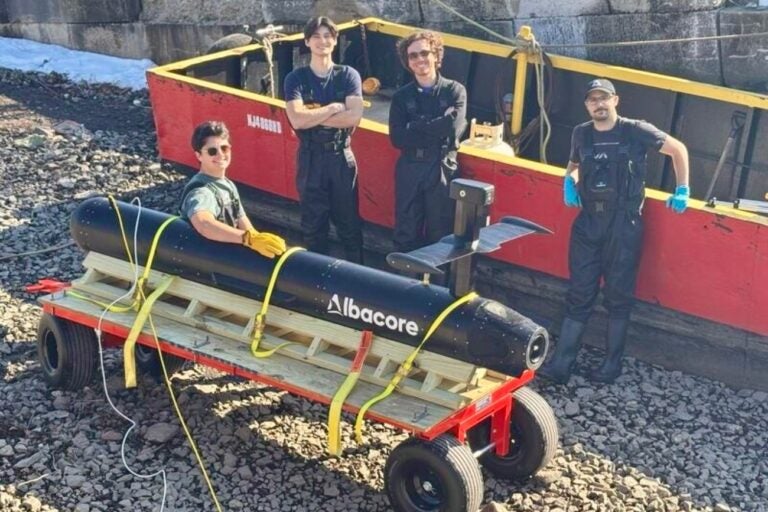
Employees of Albacore, a South Philadelphia tech startup, tested their Ghostfin drone submarine in the Schuylkill River earlier this year. (Courtesy of Dante Vaisbort/Albacore) -
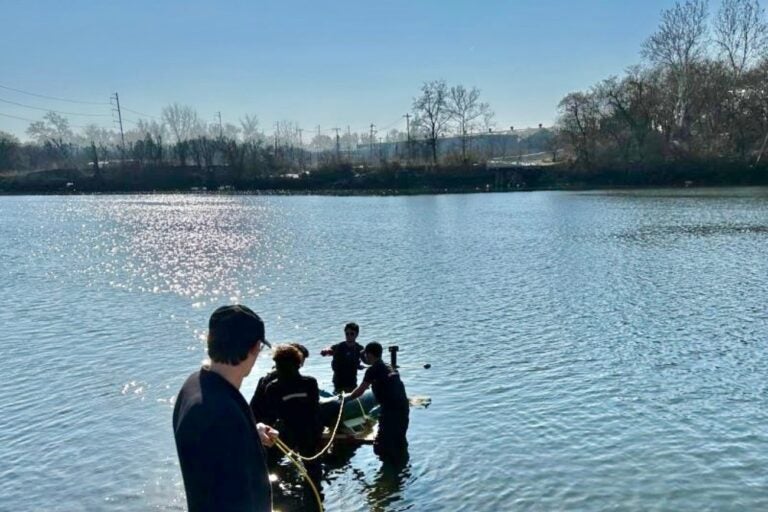
Employees of Albacore, a South Philadelphia tech startup, tested their Ghostfin drone submarine in the Schuylkill River earlier this year. (Courtesy of Dante Vaisbort/Albacore)
Albacore’s product, called Ghostfin, is about 8 feet long when fully assembled, weighs 425 pounds, and can last 30 days in the water. The company says it has a novel battery design that “radically extends” the vehicle’s range and endurance compared to older technologies for unmanned undersea use.
“Especially after the war in Ukraine started, it became so clear to so many people that unmanned systems were the future, and that the United States was really unprepared for that level of warfare,” Huddleston said.
“We’ve seen companies … manufacturing [unmanned] quadcopters,” he said, referring to the familiar four-propeller aerial drones, “but there really hasn’t been something in the equivalent for the undersea. That’s where we saw this massive gap, and created this product to really address that issue.”
Vaisbort cited Philadelphia’s long shipbuilding history, and recent big investments in Hanwha Philly Shipyard and the Port of Philadelphia, as factors that led the company to set up shop here.
“There’s a huge groundswell of support for maritime in Philadelphia, and given how close we are to New York, with access to capital there, as well as Washington, D.C., and other areas nearby where the customers and end users actually are for this product, it made a lot of sense for us to be based in Philadelphia,” he said.
Last month, Hanwha was selected for a $2 billion project to build two missile-tracking vessels for the U.S. military. It has built four national security multimission vessels to train merchant mariners, with a fifth on the way.
Related Content

A recent Brookings report found that a lack of economic coordination has led to Philly falling behind other cities and the loss of thousands of jobs.
4 months ago
Listen 1:09‘Like building Legos’
Albacore intends to initially build 75 vehicles per year at its South Philadelphia facility and would like to eventually produce several thousand units. The founders identified coastal defense — of an island like Taiwan, for example — as a prime use case for the devices.
“As we think about theater-level deterrence, especially in the Indo-Pacific, these each can do severe damage to gray-hulled vessels,” Huddleston said, referring to military ships. “If you have enough of these in a waterway, it makes it very difficult to do any island invasions. We started this because we wanted to prevent the next war from even starting, and we believe that that peaceful deterrence through strength is really the way to do that.”
The vehicles can also be used for commercial surveys of oil and gas areas and of minerals on the sea floor, and to collect data for oceanic research, he said.
The company has 25 people on staff and employs additional contractors and technicians, and plans to at least triple its headcount over the next year, the founders said. The workers include recent high school and college graduates, as well as more experienced staff who came from other aerospace manufacturers, said Andrew Wong, Albacore’s associate director of federal affairs.
“We want to give young people a chance to build something great for the country,” he said. “It’s a job that anyone can do, really. It’s almost like building Legos — very complicated Legos, albeit.”
Albacore’s website lists a dozen job openings, including for mechanical, electrical and software engineers.
Loeffler noted that the U.S. defense industrial base consists of 70% small businesses like Albacore. She said changes in tax regulations championed by the Trump administration were making it easier for them to succeed, including immediate expensing for research and development, 100% expensing for capital investment and a deduction for overtime pay.
“One of the biggest pain points of small businesses today is they want to hire more workers,” she said. “We have half a million jobs open in manufacturing today, and that’s why this administration is focusing on rebuilding the industrial base — because it provides not just national security, but economic opportunity.”

Get daily updates from WHYY News!
WHYY is your source for fact-based, in-depth journalism and information. As a nonprofit organization, we rely on financial support from readers like you. Please give today.
Philly tenant unions have quadrupled since the pandemic — and their political power is growing
From new protections and lawsuits to collective bargaining, organized renters are testing new ways to hold landlords accountable.
23 hours ago
Listen 6:15
Pa. election 2026: Voter guides, key races and more
Election Day is Tuesday, Nov. 3. Here’s what you should know beforehand, from voter deadlines to who’s on the ballot in Philadelphia and statewide.
2 days ago
Clubs, bars and nonprofits say revenue from the machines helps keep their doors open as lawmakers weigh regulation.
5 days ago