

The Philly-area economy is ‘sluggish,’ report suggests. A new partnership says family-sustaining wages are key to reversing it
A recent Brookings report found that a lack of economic coordination has led to Philly falling behind other cities and the loss of thousands of jobs.
Listen 1:09
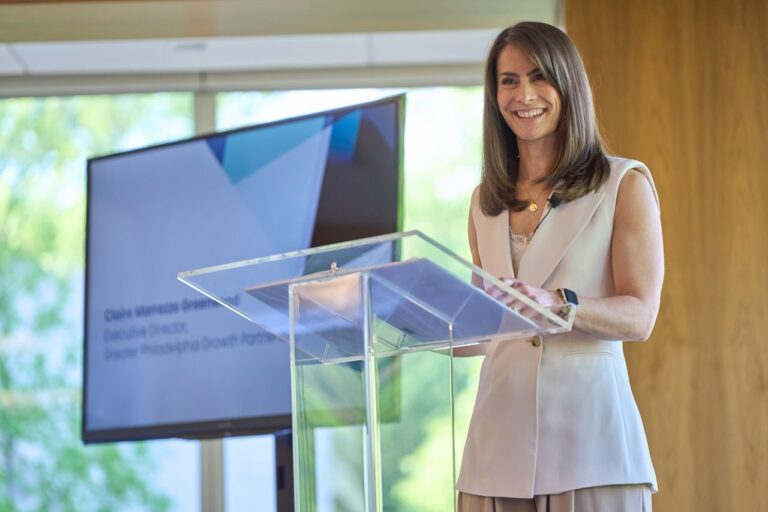
Claire Marrazzo Greenwood, executive vice president for economic growth with the Philadelphia Chamber of Commerce, announces the launch of the Greater Philadelphia Growth Partnership at the Inn at Villanova Tuesday morning, May 5, 2026. (Courtesy of Philadelphia Chamber of Commerce/WHYY)
From Philly and the Pa. suburbs to South Jersey and Delaware, what would you like WHYY News to cover? Let us know!
A new regional business coalition launched on Tuesday to help reverse years of slow job growth and make the Philadelphia area more nationally competitive.
The Greater Philadelphia Growth Partnership, or GPGP, will spearhead a long-term economic strategy focused on creating more “opportunity jobs” — positions that offer family-sustaining wages or a pathway to them.
Claire Marrazzo Greenwood will serve as executive director.
“The Greater Philadelphia Growth Partnership will attract new businesses to our region, help our existing businesses expand and grow and connect talent to employer demand,” Greenwood, who was simultaneously promoted to executive vice president for economic growth with the Philadelphia Chamber of Commerce, said. “We’ve spent several years as we’ve shared doing the data-driven planning and strategy development work to get this right. So now we have to put it into action.”
The Greater Philadelphia Growth Partnership is a regional effort across five counties to boost job growth and improve economic mobility. It began with planning led by The Pew Charitable Trusts, with support from Brookings Institution, and is now run with help from the Chamber.
The partnership will focus on areas leaders say have long been underdeveloped, including business attraction, international investment, research and workforce development. Backed by $5.4 million in initial funding from corporate and philanthropic investors, the effort aims to improve long-term coordination and economic growth across sectors.
Last year, Brookings released a report finding that the Southeastern Pennsylvania region is facing significant challenges in competing with high-performing peers such as Atlanta, Boston, and Phoenix.
The finding contrasts with perceptions of the region as a national hub for life sciences, healthcare and education — colloquially referred to as “eds and meds” — with a number of industry strengths, such as workforce and infrastructure. But the region “lacks a unified, tactics-level strategy and workplan to guide economic and workforce development efforts,” according to the report.
As a result, the region missed out on roughly 70,000 “opportunity jobs” in traded industries between 2012 and 2023. It now ranks last among large U.S. regions in upward mobility among low-income residents and faces a shortfall of more than 188,000 jobs compared to expected growth based on the national average.
Related Content

Philadelphia is set to spend big on U.S. 250th celebrations
A new city controller report states the events could contribute between $1.3 to $2.5 billion to the city’s economy.
7 months ago
How the Philly area got here
Project leaders say the problem stems from years of underinvestment in economic development and poor coordination among employers, educational institutions and local governments. They say the disconnect has left job seekers unable to fill open positions while employers struggle to find qualified candidates, despite the region’s well-educated workforce.
Those kinds of challenges are what the GPGP is expected to take on, Greenwood said.
“The regions growing faster than us are better organized,” she told an audience during the launch announcement at Villanova University. “They are more focused. They are more invested. They made a decision to act together and they built the tools to do it. So that’s what we’re doing.”
Wawa CEO Chris Gheysens likened it to geese when they fly in formation with those in front providing draft for those behind them.
The partnership “asks all of us to move together, forward together, aligned as a region, not as individual entities. At Wawa, we call it flying in V formation,” he said. “It makes us stronger. And actually when geese fly in V formation, they fly further and more efficiently.”
From potential to prosperity
The launch of the new initiative coincided with the release of a detailed strategy report, “From Potential to Prosperity,” which outlines how leaders plan to translate the region’s strong assets into sustained economic gains.
The strategy focuses on three “opportunity industries,” including biomedical engineering and production, enterprise digital solutions and precision manufacturing in industrial technologies, chosen for their ability to generate jobs accessible to non-college-educated workers while strengthening the region’s position in national and global markets.
“Growth alone isn’t enough,” said Philadelphia Works CEO Patrick Clancy. “But when we pair growth with investments connecting people to opportunity, our region can finally realize its potential.”
Donna Frisby-Greenwood, senior vice president at The Pew Charitable Trusts, added that the partnership’s work would help local families “flourish,” especially if done alongside support like housing, childcare and access to public benefits and other efforts to improve other systems.
“Joining forces to accelerate growth is critical to making progress on economic advancement,” she said at the launch. “When we are working together to do all of these things, our region can realize its potential to create a thriving economy that benefits everyone.”
The report’s comprehensive list of goals includes:
- Building regional growth capacity
- Focus on opportunity industries
- Connect talent to opportunity
The strategy also involves better coordination across Philadelphia and its suburban counties, Bucks, Chester, Delaware and Montgomery, an area that encompasses 4.2 million residents and a $355 million economy.
“The partnership will enhance our work in each individual county by providing the regional coordination and shared structure that will be a force multiplier for maximum impact,” Montgomery County Commerce Director Stephen Forster, who was involved in the strategy report’s development, said at the launch. “I’ve seen new levels of engagement and collaboration across our economic and workforce development colleagues.”
Disclosure: Pew Center for Arts & Heritage is among WHYY’s financial supporters. WHYY News produces independent, fact-based news content for audiences in Greater Philadelphia, Delaware and South Jersey.

Get daily updates from WHYY News!
WHYY is your source for fact-based, in-depth journalism and information. As a nonprofit organization, we rely on financial support from readers like you. Please give today.
Philadelphia is set to spend big on U.S. 250th celebrations
A new city controller report states the events could contribute between $1.3 to $2.5 billion to the city’s economy.
7 months ago
Greater Philadelphia immigrants fuel population, economic growth, report says
Here are six key takeaways from the report and a panel discussion hosted by The Welcoming Center and WHYY on Thursday.
1 year ago
Listen 1:00
2 Philadelphia researchers concerned with losing federal dollars for gun violence prevention
President Donald Trump proposed cuts to gun violence research that some experts say could cost lives.
1 year ago
Listen 0:59