

Delaware lawmakers propose adding $87M to FY2027 budget, exceeding governor’s growth cap
Lawmakers targeted improvements in education and child care, focusing on early education and underserved students.
Listen 0:51
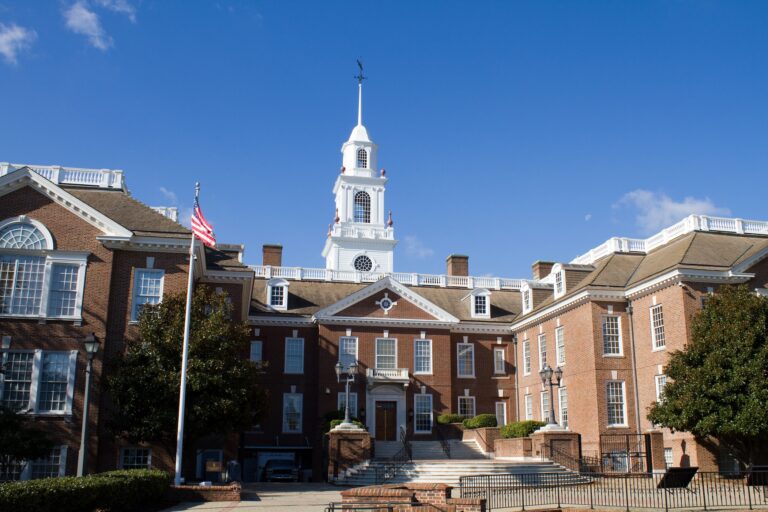
Legislative Hall in Dover, Delaware. (sframephoto)
What are journalists missing from the state of Delaware? What would you most like WHYY News to cover? Let us know.
Delaware state lawmakers are one step closer to passing a budget by the end of the month.
The Joint Finance Committee, known as JFC, recently finished marking up Gov. Matt Meyer’s $6.9 billion recommended budget for fiscal year 2027, which included nearly $29 million in one-time supplemental spending.
The committee added $87.4 million in general revenue to the governor’s proposed operating budget, for a total of about $7 billion, according to the state controller general’s office. It also hiked one-time spending to $146.2 million, an increase of about $117.2 million over Meyer’s supplemental allocations.
Meyer said he supports the group’s results, which raised growth of spending to 6.3%, although it’s above his vow to constrain spending growth to less than 5%.
JFC was able to add spending partly because the Delaware Economic and Financial Advisory Council, known as DEFAC, recently projected an additional $196 million in new revenue for fiscal year 2027. After DEFAC meets again on June 15, lawmakers will file the budget and one-time supplemental bills. State lawmakers must pass a budget to send to Meyer by June 30.
While adding more money to the next year’s budget, as in previous years, the committee didn’t touch the state’s $366 million rainy day fund or the $469 million Budget Stabilization Fund.
There are philosophical differences among members of the state legislature and even the governor on what should be done when the state has additional revenue.
Meyer told reporters he believed that the state should be either refunding it to residents or spending it on them.
“I’m a strong believer that when you have additional revenue, you don’t just put it away for some day in the future,” he said. “If we’re taking money from you, the private citizen of Delaware, I think we should take it and spend it. We shouldn’t just sock it away for some future day.”
JFC Chair state Sen. Trey Paradee, D-Dover, said the governor’s recommended budget established a strong starting place to create a bipartisan final draft. However, Paradee said that he opposed spending money the state has been putting into savings.
“Just like any family doing their financial planning at their kitchen table, you always need to have some money in reserve in case you need a new roof on the house, or your car breaks down and needs repairs,” he said. “That’s really what this is about, responsible, sustainable budgeting.”
The committee’s fiscal 2027 budget makes investments in key areas, including education, child care and workforce retention.
Related Content

Delaware officials present updated corporate franchise numbers for the first time in 2 years
Gov. Matt Meyer fired former DEFAC chair Mike Houghton days after WHYY News reported on concerns he had over a lack of data.
5 months ago
Listen 1:19Investments in education
JFC restored some of the cuts in Meyer’s recommended budget, including block grants for athletic trainers and substitute teachers. The Wilmington Learning Collaborative, which saw its $10 million budget reduced to $2 million in the governor’s proposal, got $3 million back through JFC, which gives it $11 million for the next fiscal year. It also reinstated $26 million in fiscal year 2018 funding cuts. Members also included $800,000 in rental assistance for families with school-aged children facing homelessness.
The committee also earmarked $100 million of one-time funding in anticipation of the state implementing a revamp of the public education funding formula. The new hybrid formula is aimed at giving more money to low-income and multilingual learners who have been disproportionately underfunded by the current system. Legislation beginning the formula overhaul has passed the state Senate and is awaiting consideration in the House.
Paradee said legislation raising business formation fees, along with the additional money projected by DEFAC, allowed them to raise the $100 million.
“We didn’t want to see that money just disappear, and we felt that it was very important to sock it away,” he said. “That was the smart, responsible, dare I say conservative, approach to save that for next year, when we’re likely going to need it.”
Commitments to child care
JFC members also invested $26.4 million in policy changes to its Purchase of Care program, which subsidizes child care for low-income families, bringing the total state support of Purchase of Care to $107 million. The changes include increasing the income limit for eligibility and raising the reimbursement rate for kids aged up to 5 years old and for children with special needs.
JFC Vice Chair state Rep. Kim Williams, D-Stanton, said those moves by members show a continued commitment to helping working families.
“Instead of piecemealing it, we hope to have more of a really thoughtful early learning plan moving forward,” she said.
Workforce retention and development
The budget soon heading to lawmakers includes $146.9 million for raises and benefits for state employees, including educators.
People who work in education in Delaware would receive a raise of at least 3%, but teachers, nurses and other non-administrative staff would get additional increases as recommended by the Public Education Compensation Commission, continuing toward the promise of making $60,000 the starting salary for teachers.
State employees would get a 3% raise for the sixth year in a row, and more than $16.2 million would go to cover the state’s share of employee and retiree health insurance premiums.

Never miss a moment with the WHYY Listen App!


WHYY is your source for fact-based, in-depth journalism and information. As a nonprofit organization, we rely on financial support from readers like you. Please give today.
Part of the series

The town council voted in favor of starting a repeal process for the divisive ordinance last month. The planning commission says there’s not enough evidence to support it.
1 week ago
Listen 1:06
GOP U.S. House candidate Joseph Arminio was removed from a candidate forum Thursday after repeatedly misgendering Democrat U.S. Rep. Sarah McBride.
2 weeks ago
Listen 0:59
Mike Kozikowski, the six-term recorder of deeds, was defeated after WHYY News exposed his offer of a job that Councilman Dave Tackett couldn’t take.
2 weeks ago
Listen 1:37