

A futuristic, hybrid-electric aircraft took flight at a test demo in Philadelphia
As a next-generation aircraft is tested at the Tioga Marine Terminal in Port Richmond, entrepreneurs and elected officials hope to reap economic benefits.
Listen 2:19
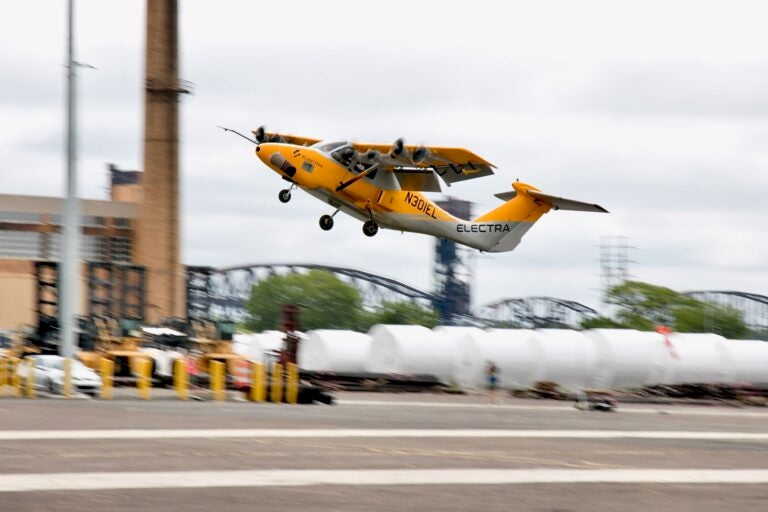
The Electra 2, an ultra-short takeoff, hybrid-electric plane, takes of from Tioga Marine Terminal for a short test flight to North Philadelphia Airport. (Emma Lee/WHYY)
From Philly and the Pa. suburbs to South Jersey and Delaware, what would you like WHYY News to cover? Let us know!
As if lifted by a sudden puff of wind, a small, yellow airplane festooned with propellers rose steeply from an expanse of asphalt on the north Delaware River waterfront and slowly buzzed away.
“Most passengers have described flying the airplane as like being on an elevator,” said J.P. Stewart, a senior vice president at Electra, a Virginia aircraft manufacturer. “It takes off and lands in six or seven seconds — it just immediately levitates off the ground, and climbs out like an elevator.”
Stewart had come from Manassas, Virginia, to the Tioga Marine Terminal in Port Richmond on Monday morning to test and show off his company’s hybrid-electric aircraft. The two-person prototype plane has a turbogenerator that turns fuel into electric power, and propellers that create more wind for the wings, allowing the aircraft to float up from the ground.
“What we’ve got is really a glimpse into the future,” he told a group of business people, aviation students and elected officials who had gathered to watch the plane land at the terminal and take off again.
The visit came in part through a federal program that aims to encourage development of what officials call “advanced air mobility,” including hybrid-electric planes that can serve as air taxis or for short-distance flights — for example, from Philadelphia to Washington, D.C., or New York. Pennsylvania is one of eight states selected to participate.
While Electra plans to eventually manufacture its nine-seat production aircraft in Ohio, Philadelphia officials who watched the flight say they’re looking forward to the business and job-creation benefits that could come from providing infrastructure and maintenance services for planes of the future.
“That’s what we’d like to do here in Pennsylvania and in Northeast Philadelphia,” said state Rep. Ed Neilson, majority chair of the Pennsylvania House Transportation Committee. “We have a training center right there at Northeast Philadelphia Airport to train future mechanics. We have a lot of manufacturing here, but we also want to maintain them and upgrade and make sure everything’s running fine, inspect them. That’s where all the jobs tend to be.”
Related Content
PGW agreed to hold public meetings on reducing its carbon footprint. At the first meeting, there were lots of questions from the public but no answers from the utility.
2 months ago
Listen 1:23‘Too short to fly and too long to drive’
Last September, the Federal Aviation Administration launched the Electric Vertical Takeoff and Landing Integration Pilot Program, under which states and companies develop safety regulations for the new class of aircraft and encourage their development.
It aims to include both piloted and unmanned drones that provide services including short-range air taxis, longer-range fixed-wing flights, cargo flights, logistics and supply for emergency management, as well as medical transport or offshore energy facility transport. The Department of Defense is also investing in Electra and other next-generation aviation firms.
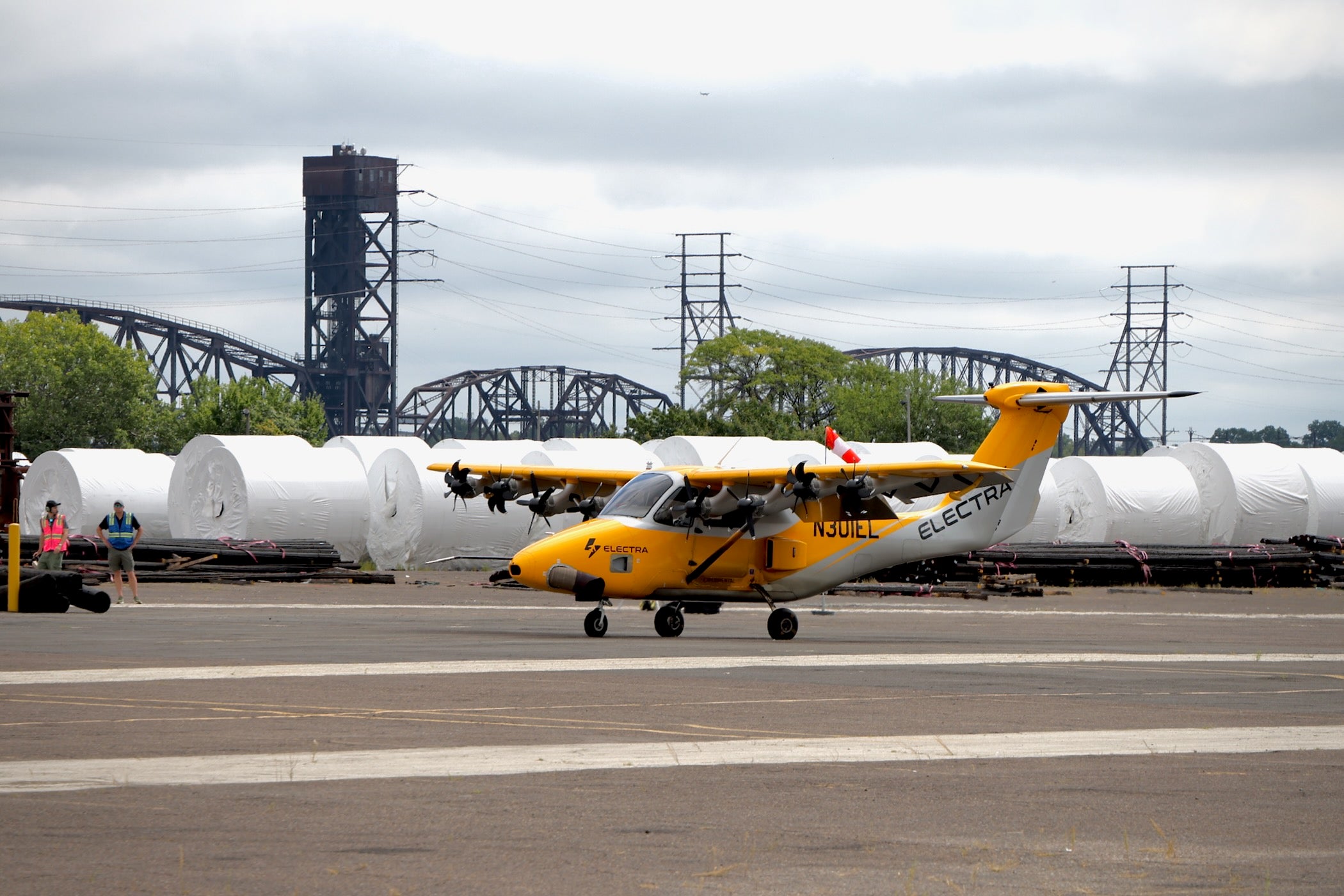
Several companies around the country are developing hybrid-electrics, including aircraft that resemble helicopters and take off vertically, and fixed-wing planes like Electra’s planned EL9 Ultra Short that only need a very small runway.
A corporation could fly the planes out of a corner of a parking lot, or a community that lacks a nearby airport could use a mall lot as the base for a short-hop shuttle service, the company said.
“We’re really trying to solve this regional mobility gap,” Stewart said. “Fifty to 500 miles is a really difficult distance. It’s too short to fly and too long to drive, so there’s really a big gap here where there’s no other good way to go around. This airplane fills that gap, and there are 35 million passenger trips every single day just within that range.”
Electra says it has presold more than 2,200 of the planned aircraft to 60 airlines and other operators; half of them are outside the U.S. It plans to start testing the EL9 next year, obtain FAA certification in 2029 and see the aircraft flying commercially in 2030.
“This is not for the top 1%” Stewart said. “This is average people, trying to take work trips, trying to go on vacation with their family, in this 50 to 500 mile range.”
Related Content
Delaware State University honors Tuskegee Airmen, inspiring the next generation of aviation leaders
Delaware State University's Tuskegee commemoration connects history with opportunity, introducing students to careers in aviation and STEM.
5 months ago
Listen 1:16‘Everything will electrify’
The crowd gathered at the Tioga terminal, the northernmost terminal of the Port of Philadelphia, to watch the prototype EL2 land and take off from an open area bordered by rows of graffiti-covered shipping containers.
The watch party was organized in part by Max Tuttleman, a philanthropist and former City Council candidate. He’s the CEO of LAND, a company that aims to provide a range of services to the hybrid-electric fleets and encourage their development.
“Philadelphia and the Commonwealth of Pennsylvania can be one of the first beneficiaries of this type of technology,” Tuttleman said. “[LAND wants to provide] areas for these aircraft to land and recharge, hangar facilities, the electric infrastructure behind those types of facilities, terminal facilities.”
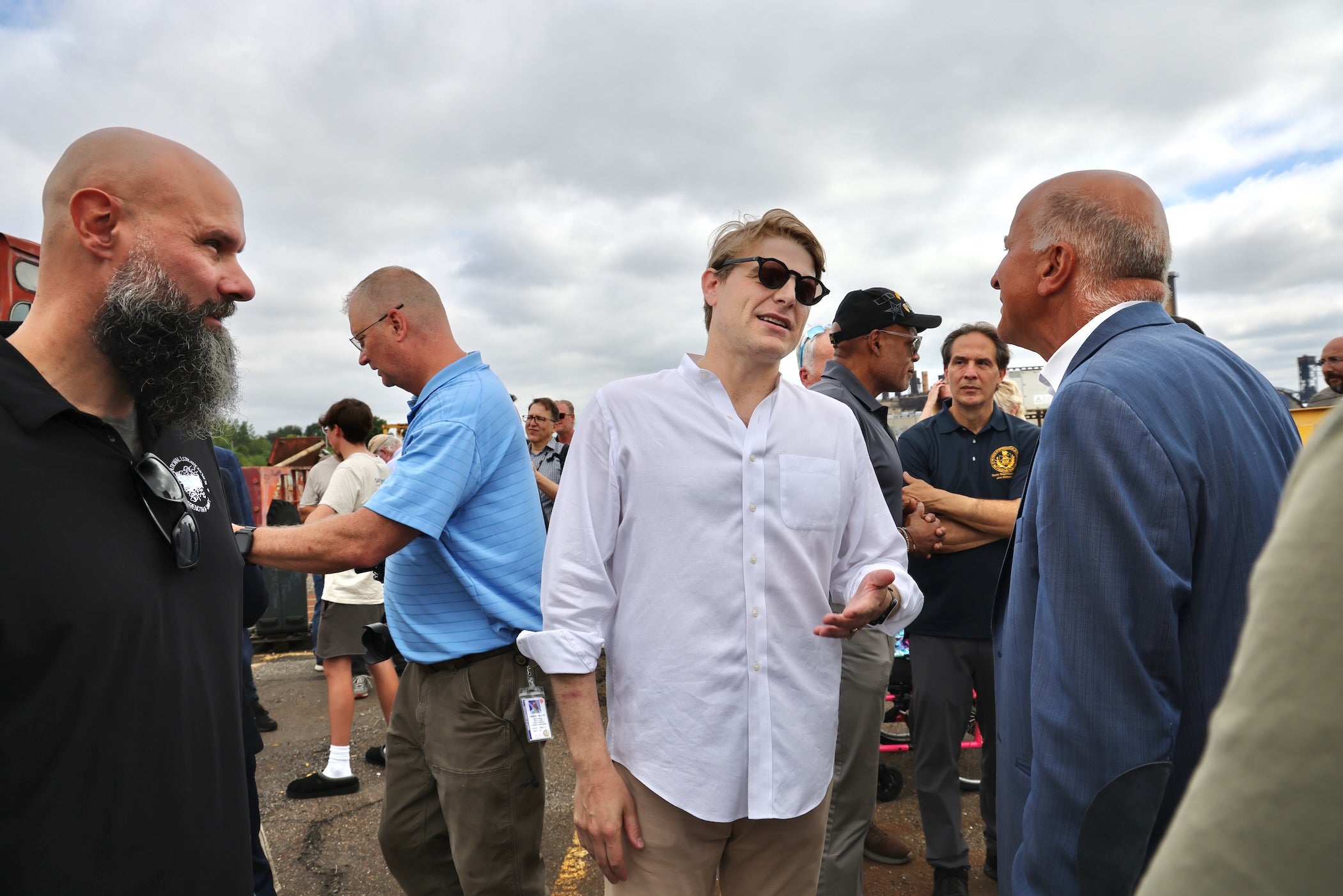
“When we think about the electrification of multimodal transportation and what is to come, everything will electrify. We need places where those vehicles can be homed and hubbed and recharged, so operators are willing to make the capital investment in those types of electric vehicles,” he said.
In addition to Neilson, elected officials on hand included Philadelphia Democrats state Sen. Christine Tartaglione, state Reps. Jared Solomon and Jordan Harris, and City Councilmembers Mark Squilla and Rue Landau.
“Whether it’s cargo or whether it’s travel or whatever it is, we need to really look at how we as a city are going to address the future of transportation,” Squilla said. “I’m excited to see how this works, and looking forward to working with all the stakeholders to bring this to fruition.”
Four students from the Aviation Institute of Maintenance at the Northeast Philadelphia Airport watched the EL2’s landing and takeoff. They said they were wowed by its floaty maneuvering, short takeoff space and innovative power system.
“It was so different from your conventional airliner,” 20-year-old Mekhi Smith said. “The way it moves is unlike anything I’ve ever seen. It’s, like, slicing through air instead of being in air.”
Editor’s note: Max Tuttleman is a supporter of WHYY’s Billy Penn.

Never miss a moment with the WHYY Listen App!


WHYY is your source for fact-based, in-depth journalism and information. As a nonprofit organization, we rely on financial support from readers like you. Please give today.
The Federal Aviation Administration is working on a short-term fix to the problems at New Jersey’s largest airport that includes technical repairs and cutting flights.
1 year ago

Software update keeps Newark airport radar online but network concerns and flight limits remain
The U.S. transportation secretary said the update prevented a third radar outage over the last two weeks at the New Jersey airport. But flight delays continued Monday evening.
1 year ago

Air traffic controllers briefly lose radar access again at Newark airport
For the second time in two weeks, the radar at the facility in Philadelphia that directs planes in and out of Newark Liberty International Airport went black.
1 year ago