
Delaware Department of Education lays out strategic plan as some state lawmakers question program cuts
The state is devoting $8 million to expand early childhood education.

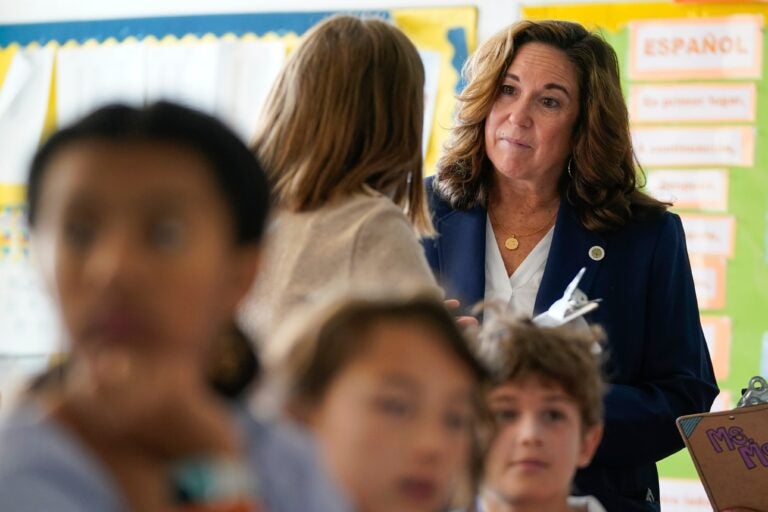
File - Delaware Secretary of Education Cynthia "Cindy" Marten, formerly the U.S. deputy secretary, meets with a student while visiting a classroom in Washington, Thursday, May 25, 2023. (AP Photo/Pablo Martinez Monsivais)
What are journalists missing from the state of Delaware? What would you most like WHYY News to cover? Let us know.
The Delaware Department of Education has requested $2.4 billion in taxpayer funding for fiscal year 2027, a nearly 4% increase over last year. But members of the state budget writing committee expressed frustration about students’ poor academic outcomes and questioned some of the cuts Gov. Matt Meyer has recommended.
Delaware public and charter schools serve 142,495 students. Nearly 60% of that population are low-income, students with disabilities or are multilingual learners.
National test scores from 2024 show that overall student academic performance remained below prepandemic levels and the national average. Eighth-grade reading scores in the First State hit a 27-year low, leading Meyer to declare a “literacy emergency” last year.
Education Secretary Cindy Marten presented the Joint Finance Committee with a strategic plan to improve student success — the first time the department has produced such a plan in more than a decade, she said. It lays out priorities, including expanding early education, improving test scores and implementing a new hybrid school-funding formula to direct more dollars to low-income and multilingual learners.
“Everything in this proposal reflects our guiding promise,” she said. “Start with students, build for impact. Outcomes matter.”
The Education Department’s budget cuts spending for several programs. That includes slashing 80% of the Wilmington Learning Collaborative’s funding. The WLC, which was receiving $10 million a year, aims to support city students across the Christina, Brandywine and Red Clay school districts. Its budget request currently stands at $2 million, with the organization projecting that it will have an additional $1.6 million in fiscal 2026 carryover dollars.
Wilmington Mayor John Carney said he wants to review the group’s proposed fiscal 2027 budget, but with the Redding Consortium moving forward to redraw school district boundaries in northern New Castle County, the learning collaborative was more important than ever. Redding members voted in December to combine the area’s school districts into one.
“If Wilmington families are going to have a strong say, as they should, then the Wilmington Learning Collaborative needs to be part of it,” he said. “Particularly now, if we’re talking about going to essentially a county-wide school district, obviously the percentage of families that are from the city of Wilmington is lower, and so I just want to make sure that their voices are heard.”
Related Content

The revamped school funding formula targets more money to students with higher needs to achieve better academic outcomes.
1 month ago
Created in 2019, the Redding Consortium is a state group tasked with redrawing lines for the school districts currently serving the city of Wilmington and northern New Castle County.
The group’s financial plan remains intact in the governor’s recommended budget, but funding committee co-chair state Rep. Kim Williams, D-Stanton, voiced concern about the lack of measurable progress and data.
“I know we’ve invested about $500 million in WLC, Redding, Opportunity Funding,” she said. “So you know, we want to see those funds put to good use and start seeing some improvements.”
Lockman said the Education Department has not provided them with the data it needs to evaluate how programs are helping students, a situation that Marten said will be remedied.
“We don’t have consistent metrics that have been coming in for us to say, ‘Oh, look at this growth,’” Lockman said. “Obviously that’s frustrating when you’re trying to show that you’re moving the needle, which is the whole point of this set of efforts under Redding.”
Some members of the Joint Finance Committee also expressed concern about the agency cutting $2.3 million from the athletic trainer block grant, $2.0 million from the substitute teacher block grant and $2.4 million from the substitute reimbursement.
The department’s recommended budget includes more than $13 million in onetime appropriations that gives $8 million to early childhood care, $3 million to teacher-driven projects and more than $2.8 million to execute the statewide move to a hybrid school funding formula.

Get daily updates from WHYY News!
WHYY is your source for fact-based, in-depth journalism and information. As a nonprofit organization, we rely on financial support from readers like you. Please give today.

Los líderes universitarios dicen que eliminar la investigación antirracista durante meses fue un error. Estudiantes e investigadores afirman que esto erosionó la libertad.
2 hours ago
The revamped school funding formula targets more money to students with higher needs to achieve better academic outcomes.
1 month ago
Delaware gets $8.7M grant to help teachers merge literacy with civics, history lessons
Delaware was one of 24 recipients of the federal grant. The money will support the education of struggling kids in grades 4 to 12.
2 months ago
Listen 0:49