

Delaware City Refinery to emit toxic gas as it repairs machinery
The Delaware City Refinery has a history of releasing sulfur dioxide while fixing equipment issues.
Listen 0:57
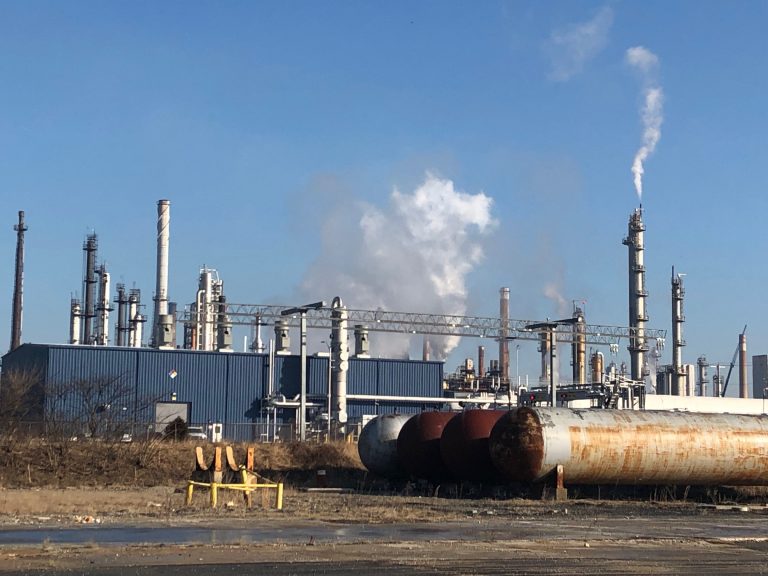
The Delaware City Refinery. (Cris Barrish/WHYY)
This story is part of the WHYY News Climate Desk, bringing you news and solutions for our changing region.
From the Poconos to the Jersey Shore to the mouth of the Delaware Bay, what do you want to know about climate change? What would you like us to cover? Get in touch.
A toxic gas is expected to be released into the air in Delaware City for four weeks as a local refinery repairs pollution-control equipment.
The Delaware City Refinery will begin repairs this week on equipment designed to reduce pollution, causing operators to rely on secondary emission control methods, according to the facility’s operators.
This change means the refinery will emit sulfur dioxide at significantly higher levels than normal and exceed permitted levels, according to state environmental regulators.
The refinery in New Castle County has a history of chronic violations, and has faced mechanical failures that cause emissions. The facility released high levels of sulfur dioxide for two and a half weeks last year when the facility faced similar repairs.
In a statement, the refinery said air emission modeling indicates the “impact will remain well below thresholds for public health.” The facility said it will work with environmental regulators to review air monitoring data, and respond promptly if any issues should arise.
“A team of competent, highly trained, and committed employees and contractors will work diligently around the clock to repair the equipment and restore [Delaware City Refining Company] to its primary process configuration,” the refinery said in a statement. “This work will take approximately four weeks to complete, and DCRC will provide updates to the public and [the Delaware Department of Natural Resources and Environmental Control] until all repairs are completed.”
However, environmentalists say the refinery’s advanced warnings and promises of transparency is not enough to ease residents’ minds.
Dustyn Thompson, chapter director of the Sierra Club in Delaware, is calling for tougher laws beyond financial penalties to ensure polluters don’t “assume fines as a cost for doing business.”
“If you dump poison into our air, water or soil, you must be held accountable, and the law as it is now clearly is not enough to make that a reality,” he said.
Related Content
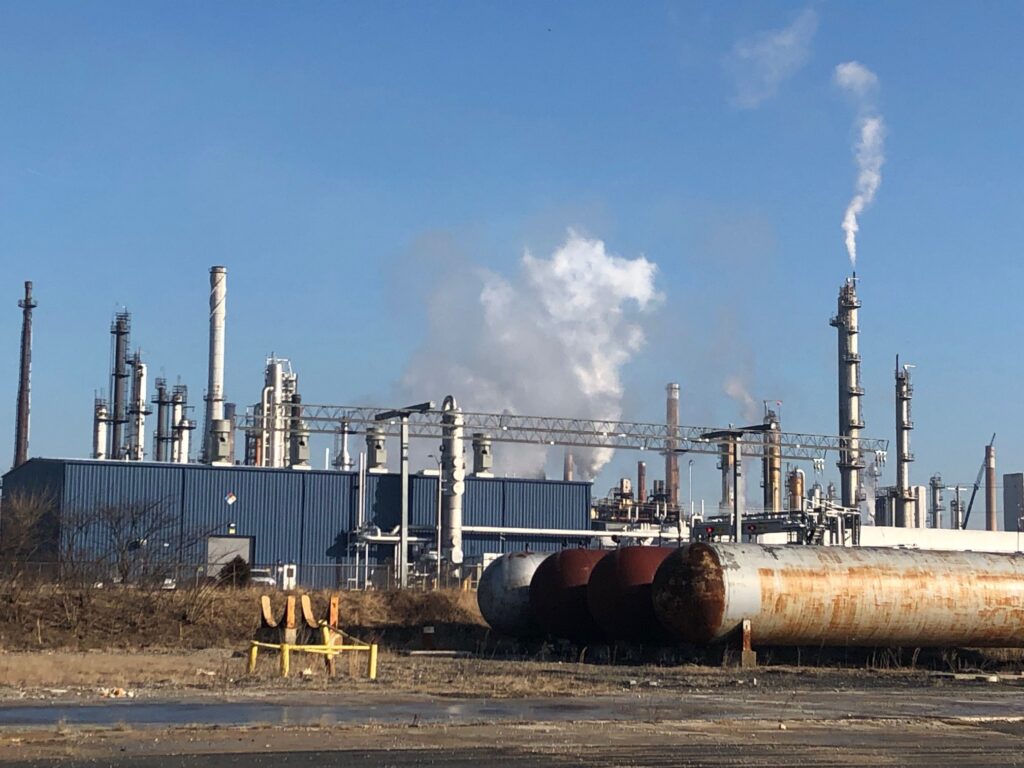
New Castle County residents seek accountability from Delaware City Refinery, regulators
Residents are calling for tougher environmental laws, and want regulators to evaluate what could have been done differently.
1 year ago
Listen 1:42History of violations
The refinery, owned by PBF Energy, has received more than 50 violations in the past 10 years. Last year, a mechanical failure led to the release of sulfur dioxide for almost three weeks, prompting residents to call on state environmental regulators to take stronger action against the company.
A few months prior, the refinery discharged high levels of carbon monoxide and sulfur dioxide into the air for 10 hours after the same equipment failed.
PBF Energy acquired the refinery in 2010 a year after its previous owner Valero shut down the facility. At the time, then-Gov. Jack Markell said PBF Energy was committed to running the plant more cleanly than its predecessors.
However, the refinery remains one of the region’s top polluters — releasing more than 4.6 million pounds of pollutants in the air and water in 2023, according to data from the U.S. Environmental Protection Agency. According to the National Emissions Inventory, the refinery released more than 430,000 pounds of sulfur dioxide in 2020.
PBF Energy said there has been about an 83% reduction in sulfur dioxide emissions alone since 2022 compared to the last three years that Valero owned and operated the refinery.
DNREC officials said that sulfur dioxide emissions, even at high levels, typically disperse into the atmosphere without harming public health.
“We’re committed to communicating clearly with the Delaware City community throughout this repair period, while closely monitoring both refinery emissions data and the state’s ground-level air quality network to provide timely, accurate information,” DNREC said in a statement.
“The refinery’s current operation with increased emissions into the air is not good for the environment, is a violation of its air permits and will be assessed for potential penalties to the company. Public health concerns would come if there is significant increase of sulfur dioxide at ground level and that has not been seen so far.”
If conditions cause sulfur dioxide to increase at ground level, there’s cause for alarm, health experts say. Exposure to the toxic gas can cause breathing issues, and people with respiratory conditions like asthma are encouraged to limit their time outdoors when there are emissions.
Sulfur dioxide levels in the air have been associated with more emergency department visits, said Dr. Marilyn Howarth, the director of community engagement at the University of Pennsylvania’s Center of Excellence in Environmental Toxicology.
“Children and the elderly may also have symptoms even if they do not have an underlying condition like asthma or [chronic obstructive pulmonary disease],” she said. “Higher levels can lead to fairly immediate shortness of breath and chest tightness.”
Howarth said that if sulfur dioxide levels exceed 75 parts per billion, children, pregnant people and the elderly should stay inside.
Environmental regulators ordered the refinery to install fenceline air quality sensors last year after facility operators failed to accurately report unpermitted levels of butane, a flammable gas, following a mechanical failure. Those sensors have been installed to measure air quality on the property edges, and the refinery has launched a dedicated website to make air quality data accessible to residents.
The state also operates two air monitoring stations in the Delaware City area located east of the refinery on Route 9 and west of the refinery near Lums Pond.
The nonprofit Clean Air Council also plans to install two community air sensors, and DNREC is funding additional community-scale air quality sensors to measure sulfur dioxide, nitrogen oxides, particulate matter, volatile organic compounds and hydrogen sulfide in areas across the state impacted by pollution.
After the refinery repairs are complete, DNREC said it will assess an appropriate violation and potential fine. The incident last year, along with a number of other incidents, resulted in DNREC assessing a $300,000 penalty, the maximum allowed by law. The refinery has appealed that fine.
Editor’s note: This article has been updated to reflect the launch of a website to make air quality data accessible to Delaware City residents.

Get daily updates from WHYY News!
WHYY is your source for fact-based, in-depth journalism and information. As a nonprofit organization, we rely on financial support from readers like you. Please give today.
Part of the series
For years, Philadelphia has built rain gardens to prevent stormwater and sewage from entering waterways. Are those efforts enough?
1 day ago
Listen 5:54
New Castle County residents seek accountability from Delaware City Refinery, regulators
Residents are calling for tougher environmental laws, and want regulators to evaluate what could have been done differently.
1 year ago
Listen 1:42
‘Boiler failure’ at Delaware City Refinery releases toxic air pollutants
The air pollutant sulfur dioxide can make breathing harder for people with asthma. The refinery has been releasing it for several days.
1 year ago