

The city of Chester is facing a $45.7 million deficit in 2027. The receiver believes the city can overcome it
“It's challenging, but I also think it's doable,” Chester’s state-appointed receiver Vijay Kapoor told WHYY News.
Listen 0:43
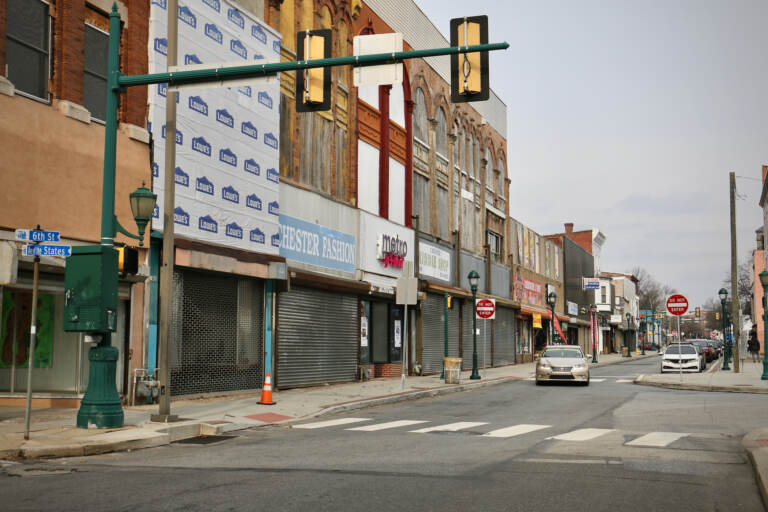
The Avenue of the States in Chester Pa. (Emma Lee/WHYY)
From Delco to Chesco and Montco to Bucks, what about life in Philly’s suburbs do you want WHYY News to cover? Let us know!
If nothing changes with the cash-strapped city of Chester’s finances, state-appointed receiver Vijay Kapoor projected the bankrupt municipality faces a $45.7 million deficit as early as 2027.
The Office of the Receiver for the City of Chester on Tuesday called the figure, which could snowball over the next decade, “the number.” It’s the gap that Chester, at the moment, must close to exit municipal bankruptcy.
“It’s challenging, but I also think it’s doable,” Kapoor told WHYY News.
Tuesday’s announcement comes four years to the day after former state-appointed Receiver Michael Doweary filed for Chapter 9 bankruptcy on behalf of the city in Delaware County. Kapoor, who previously was Doweary’s chief of staff, said the receiver’s team spent a majority of its time “stabilizing the operations” and hiring experts to secure the city’s finances.
“When we got here, the city government was not only broke, but it was also broken,” Kapoor said. “We were very close to running out of money to make payroll, and now the city has a $12 million fund balance. We were very close to having the police pension fund run out of money to pay checks, and now it’s got five years of assets in it.”
Kapoor said the past four years have given the receiver’s office the time needed to understand how the city functions at its most basic level. That enabled the receiver’s team to determine the actual deficit and how best to close it.
“This is not a conservative number,” Kapoor said. “This is not a liberal number. We’re not trying to use it based on bargaining purposes. This for us is really our good faith estimate of the projected deficit that we need to close in order to get out of bankruptcy.”
Related Content
Pa. Supreme Court rules Chester does not have unilateral power to seize Chester Water Authority
The Chester Water Authority is one of the region’s largest public water systems, serving approximately 200,000 across Chester and Delaware counties.
10 months ago
Understanding Chester’s magic ‘number’
The number comprises three parts: past due pension obligations, the operating deficit and new capital investments.
“For a period of time, the city did not make its full annual contribution to its pension funds,” Kapoor said. “And as a result of that, it owed not only the amount that it didn’t pay, but also penalties and interest on those amounts. When you don’t pay your annual pension contributions, it’s like a credit card debt. What ends up happening is any payment that you make doesn’t get applied to your current bill, it gets applied to the previous bill. And penalties and interest will continue to accrue.”
In 2027, past due pension contributions account for $41.6 million, the operating deficit accounts for an additional $3 million and infrastructure improvement projects account for another $1.1 million.
“We think it’s important to include funding for capital projects going forward because otherwise you may fix your operating deficit, but you’ve got roads that nobody can drive on,” Kapoor said. “You’ve got to include capital.”
Add those figures together and the sum is $45.7 million — the number.
Because the structural deficit and capital costs grow each year, the number, which assumes no changes in tax rates or fee levels, will grow if obligations are not adequately addressed. The annual deficit is expected to grow from $7.1 million in 2028 to $36.8 million in 2036.
Chester has four main revenue sources: earned income taxes, gaming fees from Harrah’s Philadelphia Casino and Racetrack, real estate taxes, and host fees from the Reworld Delaware Valley incinerator. Starting next year, the Chester-Upland School District is going to begin collecting its share of the earned income tax.
“That’s going to be about a $1.6 million hit for us in 2027,” Kapoor said. “That’s going to grow to about a $2.2 million hit for us in 2028.”
Meanwhile, expenditures in the form of rising employee health care costs continue to skyrocket.
How to dig Chester out a fiscal hole
In 2023, Doweary warned Chester’s financial obligations were so burdensome that a worse-case scenario could arise that could lead to the city’s disincorporation. Kapoor said Chester is no longer in a situation that dire. However, he said the new likely path is still unsavory.
“If we’re not able to close the gap, the more likely scenario is we sort of muddle along without any type of closure,” Kapoor said. “And what I would like to do though, truthfully, is to bring closure.”
In 2024, Doweary floated a plan, which Kapoor supported, to monetize the Chester Water Authority to make up for fiscal shortfalls. However, the Supreme Court of Pennsylvania ruled in January that Chester does not have the “unilateral authority” to seize the assets of the Chester Water Authority, complicating what was presumably the office’s Plan A.
When asked about the city’s latest plan to exit bankruptcy, Kapoor signaled a pathway that could involve conversations with additional state, county and local officials.
“I am open to all solutions except for the privatization of the water assets,” Kapoor said. “And that’s both in terms of looking at cuts, but also looking at additional revenues. And those are going to be the very serious conversations that we’re going to have over the next couple of months. The good thing, I think from my perspective, is I believe we have a solid number and a solid base to work from. Now we have a target to close.”

Get daily updates from WHYY News!
WHYY is your source for fact-based, in-depth journalism and information. As a nonprofit organization, we rely on financial support from readers like you. Please give today.
The receiver’s office asserts there’s an important caveat to their monetization plan: The entities must remain publicly owned.
2 years ago
Chester’s state-appointed receiver says the city never signed off on salaries for its stormwater authority board members. Board members might have to pay back restitution.
3 years ago
‘A lot of red flags’: Chester receiver demands city stormwater authority’s financial records
The city’s stormwater authority borrowed from the executive director and his church to make payroll, and won’t hand over financials to Chester’s state-appointed receiver.
3 years ago