New CDC vaccine recommendations at odds with Pennsylvania, New Jersey school requirements
Vaccines for hepatitis B and meningococcal disease, or meningitis, are no longer broadly recommended for all kids.
Listen 1:12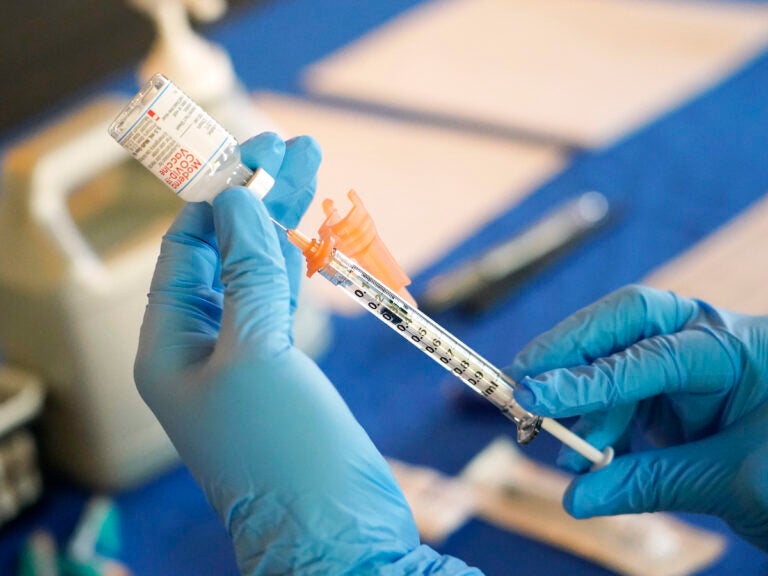
A nurse prepares a syringe of a COVID-19 vaccine at an inoculation station in Jackson, Miss., July 19, 2022. (AP Photo/Rogelio V. Solis, File)
From Philly and the Pa. suburbs to South Jersey and Delaware, what would you like WHYY News to cover? Let us know!
Schools in New Jersey and Pennsylvania will still require certain shots for attendance that are no longer universally recommended by the Centers for Disease Control and Prevention.
The latest changes to the national childhood immunization schedule include scaling back recommendations for several shots that have prevented millions of illnesses, hospitalizations and deaths.
Vaccines for diseases like hepatitis A and B, rotavirus, respiratory syncytial virus, influenza and meningococcal disease are no longer broadly recommended for all kids at certain ages, according to a Jan. 5 announcement by the CDC.
However, state officials in New Jersey and Pennsylvania say those immunization requirements remain in effect, despite recent federal actions.
“No matter what comes out of D.C., the Shapiro Administration will continue to lead with clear, science-based guidance that doctors and parents can count on to make informed health care decisions,” said Neil Ruhland, press secretary at the Pennsylvania Department of Health, in an email.
What are the new federal immunization recommendations?
The CDC is upholding broad vaccination for all age-eligible children for measles, mumps, rubella, polio, pertussis, tetanus, diphtheria, Haemophilus influenzae type B or Hib, pneumococcal disease, HPV, and varicella, which is chickenpox.
Other shots for RSV, or respiratory syncytial virus, hepatitis A, hepatitis B, dengue, meningococcal conjugate and meningococcal B, which protect against meningitis, are now recommended primarily for “high risk groups” or children at risk of severe illness.
Vaccines for rotavirus, COVID-19 and influenza are to be given “based on shared clinical decision-making,” or in consultation with a health care provider.
However, CDC officials said parents who wish to vaccinate their children against any or all of these diseases, regardless of category, will be able to do so. Private health insurers and public programs like Medicaid and Vaccines For Children must still cover the full cost of immunizations.
Meanwhile, medical organizations like the American Academy of Pediatrics recommend that families and health providers follow the prior version of the childhood immunization schedule that contained more universal vaccinations.
Related Content
Pennsylvania governor announces new vaccine safeguards, expanded access to shots in executive order
Gov. Josh Shapiro’s executive order, issued Oct. 1, directs state agencies to create vaccine information hubs, safety net programs and insurance requirements.
6 months ago
Listen 1:20State-based school vaccination requirements
Vaccine requirements for kids to attend school are under the control of individual states, which all have their own laws on the minimal number of shots students need and exemption options.
Pennsylvania requires all students to be immunized for hepatitis B and meningococcal disease, among others, even though those shots now fall under the CDC’s “high risk” category.
“Students entering kindergarten will continue to be required to be vaccinated for hepatitis B,” Ruhland wrote. “Students entering seventh (first dose) and twelfth (second dose) grades will need to obtain the meningococcal conjugate vaccine.”
Parents and guardians in Pennsylvania can seek a religious, medical or philosophical exemption to school vaccination requirements. That process “also remains unchanged,” he said.
In New Jersey, immunization requirements for students entering elementary school, middle school and high school “remain unchanged by federal actions to date,” Acting Health Commissioner Jeffrey Brown said in a statement.
Students at certain ages will still need to get hepatitis B and meningococcal conjugate vaccines, or apply for a religious or medical exemption.
Children who aren’t fully immunized and lack a documented exemption or a temporary exception from the requirements may be prohibited from enrolling or attending class.
Related Content
A new flu variant, subclade K, is driving an uptick in cases across the U.S. and prolonging influenza seasons in other parts of the world.
3 months ago
Listen 1:04Meeting families where they are
The CDC’s announcement on changes to the childhood immunization schedule caught many health providers by surprise, including pediatric nurse practitioner Margaret Quinn, a clinical educator at Rutgers University School of Nursing.
“As soon as the news hit, I started reading and looking for, what are they talking about now? Because I knew the next day, the phone wasn’t going to stop ringing, the practices were going to be going bananas,” she said.
A majority of families still vaccinate their kids, Quinn said, but over time, she’s seen an uptick in the number of parents who are questioning certain shots or coming to her with concerns based on information – sometimes, misinformation – they read on the internet or on social media.
It has changed the way she and her colleagues are approaching vaccine education and outreach.
“I think having that team approach to make the decision has to continue to happen,” Quinn said. “If they trust us, they’ll trust our opinion, our knowledge and our plan for their child. Because even these parents that don’t want to vaccinate their kids, I don’t think they’re doing it out of lack of care for their children. I just think they’re doing it for lack of education for their children.”
The mismatch of national childhood immunization recommendations and state school vaccine requirements can be a challenge, she said. That’s especially true in cases where pediatric providers spend a lot of time working with parents who agree to immunize their children, but on a modified schedule.
“But then out of the other side of our mouth, we have to say, ‘But they really need it for school,’” Quinn said. “I would love for there to be a world where academics can talk to education and we could come up with the best plans for kids, both in the community, in the schools and in our homes.”

Never miss a moment with the WHYY Listen App!


WHYY is your source for fact-based, in-depth journalism and information. As a nonprofit organization, we rely on financial support from readers like you. Please give today.
What could Trump’s move to dismantle the Department of Education mean for Pa. and N.J.?
Trump's executive order aimed at dismantling the Education Department follows drastic staffing cuts. Advocates say the changes could put critical school funding at risk.
1 year ago
Philly-area teachers and students debate proposed school cellphone ban
Pennsylvania passed a bill this year to pilot cell phone bans in schools. Will this actually improve learning, attention and mental health?
Air Date: August 14, 2024 12:00 pm
Listen 51:41
Guests: Joe Hernandez, Kristen Graham On this week’s Regional Roundup; WHYY’s ...
Air Date: December 23, 2019 10:00 am
Listen 49:02