
South Philly homeless encampment residents facing displacement call on the city for safe outdoor living space
A scheduled sweep of an outdoor encampment called Camp Chloe, home to about 20 people, was delayed Friday morning.
Listen 1:33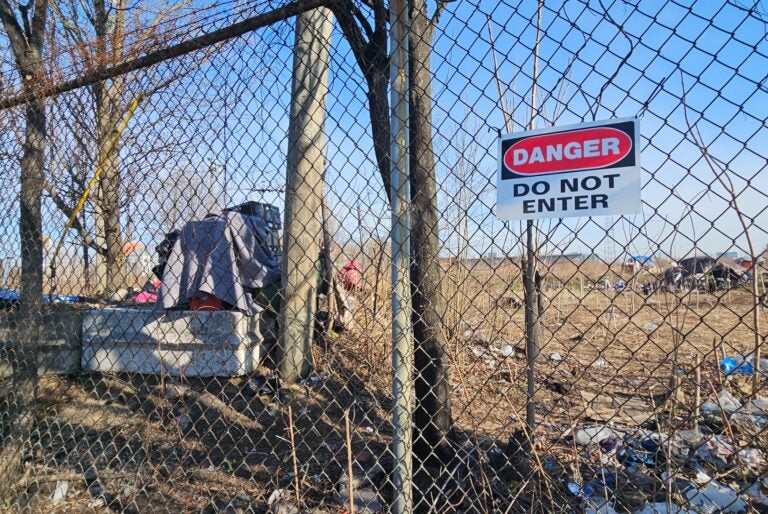
Residents and outreach workers at Camp Chloe, a homeless encampment on a vacant private property in South Philly, are calling on the city for safe outdoor sleep sites and other protections for people who are unhoused. A sweep originally planned for the site on Fri., March 20, was postponed. (Nicole Leonard/WHYY)
From Philly and the Pa. suburbs to South Jersey and Delaware, what would you like WHYY News to cover? Let us know!
An impending sweep of a homeless encampment in South Philadelphia along Christopher Columbus Boulevard was delayed Friday.
Action to remove people from the site was postponed until City Councilman Mark Squilla, who represents the area in District 1, could meet with homeless residents and advocates next week about their concerns, said chief of staff Anne Kelly King.
The delay was a small, but temporary reprieve for about 20 people who live outside on vacant private property along the Delaware River in a community they call Camp Chloe, named after a friendly local dog.
Encampment residents, who still face an uncertain future at the location and possible displacement, are calling on the city to establish alternative safe outdoor sleep sites and make bigger investments in permanent supportive housing.
“People are facing eviction, where are they going to go? Where are they supposed to habitate?” asked Erin Cookman, a volunteer community outreach worker. “I want people to think critically about the issue of homelessness, because it is a funding issue. This is about not having accessible housing for people, not having affordable housing. And that’s something that every American can sympathize with.”
Camp Chloe residents prepare for displacement
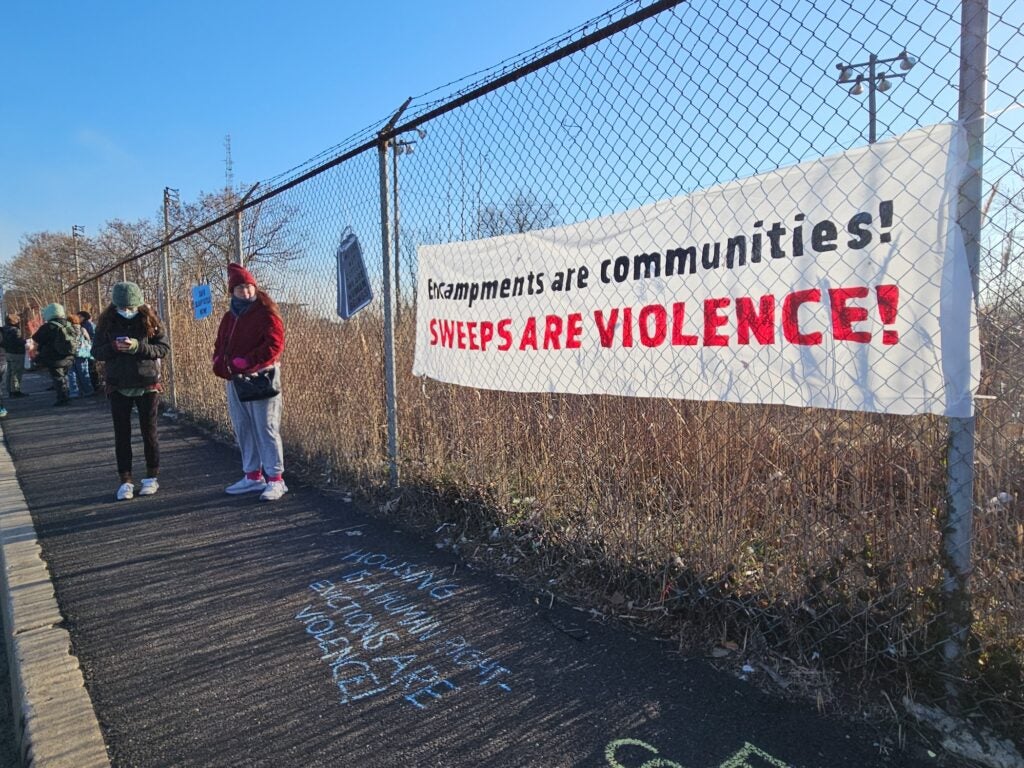
Outreach workers and community volunteers handed out coffee and donuts early Friday morning as they gathered near the property in support of Camp Chloe residents.
Cookman stood near a tall chain link fence. A chunk of it had been peeled back to create a doorway to the other side, where more than a dozen tents and structures stretched along flattened grass and small mounds of earth.
Volunteers walked around inside the encampment as they helped residents prepare for an anticipated sweep.
“So, we’re trying to ask people, ‘What’s your most important stuff?’ We have storage units and U-Hauls ready to be secured,” Cookman said.
These residents have been displaced before and told to move from other spots along the Delaware River and across the city. Each time, it has resulted in the loss of identification documents and other personal property as encampments were torn down by city authorities or private contractors, Cookman said.
People then spend time, resources and money that they may need for other necessities to restock their possessions and rebuild outdoor structures as they remain vulnerable to another sweep.
Many still prefer to live outside as opposed to indoor homeless shelters, which Cookman said can be overcrowded, understaffed and restrictive in terms of who can stay there and when.
“If you have a pet, you can’t go,” she said. “If you are in active [substance] use, there’s no place for you to go. If you have wounds, there’s no place for you to go. If you have a partner, you guys get separated, you have to go to two different places. It’s not accessible, it’s not easy for people.”
The Philadelphia Office of Homeless Services did not immediately respond to WHYY News’ requests for comment Friday.
But Jennifer Crandall, deputy public safety director for communications at the Office of Public Safety, said Monday that the city and partnering community organizations try to meet people’s needs. She said they provide shelters and beds to allow people to keep their pets, keep couples together, and find placements for people with wounds, substance use issues and other needs.
Homeless intake centers that help people find emergency and temporary shelter can assess clients for medical and mental health support, drug and alcohol treatment, legal services, case management and more, according to the city’s website.
Crandall said people may be sent to specific shelters that cater to distinct needs. For example, she said some shelters are considered low-barrier and do not require people to be abstinent or in recovery from drug use in order to stay there.
Related Content
The Hope 220 Solution Center in the Spring Garden neighborhood is part of an effort to eliminate homelessness in Philadelphia.
6 months ago
Listen 1:00Shelters, support services and possible alternatives
Still, unhoused residents say they’ve found protection, support and solidarity by forming their own outdoor communities like Camp Chloe, which is currently located on property owned by real estate developer Bart Blatstein and his company, Tower Investments Inc.
Tower did not immediately respond to WHYY News’ requests for comment about the site and Friday’s planned encampment sweep.
When encampments that are located on public property are dismantled, the city is required to provide assistance and transitional services to people. The policy does not apply when private property owners remove structures and order people to leave.
However, Crandall said the city will still offer support to people affected.
“City social services have been engaging the individuals at the location and will remain on site to offer support for those who wish to accept what the city can offer for shelter, treatment, and more,” she said Monday. “The city has been in contact with many of these individuals over an extended period of time, and we are committed to working with our partners to address these challenging situations and will continue to do all we can for our fellow Philadelphians.”
But Cookman argued that shelters should not be the only option for people who are waiting for housing placements or saving money to rent. Advocates are proposing safe sleep sites that could include bathrooms, showers and a mailing address where social services can easily find them with resources.
They also want to see the city make bigger efforts in bringing people directly off the streets and into permanent housing.
“Housing first instead of shelter first, that’s what we mean when we’re talking about that,” Cookman said. “Don’t make people go into shelters if they can safely habitat out here while they wait for housing.”
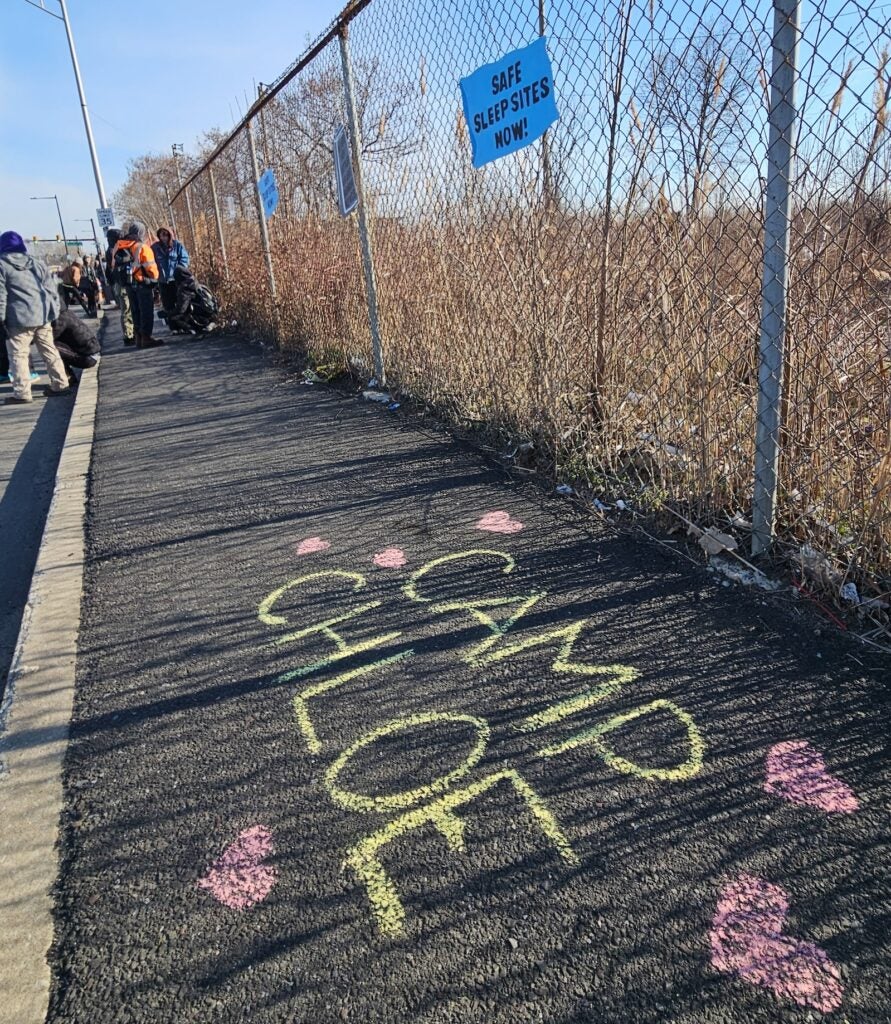
Camp Chloe residents and advocates also want city agencies to show more consideration for people’s personal property when sweeps are conducted, as well as the creation of a community oversight board filled by people with the lived experience of homelessness.
Mayor Cherelle Parker announced the city’s “One Philly Plan to End Street Homelessness” in her State of the City address in December. Plans include adding 1,000 additional shelter beds as a “first step” to getting more people off the streets.
Expanding the number of shelter beds across the city can help to some degree, said outreach worker Colleen Stepanian, who has been supporting Camp Chloe residents for about three years with an organization called South Philly Good Not Bombs.
But that strategy alone is not enough to address homelessness in Philadelphia and the complex issues people face, Stepanian said. Constant fear of displacement and a cycle of moves do not put people on a path toward stable housing, she said.
“It requires being in one place that the people living there know they are safe where they are, that they have a support system around them, that whatever issues they’re currently facing, they don’t need to be permanent problems, but they need to feel like they’re safe to deal with those things first,” she said.
Kelsey Leon, a harm reduction researcher and advocate, said she wishes others would see past stereotypical issues often associated with homelessness, like drug use or mental health issues, and instead recognize people for their skills, talents and value as neighbors.
“People think that if you are unhoused, that is somehow a moral failing. We know it’s not, but I don’t think the rest of the city knows that,” she said. “We all have a duty to stand up and protect each other when our structures fail us and we have to figure out how to survive. This is not just a fight for these residents, but it is also a fight for everyone in Philadelphia.”
It’s not yet clear what will happen next for residents of Camp Chloe, but advocates hope city leaders consider more “out-of-the-box” solutions to help people experiencing homelessness.
Editor’s note: This story was updated to reflect the Monday response from the Office of Public Safety.

Get daily updates from WHYY News!
WHYY is your source for fact-based, in-depth journalism and information. As a nonprofit organization, we rely on financial support from readers like you. Please give today.
Part of the series
In New Jersey, the Rescue Mission of Trenton is helping to instill hope and change lives
After completing a sober living program, a man who was unhoused and addicted to drugs is now working as a peer recovery specialist.
1 month ago
Listen 1:06
The city’s annual 2026 point-in-time census count on Feb. 25 recorded a total of 5,163 people who were experiencing homelessness in shelters or outside.
2 months ago
Listen 1:07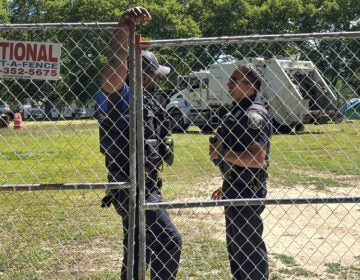
The city of Wilmington barred members of the media and volunteers from accessing residents inside the fenced perimeter.
3 months ago