

‘Who deserves to be remembered’: Potential display of Caesar Rodney statue in D.C. renews debate over monuments
Some Delawareans say that Founding Father Caesar Rodney should be remembered as a patriot. Others say his legacy is tarnished as an owner of enslaved people.
Listen 3:33
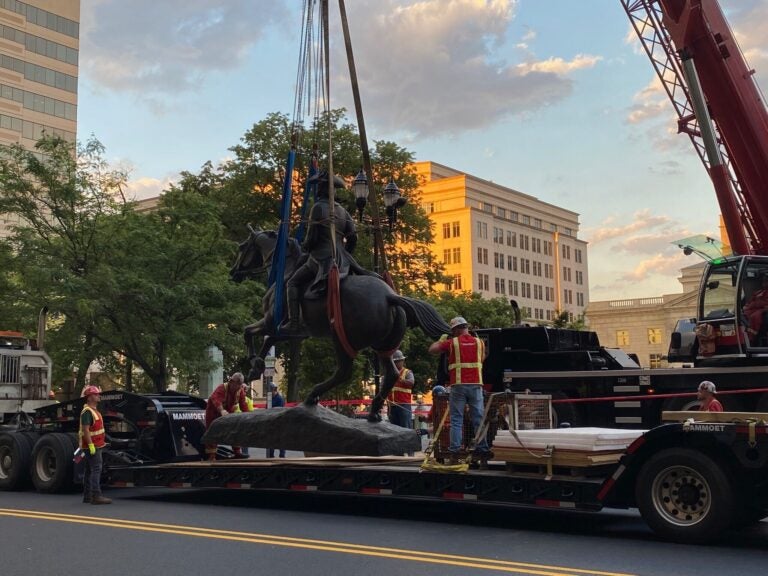
The city of Wilmington removes the Caesar Rodney statue. (Courtesy of the City of Wilmington.)
What are journalists missing from the state of Delaware? What would you most like WHYY News to cover? Let us know.
Delaware’s Caesar Rodney rode into American history in 1776, when he raced from Dover to Philadelphia to cast a decisive vote for independence.
A bronze statue depicting Rodney on a horse stood in downtown Wilmington for more than 100 years before it was taken down in 2020 amid nationwide protests that largely targeted monuments to Confederate leaders and those who held people in slavery. Rodney is said to have owned up to 200 enslaved people.
While Rodney’s statue has been out of sight for the past five years, the homage to the Founding Father could get new life next year, exhibited in Washington D.C. as part of America’s 250th anniversary. Wilmington Mayor John Carney’s office said the National Endowment for the Humanities has contacted them about the statue. The America250 committee did not respond to a request for comment.
City leaders said five years ago the Rodney statue was put in storage to make way for a larger community conversation. But that never happened, leaving Delawareans split over his legacy.
Wilmington City Council President Ernest “Trippi” Congo said that community conversation never happened because nobody wanted to address the elephant in the room.
“They knew that conversation was going to bring about a lot of truth and the truth was trying to be swept under the rug,” he said. “So why have a conversation around it when you know it’s not going to be the end result that you’re looking for?”
A potential new home for the Rodney statue
Supporters of honoring Rodney cite his famous ride to Philadelphia to vote for independence. He was also a lawyer, politician and military leader.
State Sen. Eric Buckson, R-Dover, has pushed since 2022 for the statue to be displayed again since it was taken down. He has proposed moving it to a spot in Kent County and sponsored a resolution to move the statue to near Legislative Hall in Dover or to the nearby Dickinson Plantation. That resolution did not get a vote this year in the General Assembly.
He said he reached out to President Donald Trump’s administration to see if the statue could go up in The Green, which is part of the First State National Historical Park in Dover. That’s when federal officials got interested.
“My goal was to make sure that the statue was out in time to be celebrated with the 250th in Delaware,” Buckson said. “That triggered the attention of the federal 250 who got wind of this statue and its prominence to the country, not just Delaware.”
Related Content
Wilmington’s statues of Columbus and Caesar Rodney coming down — at least for now
Bronze monuments to the two historical giants have stood in Wilmington for decades. But the mayor wants to “have discussions” about whether they should remain.
6 years ago
But some Delawareans say celebrating anyone who owned people in slavery is wrong.
“Never will be in support of it,” Wilmington City Council member Shané Darby said. “Slavery did not happen a long time ago. It’s only a few generations ago, and we still feel the impacts of it.”
Jill Hasday, a University of Minnesota law professor and author of “We the Men: How Forgetting Women’s Struggles for Equality Perpetuates Inequality,” said battles over who we commemorate never cease between people on different sides of the political spectrum.
“It takes a lot of energy to commemorate someone and usually one of the factors that drives that is people are trying to send a message about the world they live in, and not just about the past,” she said.
Was Caesar Rodney pro- or antislavery?
Delaware historian and author Bill Knightly said Rodney was not unique among the nation’s Founding Fathers in owning enslaved people and argued he has a better record on the issue than George Washington, Thomas Jefferson and others.
“I think there are some things that speak in Rodney’s favor, where I don’t think you could say those things about some of our Founding Fathers who weren’t as enlightened,” he said.
Advocates for Rodney’s statue being commemorated again include Charlie Copeland, a former state senator and head of the Delaware GOP who is now the economics center director with the Caesar Rodney Institute, a conservative think tank.
They argue that Rodney took several actions showing he was antislavery. He freed the remaining slaves from his farm after he died. He also introduced a bill in the Delaware state assembly to ban importation of slaves and voted to ban the importation of slaves into the colonies.
Related Content
Crews remove box around Christopher Columbus statue in South Philadelphia
The box has surrounded the statue for two years. On Friday, a judge ruled it needed to be removed.
3 years ago
Copeland argued those moves by Rodney mitigates his use of slave labor.
“That snowball down the hill led directly to our own Civil War, 1865 and, ultimately, to 1964 in the Civil Rights Act and things like that have to start somewhere,” he said. “It started with Caesar Rodney, and we ought to be proud of that.”
Congo and Darby call efforts to cast Rodney in a more positive light as whitewashing history.
“We need to stop idolizing these old white men from the [1700s to the] 1800s as if they were these great people,” Darby said. “When you enslave another human, or even if you enslave an animal and treat them bad, it’s wrong.”
Hasday said historical commemorations largely leave out stories of women and racial minorities.
“At the end of the day, there’s not going to be a statue in a public park to everyone,” she said. “So you’re making a choice about who deserves to be remembered.”
One aspect where there appears to be agreement between Buckson, historians and those who are against putting the statue back on display is that any new showing of it should include the full context of Rodney’s life.
“Telling the history of Caesar Rodney’s historical ride and his importance to leadership in Delaware can be told and also tell at the same time the challenges of those times with slavery and the relationship men like Caesar Rodney had with slavery as slave owners,” Buckson said. “And make sure that people far removed from me have their say in how that’s told.”

Get daily updates from WHYY News!
WHYY is your source for fact-based, in-depth journalism and information. As a nonprofit organization, we rely on financial support from readers like you. Please give today.
Part of the series
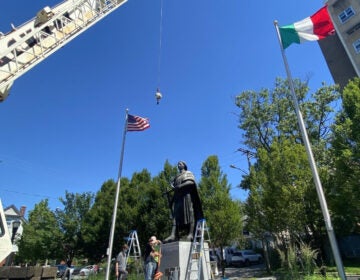
Passions run high on whether and where to reerect Christopher Columbus statue in Wilmington
City officials took down the statue of the Italian explorer, fearing it would be damaged, during the local and national racial unrest in 2020.
1 week ago
Listen 1:59
The Delaware River and Bay Authority said it was legally required to approve the lease. But Delaware and New Jersey governors were pressured to reject it.
3 weeks ago
Listen 1:01
Wilmington basketball tournament returns for its 8th year, raising money for mental health support
The two-day SL24 Basketball Classic returns to the Chase Fieldhouse to honor Sean Locke, raise funds for mental health programs and encourage open conversations.
1 month ago
Listen 1:33