
Why many Philadelphia doctors now use AI to record patient visits
Health systems say AI note-taking tools could save doctors precious hours each day. But some research shows doctors have mixed feelings about the technology.
Listen 3:51

Dr. Corinne Rhodes, a general medicine practitioner with the Hospital of the University of Pennsylvania, shows the ambient listening tool she uses to take notes. (Emma Lee/WHYY)
From Philly and the Pa. suburbs to South Jersey and Delaware, what would you like WHYY News to cover? Let us know!
It listens, takes notes and summarizes key points after each visit: A new generative AI tool is now increasingly present during doctors’ visits in the Philadelphia region.
The idea is that it lets doctors focus more on talking to a patient, and saves them from spending time after a visit to organize and type up their notes.
Dr. Laura Igarabuza, a family medicine doctor at Temple Health, has been using it for almost a year, and said it has been a “huge time saver.”
“Before I started using this technology, I don’t think I realized how much mental energy I was exerting to interpret what the patient was telling me and type it into the chart at the same time,” she said.

It was an awkward setup, with the keyboard in front of her, and the patient next to her.
“And I’m kind of like, trying to turn my neck to look at the patient and really, like, make eye contact, engage with them while I’m typing.”
She said using the AI tool lets her spend more time with patients, which “brings the joy back to medicine.”

More than 80% of family medicine doctors at Temple Health, and more than 70% of all doctors at Penn Medicine, use these generative AI tools, according to the health systems. Jefferson Health estimates this technology saves each doctor an hour of their time each day. WellSpan Health, in south central Pennsylvania, said that since adopting this technology a few years ago, doctors have saved enough time such that they can see two to five extra patients each day.
Related Content
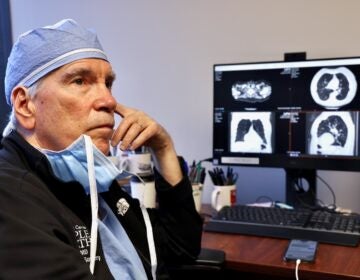
As Pennsylvania health systems rapidly adopt AI, lawmakers take steps to regulate the technology
Health systems and insurance companies are using artificial intelligence to analyze CT scans and MRIs, update electronic health records and review coverage decisions.
5 months ago
Listen 5:08After the University of California San Francisco’s health system rolled out similar technology for their doctors, the response has been “ecstatic,” said Dr. Robert Wachter, chair of the department of medicine and author of the upcoming book, “A Giant Leap: How AI is Transforming Healthcare and What That Means for Our Future.”
“The comments are unlike anything I’ve seen in technology and health care where people usually complain about the technology,” he said. “The comments are, ‘I was thinking about retiring until this came out.'”
The health systems say the technology will become a normal part of doctors’ offices in the future.
However, the tools can still make mistakes, and some doctors have mixed feelings about them.
Researchers at Penn Medicine recently published a journal article describing how 46 doctors across 17 specialties felt about the AI tool after using it for a few weeks late last year. When the researchers asked the doctors whether they would recommend it to their colleagues, half the group said yes, whereas the other half said no. Some said the automated note-taking makes them more efficient; whereas others said they have to spend time editing the AI-generated notes to make them fit their usual style.

That’s the case for Dr. Corinne Rhodes, a primary care physician at Penn Medicine. She used the AI listening program in a recent patient visit.
She explained that she’s developed a system of writing concise notes after years of experience, and now needs to heavily edit parts of what the AI generates for her. However, she expects the program to get better in the future, to the point where it will consistently save her hours, so she wants to start learning it now.

Kevin Johnson, a professor of biomedical informatics at the University of Pennsylvania, said some doctors already expect these tools to be available.
“We’re already finding that there are health care providers who are asking for it as a condition of employment,” he said. “They’re saying, ‘If I come, I really want to have access to ambient scribing,’ because they’ve already seen what the detriment of not having it looks like.”
He was a part of the research team that found doctors had mixed reactions to using the AI note-taking program, and pointed out that since the time of the surveys, program developers have released several updates to improve the software.
Related Content
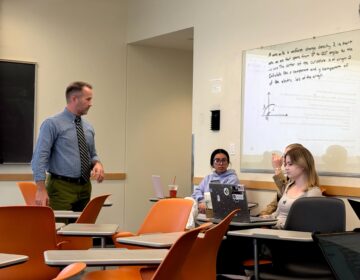
At the University of Delaware, a writing professor teaches students to use AI responsibly, exploring its capabilities and fact-checking tools.
4 months ago
Listen 1:45This technology could go beyond just physicians. Penn, Jefferson and Temple are planning to test these AI listening programs for nurses as well.
But this could mean that nurses have to change the way they practice, said Colleen Mallozzi, senior vice president and chief nursing informatics officer at Jefferson Health.
For example, she explained that while doctors may be used to saying out loud what they are writing down in their clinical notes, nurses are used to assessing patients by silently noting down details, like whether a patient is out of breath or not, in a flow chart. Using the AI note-taking technology means a nurse would have to dictate all of their assessments.
“We have to get them outside of this innate discomfort of saying it all out loud, because it would be weird for any of us to have to say everything we do out loud,” she said. “And there’s going to be different interactions that occur with patients. There’s going to be a lot more questions … this is good because then patients are engaged in their care, but it’s different.”

Get daily updates from WHYY News!
WHYY is your source for fact-based, in-depth journalism and information. As a nonprofit organization, we rely on financial support from readers like you. Please give today.

Vineland residents are protesting AI data center as concerns mount over noise and emissions
The project in South Jersey, already under construction, is being developed by DataOne for the Nebius Group as part of a $17 billion deal with Microsoft.
1 day ago
How does AI affect child development? CHOP researchers say safeguards are needed
Researchers found AI could help with creativity and education, but that it can confuse young children and generate harmful misinformation.
1 week ago
Listen 1:21
Thomas Jefferson University opens $1.8 million market research lab
The lab is funded by alum John Thackrah and allows students access to live data for market research.
3 months ago