
SEPTA to install AI cameras on trolleys to catch parking violations in Philadelphia
Philadelphia is the first city in the country to employ this enforcement approach on trolleys or light rail.
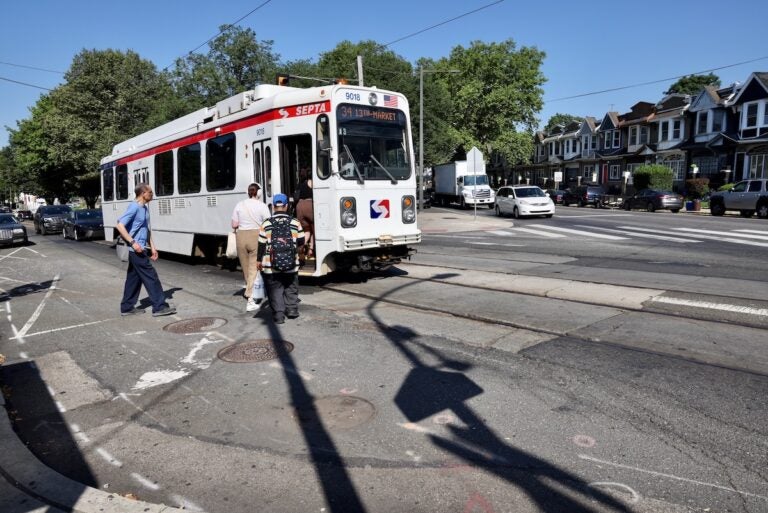
The busy, confusing intersection of Baltimore Avenue, 58th Street and Cobbs Creek Parkway hosts bus and trolley stops that draw many pedestrians. (Emma Lee/WHYY)
From Philly and the Pa. suburbs to South Jersey and Delaware, what would you like WHYY News to cover? Let us know!
Starting Monday, SEPTA and the Philadelphia Parking Authority will install artificial intelligence cameras on trolleys across the city to catch instances of illegal parking that block trolley routes.
The cameras will help the PPA enforce parking violations for drivers who block trolley lanes and stops, which often cause delays for SEPTA vehicles, recording details of parking violations and sending them to the PPA for confirmation and enforcement. Philadelphia is the first city in the country to utilize this approach on trolleys.
“The trolleys are a really great use for this kind of enforcement because they can’t get around a parked car,” Matthew Zapson, a manager of planning programs at SEPTA, said, adding that SEPTA has seen a 3-6% decrease in travel times on bus routes with these cameras. “We’re really hopeful that on the trolleys it’ll be a really profound impact for riders.”
“A single illegally parked vehicle can disrupt service for thousands of riders and create unsafe boarding conditions that force passengers into moving traffic,” PPA Executive Director Rich Lazer said in a release.
The trolleys will soon feature two cameras to support enforcement. One uses AI to identify vehicles parked illegally, recording their license plate number and the date, time and location of the incident. A detected violation triggers a standard video camera, which records the infraction. The combined footage creates an “enforcement package” that is then sent to a PPA enforcement officer for verification. If confirmed, the driver receives a ticket, according to Zapson.
The video camera “only turns on when a violation is detected by the AI camera, [and] people’s facial features are automatically blurred out as well as the license plate of surrounding vehicles,” Zapson said, adding that riders should not be concerned about privacy.
The installation continues a partnership between SEPTA, the PPA and the city of Philadelphia’s Office of Transportation, Infrastructure and Systems, utilizing cameras from Hayden AI. SEPTA first piloted the initiative in 2023, testing the cameras on seven buses across two of its busiest lines. Over 36,000 parking violations were recorded in just over two months, Zapson said.
“That, for us, really helped articulate a problem that SEPTA and our riders knew was a big issue, which was that illegally parked cars make it difficult for people to safely and accessibly get on and off a bus or trolley at a stop, [and] can cause delays [and] get buses and trolleys off schedule,” he said.
Related Content
Artificial intelligence to be used by SEPTA, PPA to catch drivers illegally parked in bus lanes
High-tech cameras will be mounted onto more than 150 buses and trolleys so the Philadelphia Parking Authority can identify and ticket vehicles illegally parked in bus lanes.
11 months ago
Listen 1:11Following the passage of a 2023 City Council ordinance allowing SEPTA to use the cameras, SEPTA and the PPA began pushing camera enforcement of parking violations in early 2025. By the end of last summer, cameras had been installed on 152 buses across the city, Zapson said.
Although SEPTA buses were the first to receive the cameras, Zapson said that parking enforcement on trolleys has always been the end goal.
“We had been in conversation for ages that our trolleys in West Philly, on Girard [Avenue], are constantly being thrown off schedule by folks who are double-parked or parked improperly,” he said. “We’ve been excited to get started on trolleys for some time now.”
Cameras will be installed on 30 trolleys in the coming weeks. $51 fines for violations will start on April 1, following a 30-day warning period, according to a PPA release.
Zapson said that the end goal of this initiative is that trolley riders “see their rides become more reliable [and] more often on schedule.”
“Our hope is that over time trolley riders should see their rides become more reliable, more often on schedule, and hopefully maybe the number of trips that get delayed by a car will decrease,” Zapson said. “We’re excited to be the first agency in the country to be doing this on light rail [or] trolleys.”
Related Content

AI is watching: Are we safer or sliding toward ‘1984’?
Does AI-powered surveillance make us safer? From Ring cams catching package thieves to systems claiming to detect shooters, AI security tech is rapidly advancing.
Air Date: December 8, 2025 12:00 pm
Listen 51:12
Get daily updates from WHYY News!
WHYY is your source for fact-based, in-depth journalism and information. As a nonprofit organization, we rely on financial support from readers like you. Please give today.
‘Going to make my life much better’: SEPTA trolley riders react to tunnel reopening
The trolley tunnel has been closed since November. It reopened Monday, but will close again for shorter periods in January and February.
2 months ago
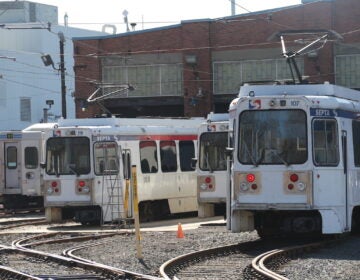
SEPTA says trolley wire replacements are done, estimates tunnel will reopen in ‘weeks’
With the trolley tunnel from West Philly to Center City closed the past two months, roughly 60,000 trolley riders have relied on the El or a shuttle.
2 months ago
Listen 0:50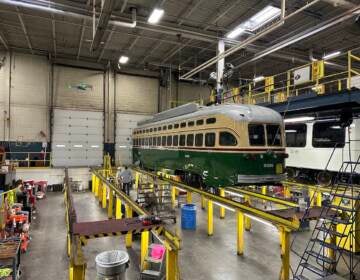
SEPTA delays the debut of rebuilt retro trolley cars, now expected in the spring
The rebuilt trolleys have modern underpinnings and a vintage look. SEPTA expects them to be back in service this spring.
2 years ago