
Philly band Walnut Brain takes humble diddley bow from earliest days of blues to modern psychedelic improvisation
Steve Heise and Alina Josan make music together by instinct and improvisation, one string at a time.
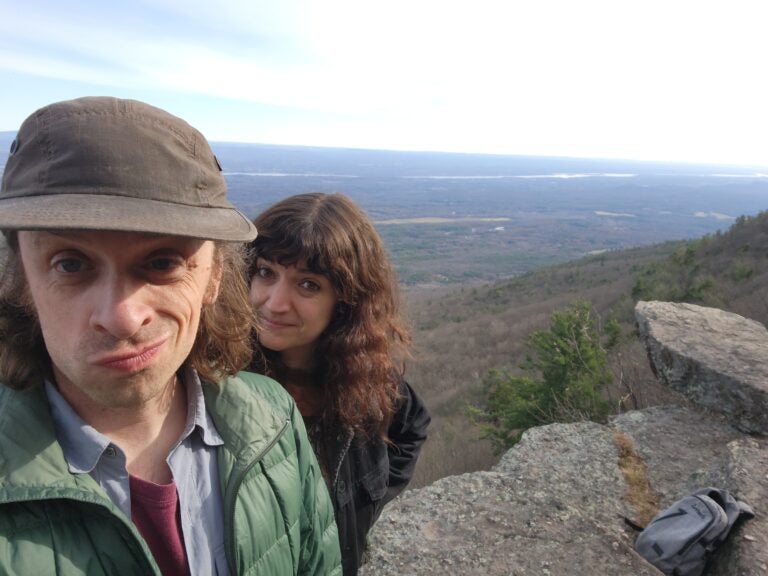
Steve Heise and Alina Josan of the band Walnut Brain take in the expansive landscape. (Courtesy of Walnut Brain)
From Philly and the Pa. suburbs to South Jersey and Delaware, what would you like WHYY News to cover? Let us know!
The experimental duo known as Walnut Brain is part of a Philadelphia music scene so underground it might rightly be considered to inhabit the city’s sub-basement.
It’s easy to be transfixed by the band’s psychedelic drone. Their hypnotic rhythms, which they create with a diddley bow and a “randomly tuned” electric guitar, ground them firmly in the city’s experimental music traditions.
Steve Heise and Alina Josan, who have been partners for many years, say they bonded over their similar fascination with underground music. They say they never set out to start a band. But then they made an album together. On accident.
The pair recently discussed their artistic convergence, and the birth of that first album.
“We were just messing around, not thinking anyone would ever hear it,” Heise said. “We had jammed together maybe once or twice before that at home, but that’s it.”
Last fall, the pair took a guitar, a few effects pedals, a small amp and a handmade diddley bow with them on a weekend cabin excursion in the Catskills. They hit “record” on a portable digital recorder and didn’t stop.
“Pretty much all those songs were written on the spot,” Heise says.
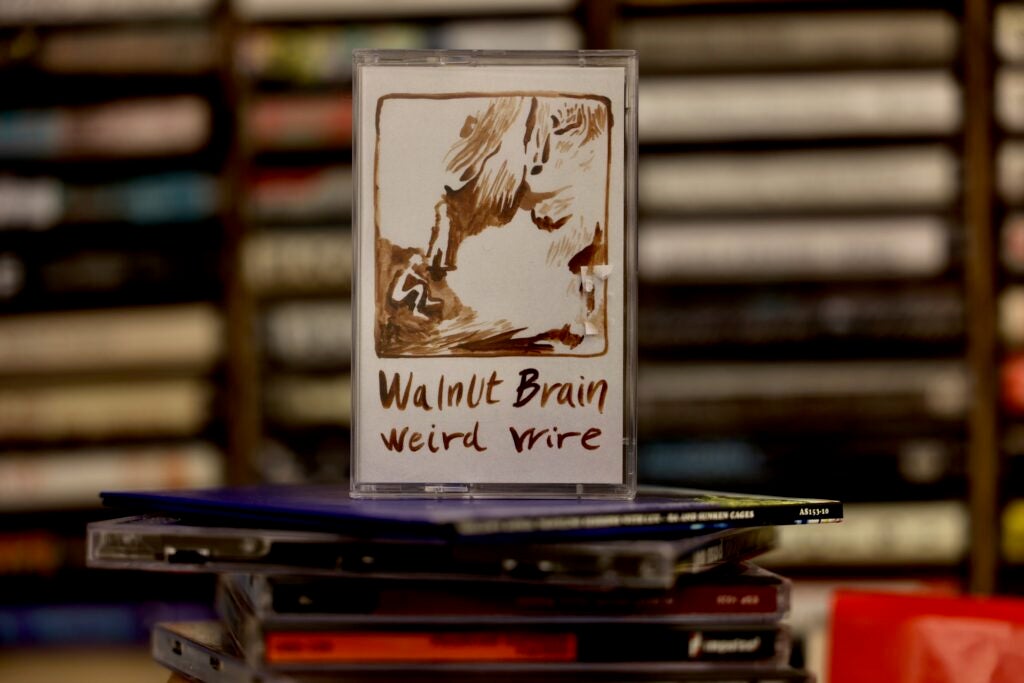
That informal session in the Catskills became the bulk of their eventual release, “Weird Wire,” which they casually posted on Bandcamp in August.
Neither Heise nor Josan expected a community response, but within weeks, Philadelphia underground fixtures Emily Robb and Richie Charles had become, as Heise puts it, “our two biggest fans.”
For Josan, who had long admired Charles’ Petty Bunco label, which released the album, the sudden attention was surreal.
“It was mind-blowing,” Josan said.
A sound rooted in improvisation
Low-key and authentic, the duo’s friendly, unassuming personalities are a good match for the flourishing music scene Walnut Brain exemplifies, which really exploded after the pandemic. Heise said that rebirth came at a moment when everyone was brimming with energy and enthusiasm, itching to see live music again and wanting to reconnect.
Today, it’s a tight-knit group of people who support each other’s work. Josan said she has found the community to be “very welcoming.” At the moment, it’s full of emerging projects and artists. Many are in their 30s, 40s and 50s — older than you might expect for an ensemble cast labeled “underground.” But for most of these music “lifers,” their creative outlet is a labor of love.
Heise and Josan have both been active in Philadelphia’s underground psychedelic and experimental music scene for years. Heise, who has been in numerous bands, including Wasnt Wisnt, said he started playing guitar and bass in junior high school. Then he started jamming with friends, banging away on “crappy guitars and pots and pans and suitcases.”
Everything changed when they acquired a Tascam four-track recorder and started recording everything they did.
“We had endless, endless recordings,” Heise said.
He and his friends were obsessed with the band Ween and took great inspiration from their early homemade albums. Sonic Youth was another early favorite. Their records remain in heavy rotation on Heise’s turntable.
Josan, a visual artist with no musical background or formal training of any kind, is nonetheless a longtime champion of local music. She has hosted her “Sonic Rendezvous” radio show on WKDU since 2015 and often invites local bands to come play live or co-host the show with her.
Growing up in Romania, she says she never had an opportunity to learn a musical instrument. She was more focused on painting and drawing. When she and her family moved to New Jersey when she was 12, she gravitated towards the music community.
Her formative musical discoveries came in middle and high school: listening to WPRB, checking music out of the library and making tapes with friends. Among her biggest influences are The Velvet Underground, L7 and The Monks. She said she had an especially “foundational” obsession with Revenant Records’ “Harry Smith Anthology Volume 4.”
Related Content

Philadelphia musician LARS navigates self-discovery on debut EP ‘I Should Be OK Now’
The four-track EP dives into the nonbinary musician's recent transition and connection to the city’s queer community.
3 months ago
Listen 1:16Walnut Brain’s earliest rumblings
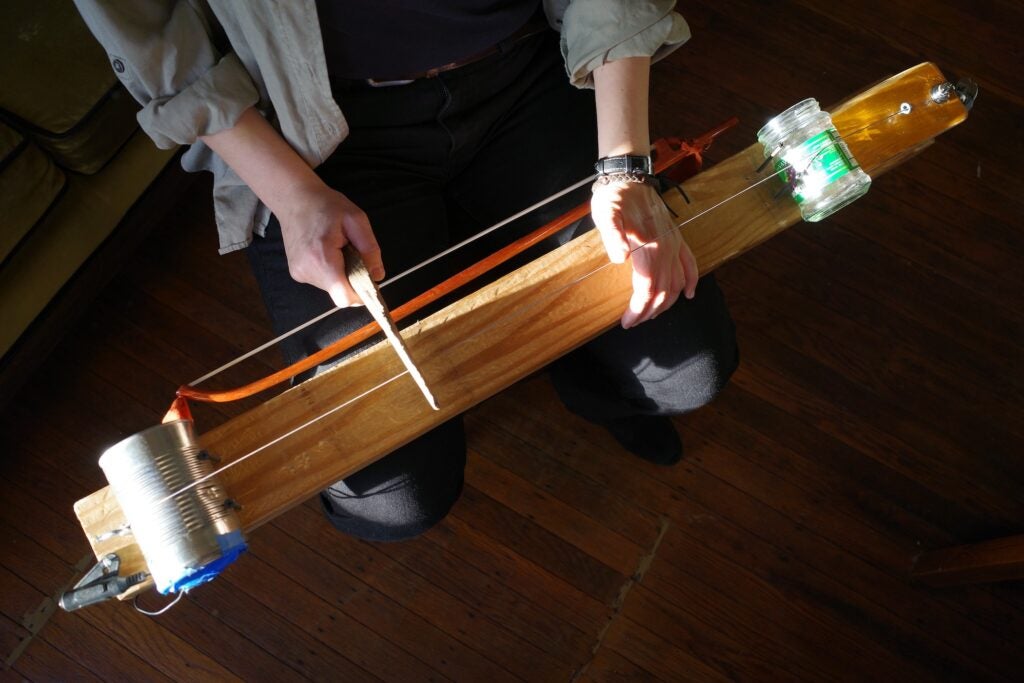
All you need to make a diddley bow is a piece of wood, a bottle, a nail and a string. The crude instrument has strong roots in the earliest iterations of blues music. And it contributes to the outsider flavor of their sound.
In 2024, after a few attempts at learning how to play instruments, Josan asked herself, “What if I just make myself an instrument and figure out how to play it?” So she built one from a single guitar string stretched across two cans.
“So, a one-string instrument is essentially my first instrument,” she said.
Scraping and banging on the string with a mix of bows, sticks, jars, and using a battery as a slide, she began by “just trying to make something new,” she explained.
They ran into problems with her first iteration. After banging on the string for a couple minutes, the cans would shift and the tone would change, making it too hard for Heise to play along. In its next generation, the instrument included a tuning peg borrowed from a guitar.
Improvisation and repetition form the backbone of Walnut Brain’s music. They avoid structure on purpose. They both credit the legendary avant-garde musician and philosopher Henry Flynt, especially his “Back Porch Hillbilly Blues” and “Violin Strobe,” with shaping their taste for long hypnotic stretches.
“I’ll kind of, like, bend the string,” Josan said. “And I’ve figured out that I have a whole little bag of tricks of things to do. But again, I’m not professionally trained, so I don’t really know how to explain what I’m doing. I just have to remember how I achieved a certain sound.”
Heise no longer tunes his guitar conventionally. He said he was bored with “playing the same things,” so to keep the music exciting for himself, he uses “random alternate tunings” as a way to get different sounds.
After Josan establishes a rhythm, whatever it might be, Heise joins in on his electric guitar. He said he gravitates toward rhythms and beats, even in their most esoteric experimental music.
“A lot of our jams start a little loose, and then at some point we lock in together,” he said.
Josan said she loves the moment when they snap into sync.
“It’s really fun when I notice we’re locked in,” she said.
The duo will record with Emily Robb in December. They say they’re excited — and curious to hear what their improvisation will sound like in someone else’s environment.
They recently marked the anniversary of Walnut Brain’s creation by once again heading to a cabin with their gear and recording equipment. The nascent duo have the potential to reach an untold number of new fans, but they approach the thought of their future with a touch of humility. “It’s fun to play music together,” Josan says. “It’s really cool if other people like it.”

Get daily updates from WHYY News!
WHYY is your source for fact-based, in-depth journalism and information. As a nonprofit organization, we rely on financial support from readers like you. Please give today.
For 25 years, Philly’s Fire Museum Presents has made a home for ‘all music for everybody’
The DIY concert series, founded by Steven Tobin, pairs global folk traditions with underground local artists — and keeps shows accessible to everyone.
3 days ago
The scorched guitar fuzz and reverb that define Robb's experimental sound anchor Jessica Kourkounis' surreal film.
2 months ago
North Philly’s New Barber’s Hall hosts ‘Matinee Jams,’ celebrating the city’s jazz legacy
Aqueelah Jamal hosts live jazz jams in North Philly every 2nd Saturday, 3-7 p.m.
2 years ago