
What portion of your electric bill goes to company profits? It could be up to 20% in the Philly region, according to a new report
Some customers in the Philly area pay as much as 20% of their monthly electric bill to company profits, according to a report. An industry group calls the report misleading.
Listen 1:40
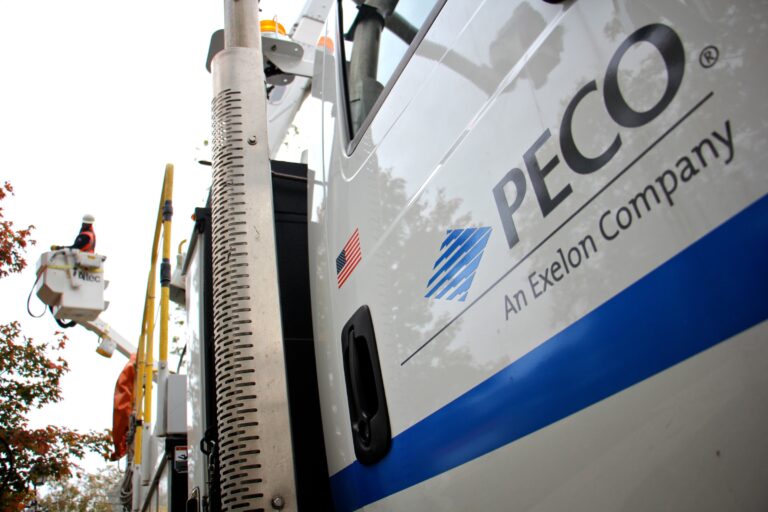
In 2025, almost $35 of every $200 spent by PECO customers went straight to the utility's profits. (Emma Lee/WHYY)
From Philly and the Pa. suburbs to South Jersey and Delaware, what would you like WHYY News to cover? Let us know!
Investor-owned electric utilities’ profits made up, on average, 12.8% of a customer’s bill in a four-year span between 2021 and 2024 nationwide, and that rate is rising, according to a new report out this week by the nonprofit Energy and Policy Institute.
For 2025, that figure rose to an average of 14.6%. That means that for an average bill of $200, a customer paid more than $29 toward company profits.
In the Philadelphia region, some electric utilities’ customers pay above that average, including those served by PPL Electric, PSE&G and PECO.
Pennsylvania customers who have PPL as their provider pay some of the highest portions of their bill toward profits in the country: 20.5%. The utility is currently asking the Pennsylvania Public Utility Commission to increase customers rates. New Jersey customers who use PSE&G are not far behind with 18.3%, while PECO customers pay 17.4%.
PPL Electric customers, using $200 as an average bill, pay $41.06 a month toward company profits. For PSE&G, that figure is $36.52, while PECO customers pay $34.76.
How much of your electric bill goes to company profits?
Some area utilities are below average, with Delmarva customers paying 11.4%, or $22.72 toward company profits for an average $200 bill. Atlantic City Electric customers pay 10.9%, while Jersey Central Power & Light customers pay 10.8% of their monthly bill toward profits.
The Energy and Policy Institute report, “Paying for Their Profits,” looked at financial data from 110 investor-owned electric utilities across the country between 2021 and 2024. For 2025, the institute was only able to access information for 79 companies. For profits, the report refers to net income, which is the company’s bottom line after all operating costs, interest payments and taxes are subtracted from total revenue. The customer share of profits is calculated by dividing net income by annual operating revenue.
“Electricity bills are rising substantially,” said Daniel Tait, the institute’s communications director and one of the authors of the report. “When utilities or politicians are explaining why, they often point to things like fuel costs and infrastructure investment and things like extreme weather and those things are real. But there’s another really important factor that needs to be examined in a serious and systemic way and that is how much of your bill is going to profits for investors.”
But an industry group that represents investor-owned utilities called the report “misleading.”
“This is just the latest example of EPI making up alternative definitions that serve the interest of their dark-money benefactors,” wrote Dani Marx, a spokesperson for the Edison Electric Institute. “There are standard calculations for evaluating regulated utility profits that appropriately recognize that most of a customer’s bill reflects pass-through costs of service, but EPI instead took a simple but analytically weak and insufficient approach to intentionally mislead readers into believing that a high percentage of customer bills goes toward profits.”
The Energy and Policy Institute’s Daniel Tait defended the methodology as “simple, transparent and easily replicable.”
Tait said if the pass-through costs of service were removed, profit margins would appear higher.
How much is too much profit for a monopoly?
Between 2021 and 2024, the 110 utilities analyzed by the institute collectively earned about $186 billion in profits. During that four-year span, for every dollar the average utility customer paid for electricity, about 13 cents went directly to company profits.
Investor-owned electric utilities make their profits on distribution and infrastructure upgrades, not the supply of electricity, so the more they build, the more profit they can make. Because utilities enjoy a monopoly when it comes to the distribution of electricity, any increase in distribution rates must be approved by regulators.
These rate-making cases are legal procedures that involve abundant and complex financial documents. In order to attract investment in infrastructure, investors do need to earn a return, but critics say those returns have soared, while ordinary ratepayers struggle to pay their bills.
“The academic literature and financial markets indicate that the return that they’re currently getting authorized by state regulators is well in excess of what is required in order to attract capital,” said Marissa Gillett, senior fellow at the American Economic Liberties Project.
Gillett served as chair of Connecticut’s Public Utilities Regulatory Authority between 2019 and 2025.
“These utilities have fiduciary duties to their shareholders,” Gillett said. “Their first duty is not to their customers. It’s a fiduciary duty to maximize profits for their shareholders.”
Gillett said reforms are needed to help regulators better scrutinize requests to increase rates.
Related Content
How PECO’s profits impact your electricity bill
Electricity rates are rising along with profits for investor-owned utilities.
3 weeks ago
Listen 6:59The infrastructure upgrades and expansions that are the source of profit for investor-owned utilities often include new poles, pipelines, wires or substations that provide safety and reliable service. These are financed through a combination of debt and equity, or funds contributed by their shareholders. The shareholders expect a return on that investment.
This is referred to as “return on equity,” or ROE, a different figure than net income or profit. Consumer advocates like Gillett say these are too high and are the source of both rising profits for companies and the growing affordability crisis for the average customer.
The report found that the average “return on equity” nationwide for 2024 was 9.7%. The American Economics Liberties Project estimates that these ROEs cost the average household an extra $300 each year.
“I think if you’re looking for something to try to compare that to, a good benchmark is the U.S. Treasuries, which are around 3–4%,” said Gillett. “Long-term asset projections from Wall Street say that 6–7% is more what the equity market demands.”
Gillett said return on equities for investor-owned utilities that enjoy a monopoly should be in the 6–7% range. She said unless the regulatory system is reformed to “right size” utility returns, the portion of an individual’s bill that feeds industry profits will continue to climb.
One way to get control of utility bills is to encourage public participation in rate cases and provide as much documentation as possible to counter a company’s arguments in favor of rate hikes, said Gillett.

Get daily updates from WHYY News!
WHYY is your source for fact-based, in-depth journalism and information. As a nonprofit organization, we rely on financial support from readers like you. Please give today.

PGW residential customers will see monthly bills jump by about $6 on average starting in December
The average customer will see a 6.6% rise in costs starting on Monday, Dec. 1. The rate hike will increase PGW’s annual revenue by $62 million.
4 months ago
Listen 0:57
Electric bills in N.J. are about to shoot higher. Lawmakers are scrambling to hold the line on costs
An Assembly committee has approved an eight-bill package focused on energy affordability. The problem is the PJM grid is not keeping pace with demand.
11 months ago
Listen 1:01
New Jersey politicians, officials react to pending electric rate increase
Officials blame energy policy and the disconnect between demand and supply for the rate hike.
1 year ago
Listen 1:06