

$1.3 million dam-removal project in Bucks County aims to create and ease fish passage
The project aims to restore river flow in the Neshaminy Creek and help fish to migrate.


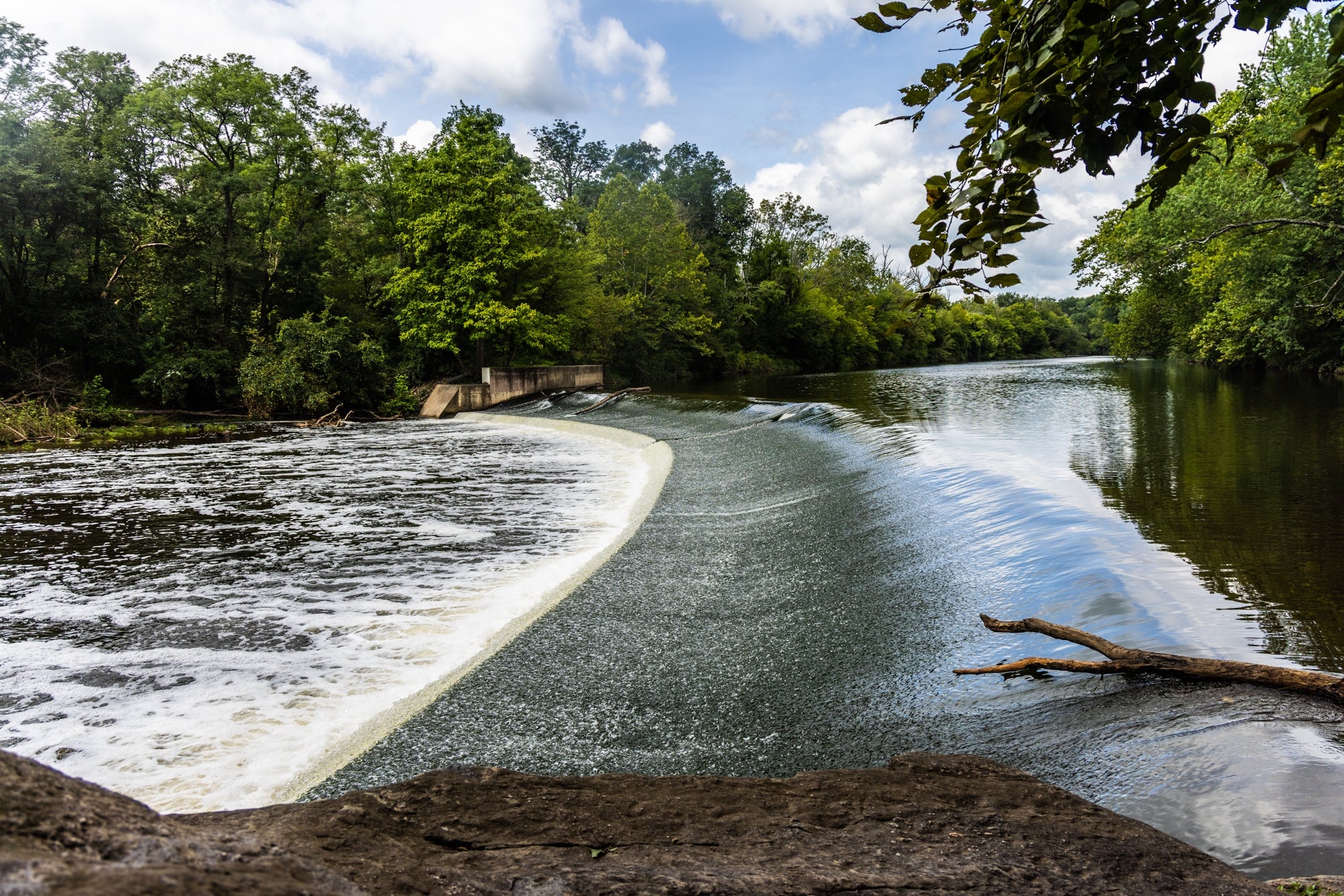
Hikers look out at the Spring Garden Dam in Pennsylvania’s Tyler State Park on Sept. 4, 2026. (Kimberly Paynter/WHYY)
This story is part of the WHYY News Climate Desk, bringing you news and solutions for our changing region.
From the Poconos to the Jersey Shore to the mouth of the Delaware Bay, what do you want to know about climate change? What would you like us to cover? Get in touch.
Construction to remove the Spring Garden Dam in the Neshaminy Creek to restore river flow and allow fish to migrate will begin Tuesday.
The dam at Tyler State Park in Bucks County, which is roughly 225 feet wide and 9 feet tall, is the second-largest to be removed in the state.
The $1.3 million project is one among more than 430 dams Pennsylvania has removed since 1912, making it the leading state in the U.S. for dam removals, according to state officials.
The goal of the project is to help fish move freely to reproduce, find food, escape predators and locate cooler waters during the summer months.
The project is a collaboration between the Pennsylvania Fish and Boat Commission and the state Department of Conservation and Natural Resources.
“Anytime you have a dam, which is a human-made structure that impounds water, you are disrupting the way that rivers and creeks work under more natural conditions,” said Dave Dippold, a fish passage biologist for the Pennsylvania Fish and Boat Commission. “Dams serve as barriers. They create a vertical offset that fish can’t navigate up, and they also slow water down that should be moving.”
Historically, the Neshaminy Creek and other tributaries of the Delaware River were full of migratory fish like river herring and American shad. Known as “America’s founding fish,” American shad were so abundant before the 1900s that it was said people could “walk across their backs.” However, populations have declined significantly because of issues like dam impediments.
The dams are also impacting more common resident fish species like smallmouth bass, which need to travel to reach seasonal feeding zones and spawning areas. Dams can also impact water quality and deplete oxygen levels that fish rely on.
“Unlike humans who, when a road is closed, we have the luxury of taking a detour, fish live in a linear network,” Dippold said. “Anytime there’s a barrier in their world, they can’t get around it. They don’t have an ‘alternative route.’”
Related Content
Researchers find microplastics in insects from Schuylkill River watershed
The researchers found that microplastics were as prevalent in forested parts of the watershed as they were in urban areas.
4 weeks ago
Listen 1:21The project, funded by the National Fish and Wildlife Foundation and the state’s Department of Conservation and Natural Resources, also aims to improve visitor safety and allow for increased recreation like paddling and fishing.
Though the area is a popular spot for anglers, the state advises people to avoid eating the fish because of high levels of PFAS in the water. The toxic “forever chemicals,” found in hundreds of everyday products, are linked to serious health problems.
The Spring Garden Dam was built in the 1920s, and was later revamped in the 1970s.
The dam had replaced, or modified, a historical 19th-century dam that likely powered the Spring Garden Mill in the late 1800s, according to the Department of Conservation and Natural Resources.
The latest iteration of the dam created a 1-mile pool behind the structure, which was used for kayaking and fishing. However, there hasn’t been enough water flow to allow for recreation in several years. Though removing the dam won’t allow for kayaking, it will increase angling and other water recreation opportunities.
The dam is one of four along the creek.
The dam was not designed to control floods, and officials say removing the structure won’t increase flood risks during storm events.
The Pennsylvania Fish and Boat Commission has trapped and relocated threatened red-bellied turtles to protect them during construction work.

Visitors will have access to Tyler State Park during construction, including the Fisherman’s Parking Lot. However, a section of footpath along Tyler Park Drive near the dam will be closed. A section of the Neshaminy Creek Trail will close for two days while a new access gate and drainage cross-pipe are installed.
Dippold said he believes the project will not only benefit aquatic life, but also people who enjoy hiking, paddling and fishing in the park.
“Removing [dams] reduces liability, reduces operation maintenance burdens, provides aquatic connectivity, makes the creek safer for anglers and paddlers and all the folks that enjoy Pennsylvania’s 86,000-plus miles of streams and rivers,” he said.

Get daily updates from WHYY News!
WHYY is your source for fact-based, in-depth journalism and information. As a nonprofit organization, we rely on financial support from readers like you. Please give today.
Part of the series
Part of the series
Watershed
Preserving Our Water: How we use our Delaware Watershed.
The project is funded by The William Penn Foundation.

The task force would be required to develop recommendations for data center regulations. Residents say a moratorium is needed in the meantime.
3 days ago
Listen 1:01
Data center growth could mean blackouts in coming years, Pa. utility regulators say
A report predicts electricity demand on the regional grid will nearly double by 2040, due almost entirely to data centers.
5 days ago
Listen 1:08
Conservationists to restore wetlands, save habitat for diamondback terrapins in New Jersey
Tidal salt marshes across New Jersey are being drowned out by sea level rise.
2 weeks ago
Listen 1:17