Community trash disposal sites are coming to Southwest Philadelphia
The trash disposal sites will be open 24/7 and accept residential waste.
Listen 0:58
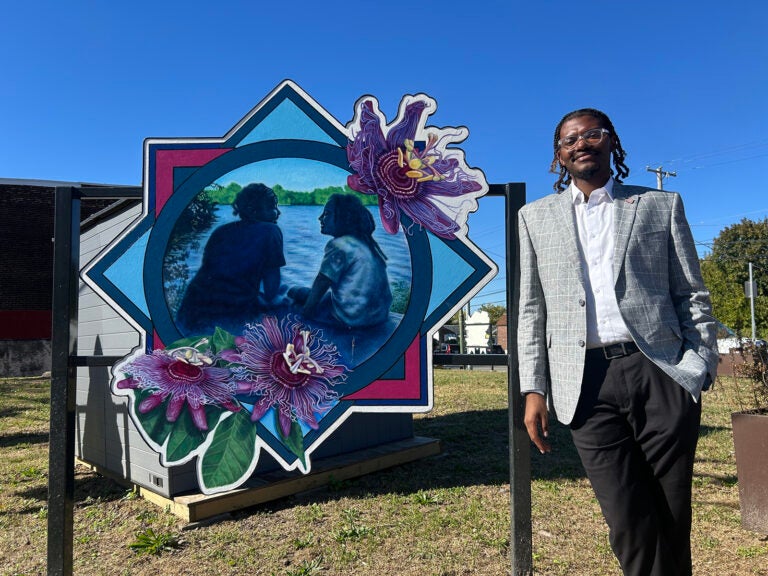
Isaiah T. Martin, Empowered CDC’s president and CEO, stands next to a piece of artwork at the nonprofit's first community waste disposal site near Bartram's Garden. (Sophia Schmidt/WHYY)
This story is part of the WHYY News Climate Desk, bringing you news and solutions for our changing region.
From the Poconos to the Jersey Shore to the mouth of the Delaware Bay, what do you want to know about climate change? What would you like us to cover? Get in touch.
Gloria Renee Kellam is tired of finding old furniture, tires, construction debris and bags full of trash dumped in her neighborhood in Southwest Philadelphia.
“It’s just horrible,” Kellam said. “No matter how many times we call to the city … we get ignored.”
A nonprofit in Kellam’s neighborhood hopes it can be part of the solution. Empowered Community Development Corporation is creating three legal dump sites in Southwest Philadelphia, with large public trash cans where anyone can dispose of household trash.
“We wanted to create an outlet for people to be able to legally get rid of their waste,” said Isaiah T. Martin, Empowered CDC’s president and CEO. Martin recently announced his candidacy for Pennsylvania’s 3rd Congressional District race.
Community trash cans open 24/7
Empowered CDC’s legal dump site project is part of a slew of local anti-dumping initiatives funded by grants from the William Penn Foundation. Under the same grant program, a nonprofit in North Philadelphia started offering vouchers to small waste haulers to dispose of trash legally in October.
One motivation for Empowered CDC’s project was the limitations of the city-run sanitation convenience centers, which accept household trash, oversized items, recycling and yard debris from Philadelphia residents. The city-run centers are open Monday through Saturday, 8 a.m. to 6 p.m., making them difficult to access for people who work 9-to-5 jobs, Martin said.
“At our sanitation site in Southwest Philadelphia, you’ll see trash piled up there from the weekend,” he said. “You’ll see trash piled up there overnight.”
The three legal dump sites Empowered CDC is setting up will be open 24/7. Martin said they’ll be monitored regularly by the team of neighborhood ambassadors and emptied every two weeks, or as needed by Trash 2 Treasure, the nonprofit run by Terrill Haigler, better known as Ya Fav Trashman.
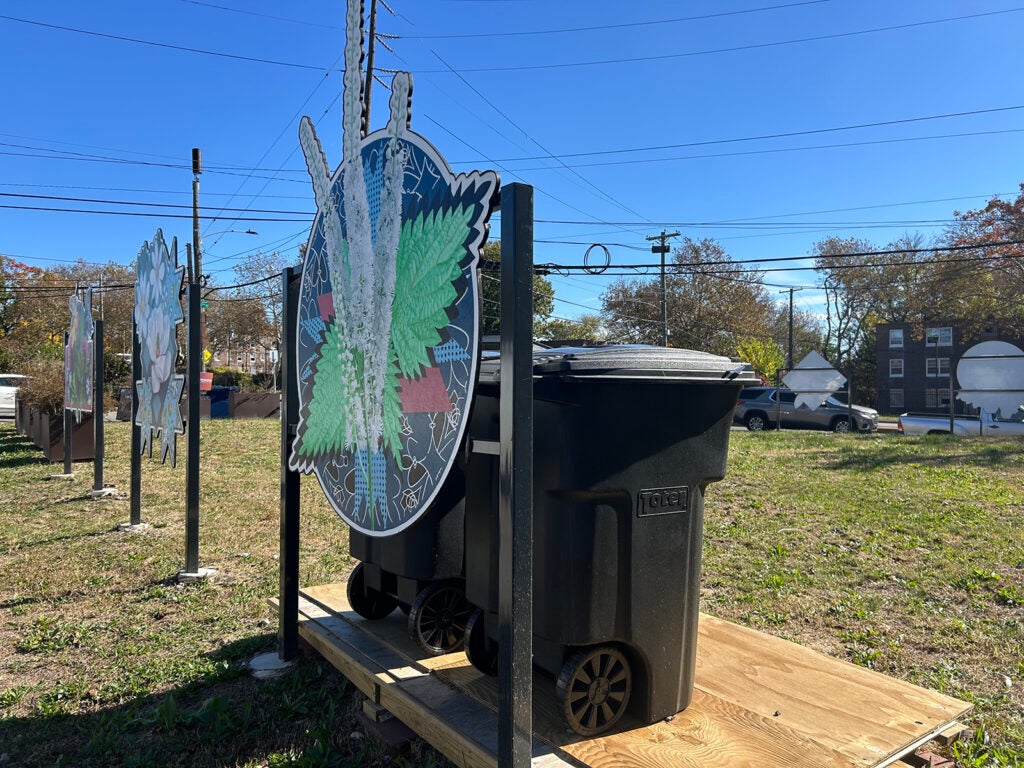
Each dump site will be equipped with two large, 96-gallon trash cans. The first is open at Elmwood Avenue and 56th Street.
Related Content
Chester to Philadelphia: ‘Find somewhere else’ to send your trash
A bill would prevent Philadelphia from signing new contracts for waste incineration, forcing the city to send all of its waste to landfills.
9 months ago
Listen 0:58Empowered CDC plans to set up two more legal dump sites by the end of the year, located at 60th Street and Greenway Avenue and at Cecil Street Garden on Kingsessing Avenue and South Cecil Street.
Murals by local students will enclose the trash cans, and a small team of paid part-time neighborhood ambassadors will raise awareness about the sites and pick up litter, Martin said.
Project scales back after dumpster stolen
Empowered CDC’s project initially included a publicly accessible front-load dumpster at the lot on Elmwood Avenue, emptied regularly by Trash 2 Treasure.
But earlier this fall, the dumpster was stolen, Martin said.
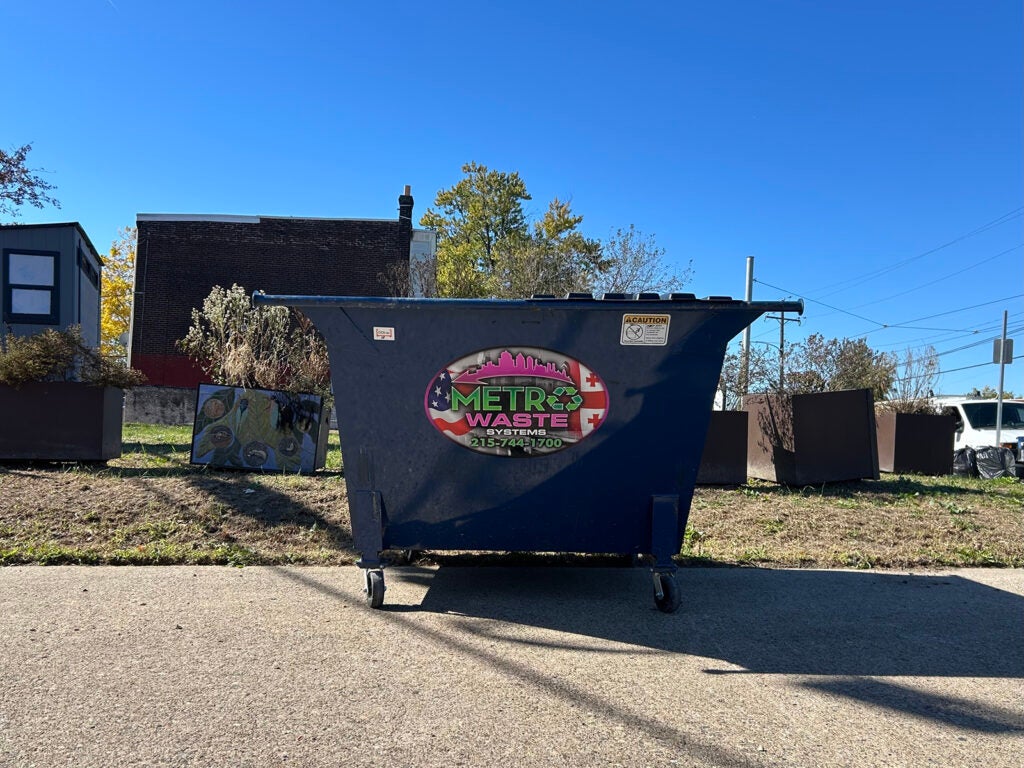
In response, Empowered CDC decided to scale back the project, focusing on the large trash cans — which Martin sees as a more feasible solution.
“Trash cans … are easily moved, they kind of blend in a little bit better and can be encapsulated better and maintained better,” he said. “If a trash can is stolen, it’s a lot faster and easier to replace than a dumpster.”
Related Content

The rhythm of recycling: How a Philly-based master musician crafts instruments from the trash
The average American throws out almost 5 pounds of solid waste each day. One local musician aims to reduce waste by giving trash a second life.
8 months ago
Listen 5:29Limits of a ‘small solution’ to illegal dumping
Oskar Castro, who lives in Southwest Philadelphia’s Elmwood neighborhood, worries that because Empowered CDC’s legal dump sites are geared toward residential trash, the project won’t fully address the illegal dumping issue in his neighborhood. He often finds bags of household waste dumped near his home, but also tires, construction debris, furniture and large electronics.
“If it’s just your regular household trash, … I think that’s a waste,” he said. “Because then that’s not really helping the neighborhood with things like the stuff that would be illegally dumped or sit on a curb for weeks.”
Kellam worries that trash could pile up at Empowered CDC’s sites if they’re not cleaned up frequently enough.
“It might help, and it might not,” Kellam said. “But if we don’t try, we’ll never know.”
Kellam said projects like this should be paired with stronger enforcement of antidumping laws from the city.
Martin acknowledged that Empowered CDC’s project is a small part of the broader changes he wants to see made to how the city handles waste, including creation of a citywide compost program and more education around recycling and illegal dumping.
“These trash cans are a small solution,” he said. “I think we need to have a culture shift in Philadelphia.”
Editor’s Note: The William Penn Foundation is among WHYY’s financial supporters.
WHYY is your source for fact-based, in-depth journalism and information. As a nonprofit organization, we rely on financial support from readers like you. Please give today.
Part of the series
Amazon to install hundreds of gas-fired generators at Bucks County data center site
Nearby residents opposed the project during a tense public meeting Tuesday.
6 days ago
Listen 1:07
Public utility regulators say the natural gas explosion was not caused by PGW infrastructure.
2 weeks ago
Listen 1:13
3 injured after fire at Delaware County refinery; shelter-in-place order lifted
The Monroe Energy refinery in Trainer processes an average of 185,000 barrels per day, including jet fuel, gasoline and diesel.
4 weeks ago