
Trump administration to appeal ruling restoring slavery exhibit at Philadelphia’s President’s House Site
A Department of the Interior spokesperson said they “disagreed” with the decision. Meanwhile, Mayor Cherelle Parker said she was “thrilled.”
Listen 1:13
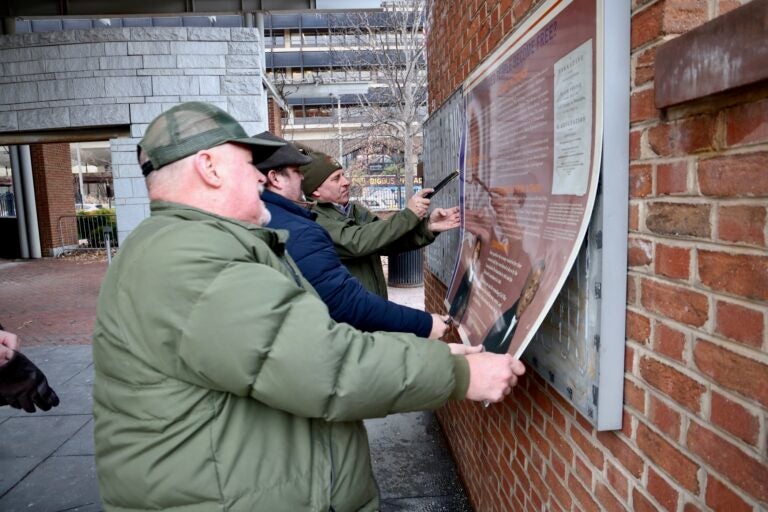
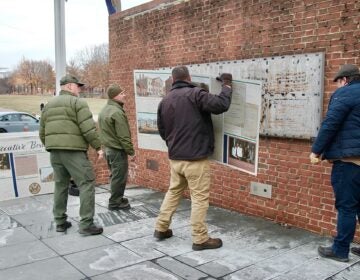
National Park Service employees remove signage related to enslaved people from the President’s House site on Independence Mall. (Emma Lee/WHYY)
From Philly and the Pa. suburbs to South Jersey and Delaware, what would you like WHYY News to cover? Let us know!
The Trump administration said it will appeal a federal judge’s ruling to restore the slavery exhibit at the President’s House Site on Independence National Historical Park in Philadelphia.
“We disagree with the court’s ruling,” a spokesperson for the U.S. Department of the Interior said in a statement.
The spokesperson reiterated the agency’s belief that it had the legal and historical authority to unilaterally change exhibits across the country, regardless of agreements with local jurisdictions, such as the one entered into with the city of Philadelphia for the development of the President’s House Site.
“The National Park Service routinely updates exhibits across the park system to ensure historical accuracy and completeness,” the statement read.
The panels that described the lives of nine people enslaved by George Washington, while he lived in Philadelphia, were removed on Jan. 22, the result of an executive order issued by President Donald Trump last year, which directed the Interior and National Park Service to review and remove exhibits that “disparaged” American history.
The city of Philadelphia sued the park service, arguing it violated a cooperative agreement for the site’s development. U.S. District Court Judge Cynthia Rufe ruled in the city’s favor.
Related Content
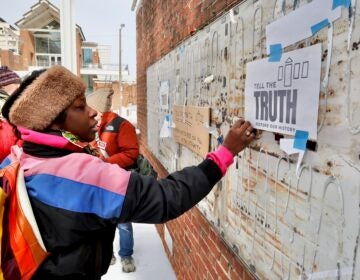
The judge, a President George W. Bush appointee, likened the administration’s rationale for removing the panels to the authoritarian regime in George Orwell’s novel "1984."
1 month ago
City and activists celebrate
Despite the appeal, local politicians and activists around the country have been celebrating Judge Rufe’s decision.
Philadelphia Mayor Cherelle Parker said she was “thrilled that the city’s preliminary injunction has been granted in full, meaning that the National Park Service must restore the President’s House Site, including all of the interpretive panels immediately.”
In a social media video, Parker referenced the upcoming semiquincentennial celebrations “to honor America’s 250th birthday” and said the city will celebrate “with a great deal of pride.”
“A pride that comes from acknowledging all of our history and all of our truth,” she said. “No matter how painful it may be, it will be the truth when it’s told accurately. We will not allow anyone to erase our history today.”
Trevor Smith, executive director of BLIS Collective, which stands for Black Liberation-Indigenous Sovereignty, called it an “amazing” win and said that the country was better off learning about the “contradictions” found in national history, including those among the founding fathers.
“A number of the ideals that they put in the Declaration of Independence are great ideals that we should strive to live up to, but we’ll never live up to those ideals unless we can truly reckon with the twin original sins of slavery and colonization and strive to create a world where nobody — no matter their identity — has the ability to live freely and fully in what we now call the United States,” he said.
Related Content
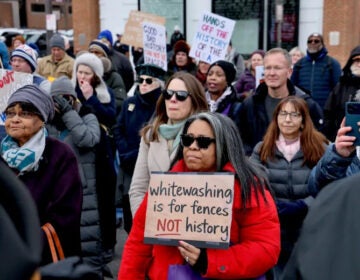
Historians, faith leaders, politicians and tour guides denounced the federal government’s removal of the display as Philly’s lawsuit goes through federal court.
1 month ago
A national lawsuit
The National Parks Conservation Association and several other organizations filed another lawsuit in the U.S. District Court for the District of Massachusetts seeking to block the Trump administration from removing or altering historical sites across the country.
The suit argues that federal law requires the government to operate national parks and historic sites “for the benefit and enjoyment of the people,” but argues officials have “betrayed that trust by mounting a sustained campaign to erase history and undermine science.”
The plaintiffs point to the Trump administration’s efforts to “whitewash” sites that memorialize the country’s history of slavery — including the President’s House Site — the Civil Rights Movement and sacred Indigenous grounds, but also attacks exhibits that discuss climate change, Japanese internments and women’s rights.
Alan Spears, senior director of cultural resources at the nonprofit National Parks Conservation Association, quoted Rufe’s decision that the government’s actions were “arbitrary and capricious.”
“This appears to be an assault on critical thinking that anything, whether we’re talking about national parks, other federal agencies, books and trinkets in gift shops, anything that might make someone think critically about the history of this country,” he said. “And critical thinking, I think, is the highest form of patriotism.”
The association and its co-plaintiffs — which include American Association for State and Local History, Association of National Park Rangers, Coalition to Protect America’s National Parks, Society for Experiential Graphic Design and Union of Concerned Scientists — are asking the court to order restoration of the sites in question.
“What we want is for this lawsuit to, at first, halt and then hopefully reverse this punitive, unnecessary and unAmerican exercise that this administration is leading to censor history in our national parks,” Spears said.

Get daily updates from WHYY News!
WHYY is your source for fact-based, in-depth journalism and information. As a nonprofit organization, we rely on financial support from readers like you. Please give today.
Judge orders the immediate restoration of Philly’s President’s House slavery exhibit
The Trump administration said Tuesday it plans to appeal the judge's earlier ruling ordering the park service to restore the exhibit.
4 weeks ago
A federal judge on Monday ordered that an exhibit about nine people enslaved by George Washington must be restored at his former home in Philadelphia.
4 weeks ago

‘The Second: Race and Guns in a Fatally Unequal America’
Emory University historian Carol Anderson discusses the racist roots of the Second Amendment and the impact on African Americans from slavery to the present.
Air Date: July 2, 2021 10:00 am
Listen 49:01