

‘Plantation Black’ muddles history with a game of chance in its Philadelphia world premiere
The world premiere by Phaedra Michelle Scott is about murky family secrets leading to tangled real estate titles.

From Philly and the Pa. suburbs to South Jersey and Delaware, what would you like WHYY News to cover? Let us know!
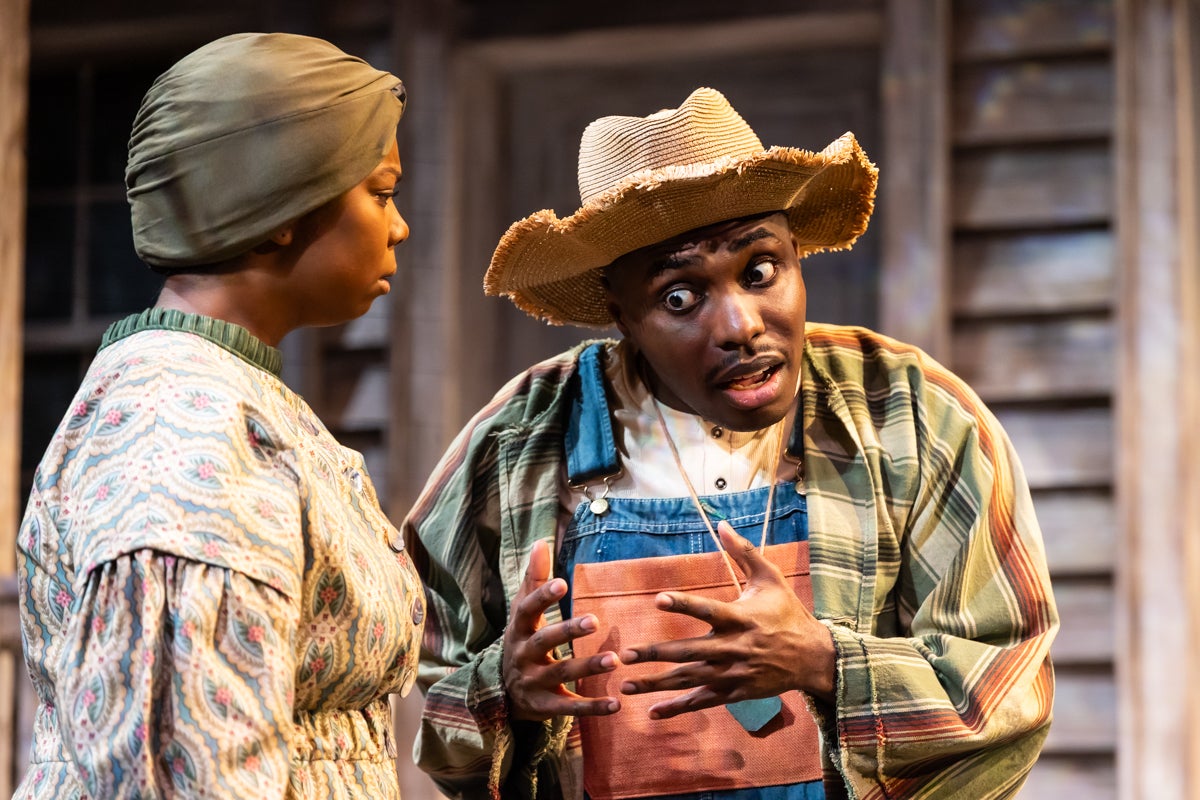
“They say when you dig deep enough, all you find is blood,” said Big Mom, a character played by Lenny Daniels in the play “Plantation Black,” now premiering at Philadelphia’s InterAct Theatre.
Big Mom scratched at the floor of the stage, as though physically pulling family secrets out of the land her enslaved ancestors once worked.
“When you make yourself keep digging and digging and digging, ripping out the intestines of the Earth, I don’t think you find blood,” she said. “You find answers.”
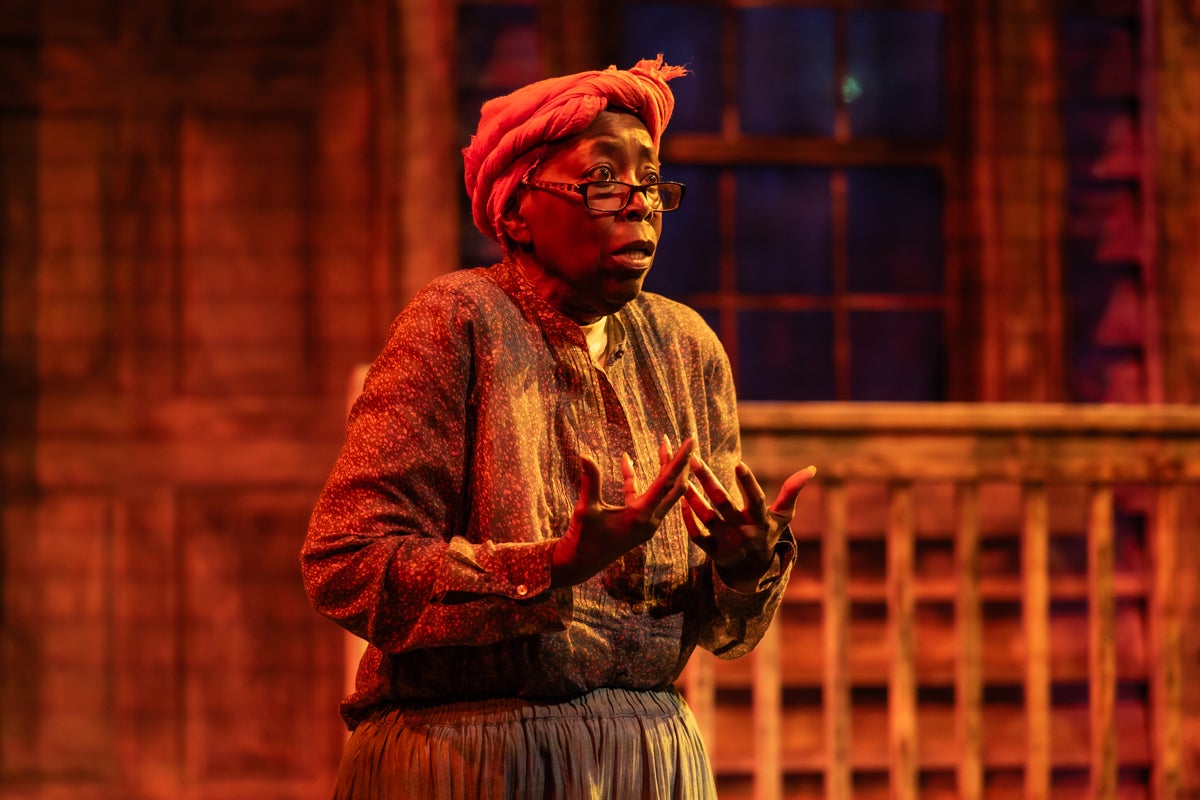
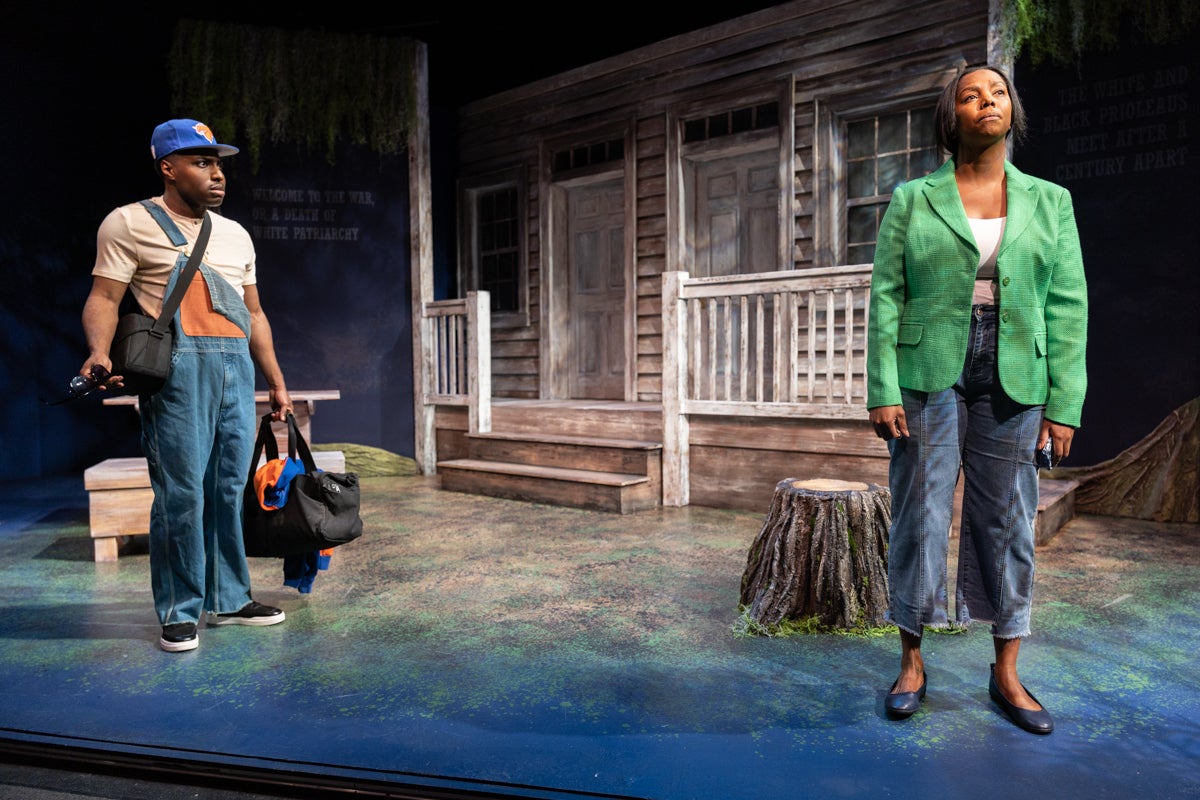
The family secrets in “Plantation Black” are literally in the dirt. The past generation living on a plantation at the eve of the end of the Civil War are tied to the present generation living in 2019 through the inextricable binds of real estate law.
Playwright Phaedra Michelle Scott based the play on the phenomenon of heirs’ land, wherein land is passed informally from generation to generation without involving wills or probate court. As the pool of descendants grows with each subsequent generation, legal ownership becomes murkier.
“That is actually the No. 1 cause of land loss for Black Americans,” Scott said. “It’s something that is particular in the South because a lot of it is what happened right after enslavement and the ownership that free Blacks were able to get.”
Scott’s play is steeped in history and historiography. The native of Wilmington, Delaware, studied history at Washington College in Maryland and briefly interned at Philadelphia’s National Constitution Center, doing research on artifacts for exhibition.
“This thing would happen where I would learn something new and then have to completely recontextualize the exhibit,” Scott said. “So when I was writing this play, I was, like, ‘How can I have audiences experience what it is like to learn history?’ We actually don’t get all the pieces. How we learn it, in what order, colors how we perceive everything.”
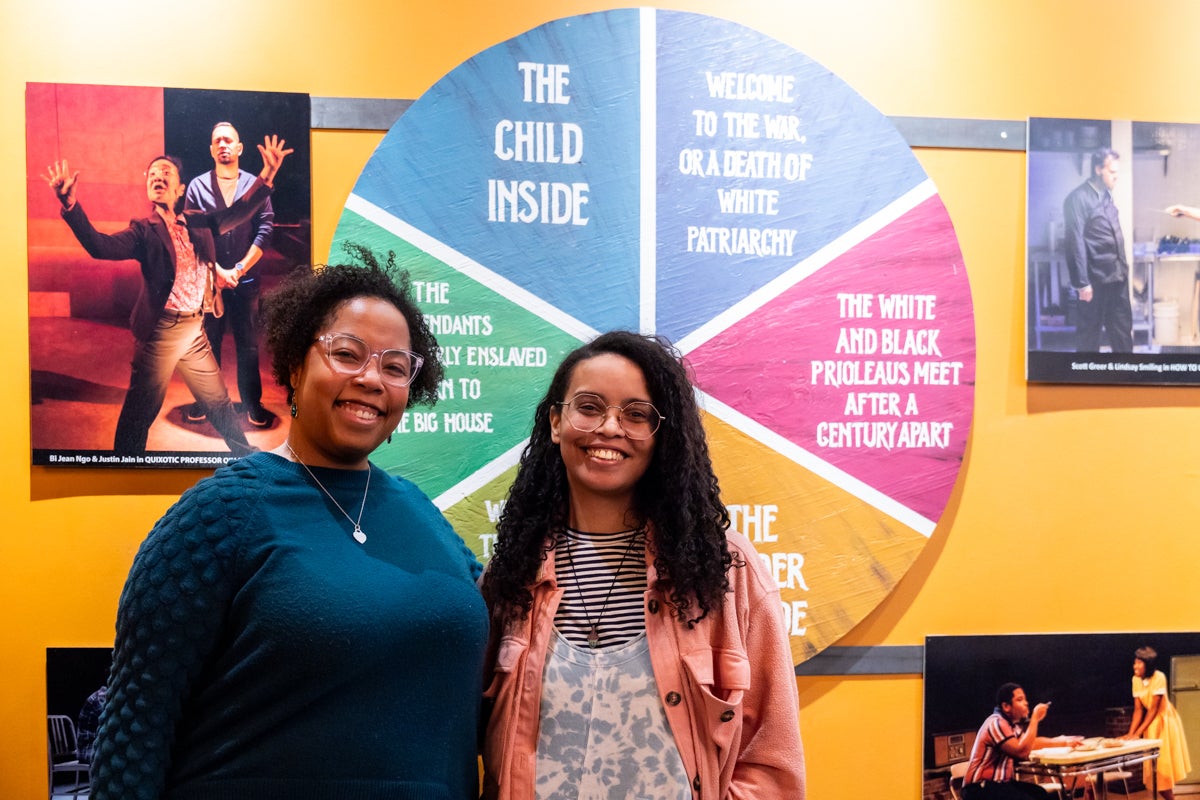
To that end, “Plantation Black” is designed to randomize how the audience follows the action on stage. About 20 minutes before each performance, a ball drum in the lobby of the Drake Theater spins a set of ping pong balls in six colors, each corresponding to moments in the play’s six scenes.
Related Content

A Shakespeare remix for the age of Instagram
In “Rare Accidents,” Quintessence blends two history plays into one look at performing your best self — on stage and off.
3 months ago
Like with bingo or lotto, whatever colored ball drops out of the drum is where the play starts that night. The actors perform to the end of the script and then loop around to the beginning. The evening’s performance stops wherever it started.
“In one version of the play you might see someone as a hero first and then they turn into a villain, or someone as a villain first and they turn into a hero,” Scott said. “The order that you get it is the perception that you’re going to get.”
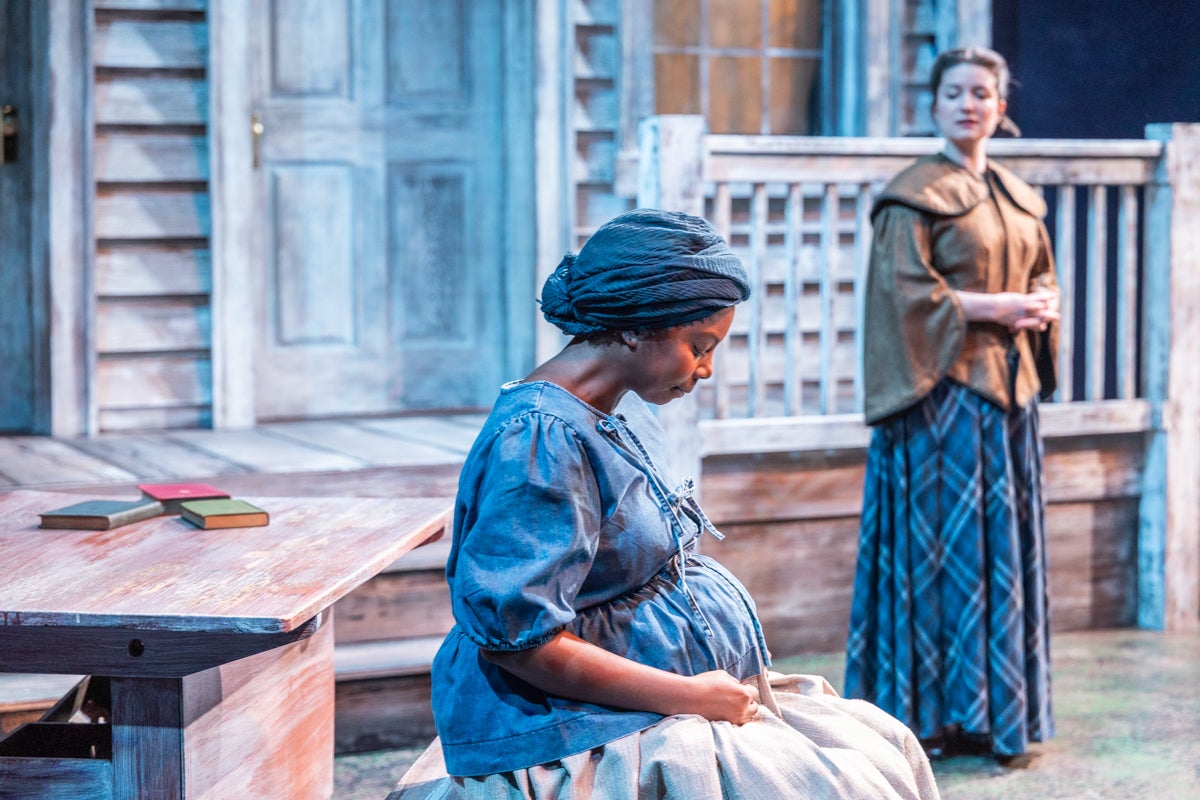
Scott has essentially blown up the familiar procession of exposition, conflict and resolution. “Plantation Black” is filled with easter eggs of clues to determine which of these people has legal claim to the land and how they are all related to each other.
Director Kimille Howard said that muddle mirrors most people’s family trees.
-
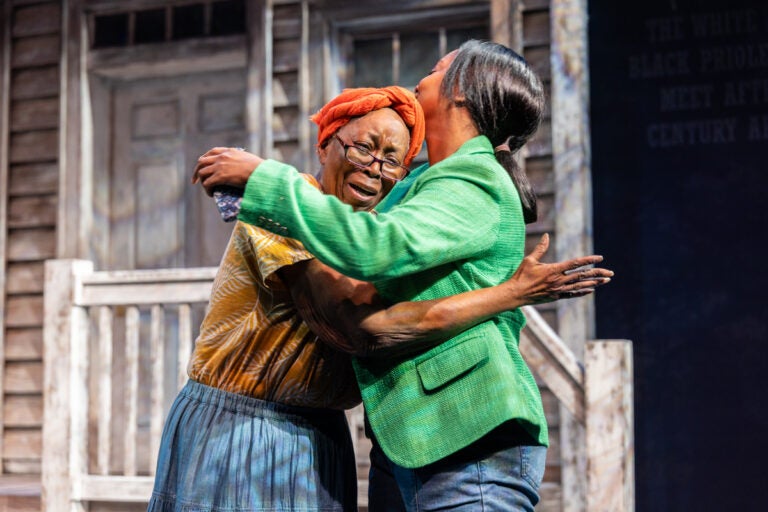
Lenny Daniels as Big Mom (left) hugs DeAnna Supplee (right) as Tasha in the InterAct Theatre Company’s production of Plantation Black at the Proscenium Theatre at The Drake in Philadelphia. (Kimberly Paynter/WHYY) -
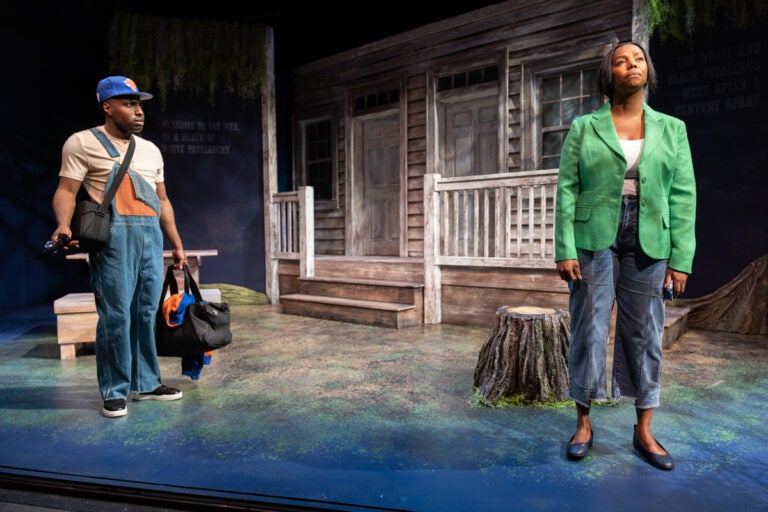
Tymothee Harrell as Jonathon (left) and DeAnna Supplee as Tasha (right) portray siblings in 2019 in the InterAct Theatre Company’s production of Plantation Black at the Proscenium Theatre at The Drake in Philadelphia. (Kimberly Paynter/WHYY) -
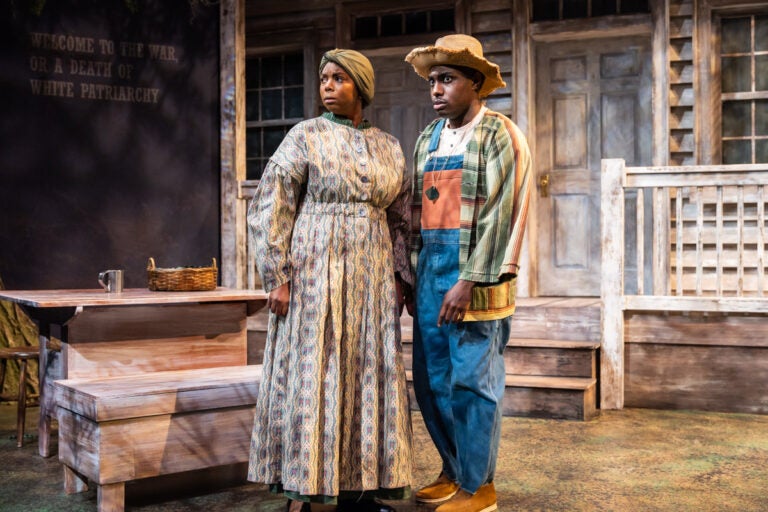
DeAnna Supplee as Morning (left) and Tymothee Harrell as Abraham (right) portray siblings in 1864 in the InterAct Theatre Company’s production of Plantation Black at the Proscenium Theatre at The Drake in Philadelphia. (Kimberly Paynter/WHYY) -
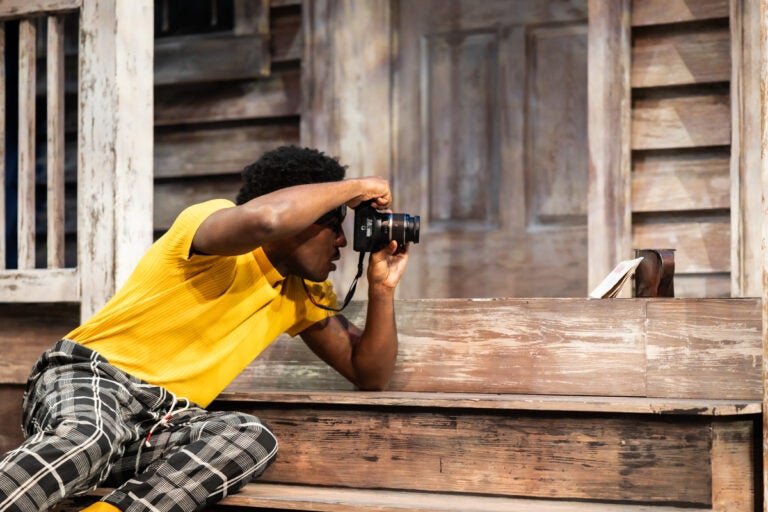
Tymothee Harrell as Jonathon in the InterAct Theatre Company’s production of Plantation Black at the Proscenium Theatre at The Drake in Philadelphia (Kimberly Paynter/WHYY) -
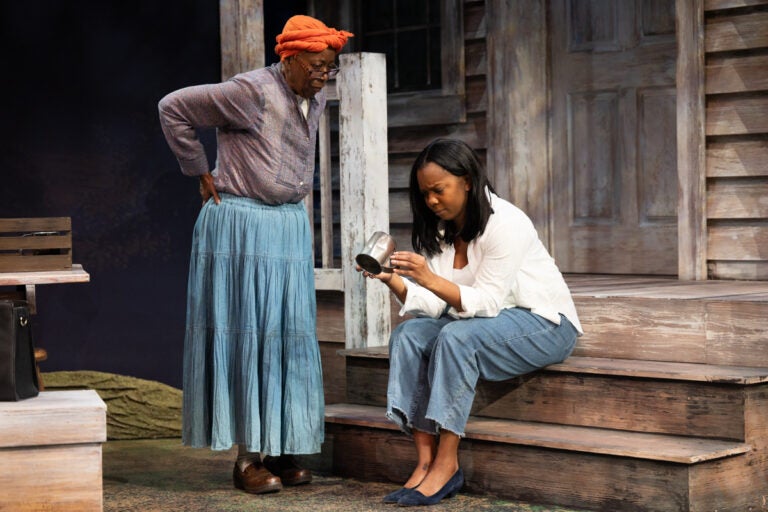
Lenny Daniels as Big Mom (left) and DeAnna Supplee as Tasha in the InterAct Theatre Company’s production of Plantation Black at the Proscenium Theatre at The Drake in Philadelphia (Kimberly Paynter/WHYY) -
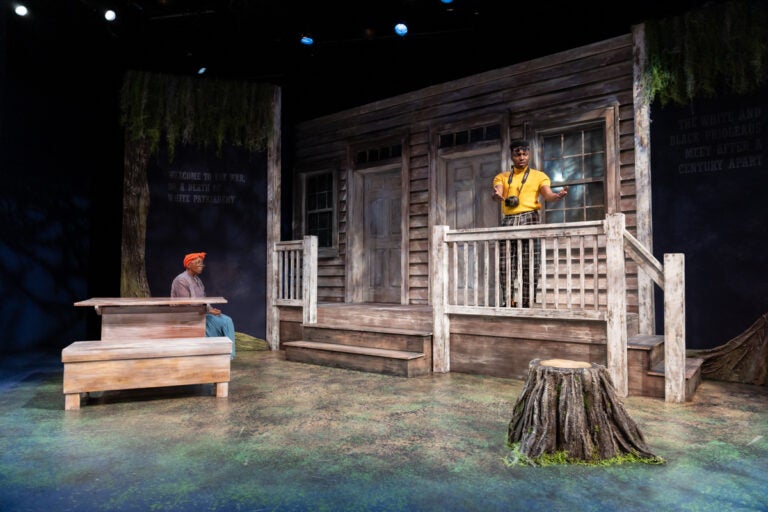
Lenny Daniels as Big Mom (left) and Tymothee Harrell as Jonathon (right) in the InterAct Theatre Company’s production of Plantation Black at the Proscenium Theatre at The Drake in Philadelphia (Kimberly Paynter/WHYY) -
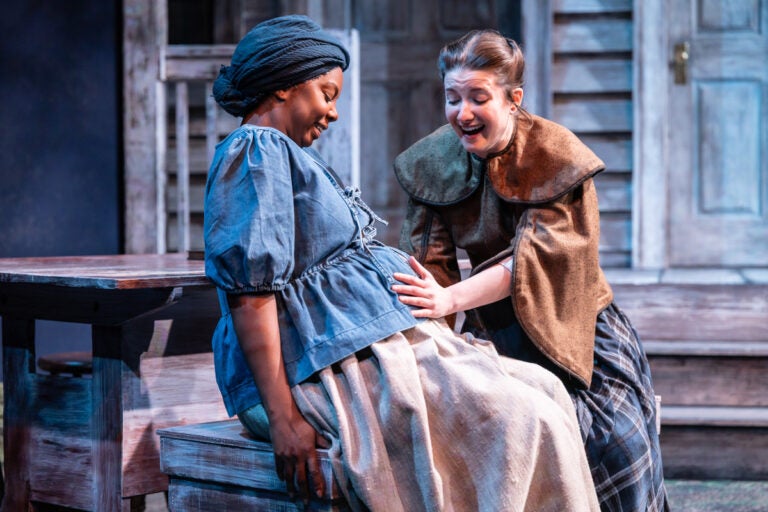
DeAnna Supplee as Morning (left) and Hannah Parke as Mary (right) in the InterAct Theatre Company’s production of Plantation Black at the Proscenium Theatre at The Drake in Philadelphia (Kimberly Paynter/WHYY) -
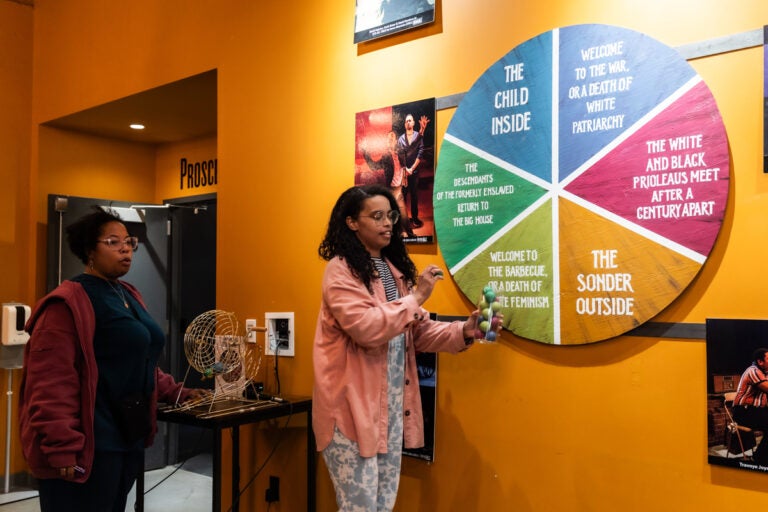
Phaedra Michelle Scott, playwright of Plantation Black (right) and Kimille Howard, director (left), demonstrate how the first scene of the play will be chosen using a drum and color-coded ball system before the play begins. (Kimberly Paynter/WHYY)
“Especially for Black family members who are descendants of formerly enslaved individuals. There aren’t photographs. Nobody was able to write anything down,” she said. “A lot of that is lost to time. Some things are lost to time because families bury the secrets.”
“Plantation Black” runs at the Drake Theater until March 1. The play depicts enslavement but intentionally does not depict or imply violence on any Black person nor use racial slurs.

Saturdays just got more interesting.
WHYY is your source for fact-based, in-depth journalism and information. As a nonprofit organization, we rely on financial support from readers like you. Please give today.

Why Yiddish is experiencing a grassroots revival in West Philadelphia
A rag-tag group of younger adults has rediscovered the West Germanic language and culture for heritage and politics.
4 weeks ago
Listen 4:41
Historic Philadelphia expands Revolutionary War performers for America’s 250th celebrations
Historic Philadelphia has hired more performers to populate Old City for the semiquincentennial.
2 months ago
Listen 1:09
Macy’s building is both setting and inspiration for a Philly Fringe Fest cabaret
The Bearded Ladies Cabaret’s “The Layaway” is a cheeky and mischievous take on opulence and commerce.
8 months ago