

Philly’s Liberty Museum shows what the World Cup and the First Amendment have in common
“In the Arena” demonstrates how sports exemplify the U.S. Constitution’s Freedom of Assembly.
Listen 1:41
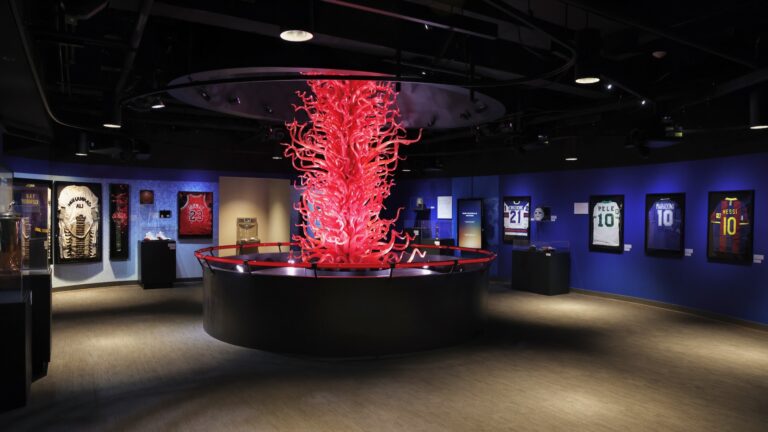
The National Liberty Museum exhibiting a collection of sports memorabilia. ''In the Arena: Sports and Assembly'' looks as sports gatherings as civic assemblies. (Emma Lee/WHYY)
From Philly and the Pa. suburbs to South Jersey and Delaware, what would you like WHYY News to cover? Let us know!
With the World Cup soccer games just a few weeks away, the National Liberty Museum in Philadelphia’s Old City has four jerseys from players considered the greatest of all time: Diego Maradona, Lionel Messi, Christiano Ronaldo and Pelé.
The upcoming summer season in Philadelphia will be a heady mixture of sports and national history, with the semiquincentennial celebrations and major games of soccer, baseball, golf and tennis. With its exhibition “In the Arena: Sports and Assembly,” the Liberty Museum is making the claim that American democracy and the World Cup games matter much more than people think.
“This is quite literally the largest assembly of human beings on the planet,” Andrew Hammond, senior director of content and interpretation, said in reference to the 6 billion people expected to watch the games. “We’re trying to show people that there’s actually more going on right in front of their eyes than they realize.”
Hammond is talking about the Constitutional right to assemble, one of the five core freedoms codified in the First Amendment of the U.S. Constitution. It is often overshadowed by the more popular freedoms of speech, religion and press.
According to a recent study by Penn’s Annenberg School, most people forget that the right to assembly is included within the First Amendment.
“This is the forgotten freedom,” Hammon said. “But it’s arguably one of the most important ones.”
The exhibit features historic sports artifacts as part of a series about the right to assemble, called “The Forgotten Freedom.” Hammond selected objects that demonstrate how the collective lure of sports drives civil rights, economics and international politics.
“Sports is never just about sports,” Hammond said. “We’re talking about moments that stand out at a national or a global level. Something that disrupted the fabric of what had come before it.”
Related Content
It took 10 years for the children's museum to raise the money to replace its 19th-century marble floors.
5 months ago
Listen 1:49Athletics have always driven fans to assemble together, but not always in equitable ways.
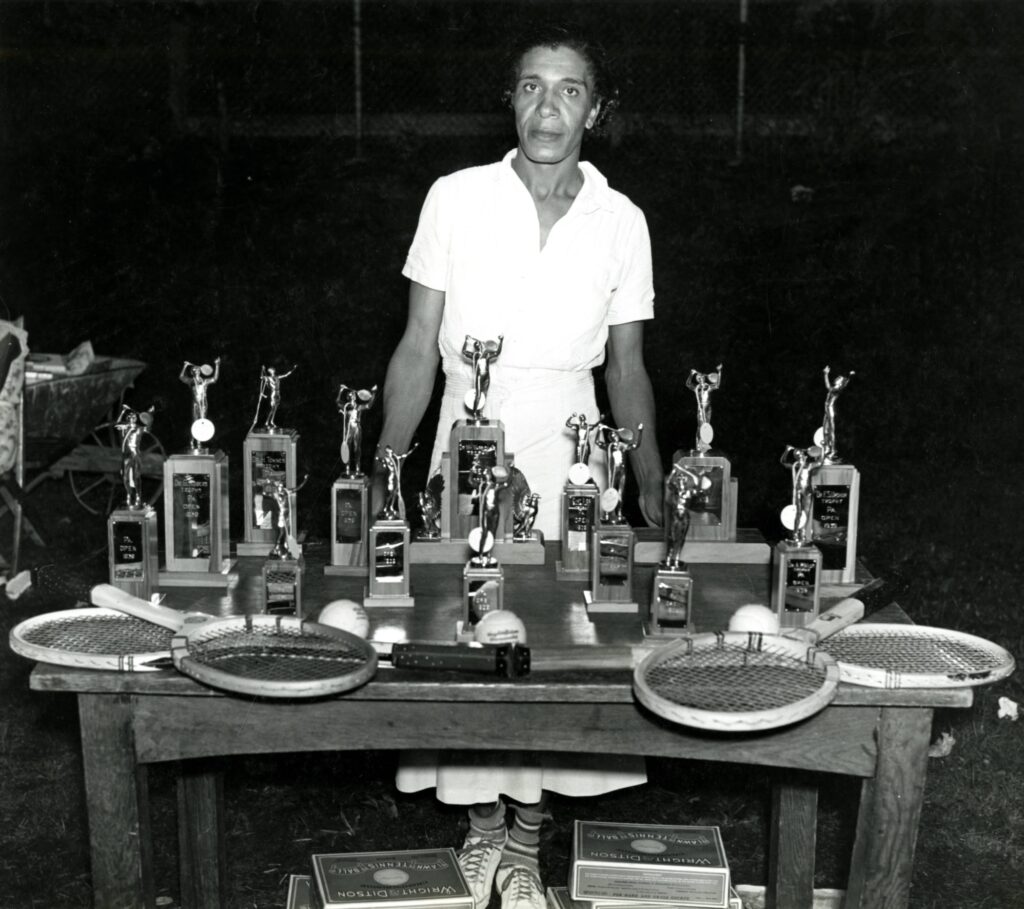
“In the Arena” features a 1930s national championship trophy earned by Ora Washington, a tennis player from Philadelphia’s Germantown considered the greatest Black woman athlete of her era. However because of her race, Washington was not allowed to compete in major tournaments put on by the United States Lawn and Tennis Association — now the U.S. Tennis Association.
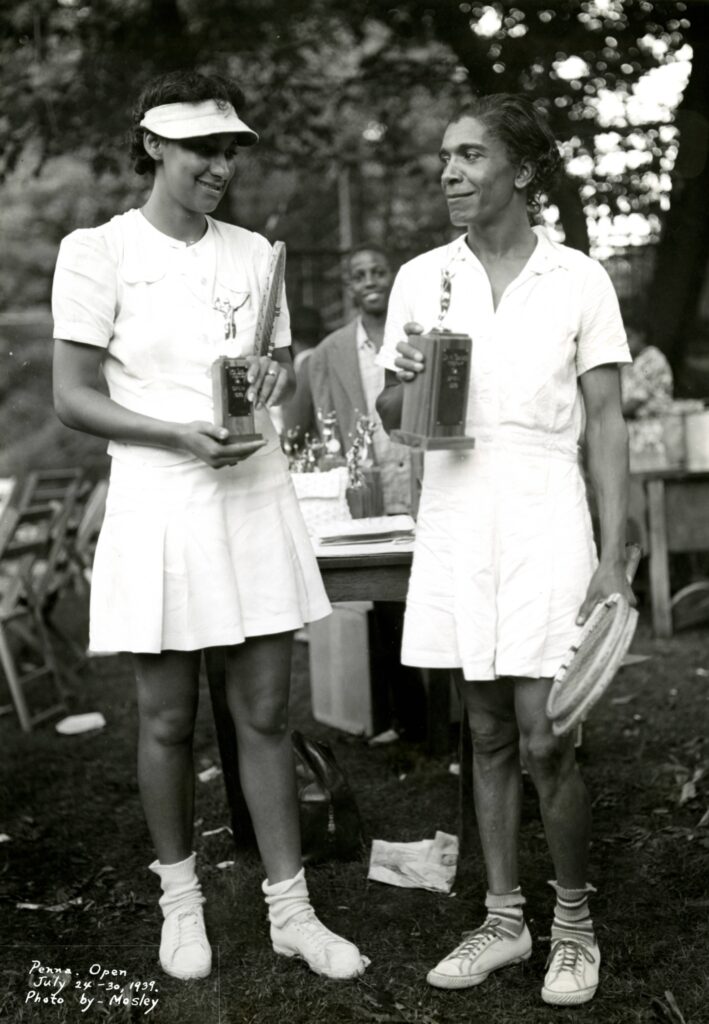
Washington could only play in the American Tennis Association, a Black league. Despite her athletic accomplishments, including winning 23 national championships, she was never able to let go of her day job. She worked as a housekeeper for most of her life, including during her championship years.
“Ora Washington during her career was overlooked as a tennis player,” said museum educator Tyler Fuller. “Although she was the best of her time, in the public eye she was not seen.”
Washington died in 1971. In 2024, the USTA inducted her into its hall of fame.
“The very ability to assemble has not always been something that everybody has been able to take advantage of,” Hammond said. “Sports are just as much a part of the American story as apple pie or the Constitution.”
“In the Arena” includes a short sweep of racial advancement in sports, including the story of Ora Washington; an athletic duffel bag once owned by Jackie Robinson, who broke professional baseball’s race barrier in 1947; and a pair of Nike Air Jordan sneakers, which represent the apex of professional sports accomplishment – the most lucrative commercial contract ever signed by an athlete, and a Black athlete at that. Michael Jordan earned that feat in 1984.
“In the Arena” has a stainless steel torch used during the 1936 Olympic Games, which took place in Berlin, Germany. That was the first year of the tradition of relaying fire from Athens, Greece, across several national borders by runners to the site of the games.
“The 1936 Olympic torch really shows the beginning of an international assembly, where for the first time in the modern Olympics, they start doing the international torch relay,” educator Fuller said. “It really demonstrates this idea that beyond national borders, beyond ideologies, people can gather for something like sports.”
The 1936 Olympics was hosted by Germany’s ruling Nazi party, which attempted to shape the games as a demonstration of white supremacy. The effort was thwarted by Jesse Owens, the Black athlete from America, who won four gold medals.
Eighty years later in 2016, President Barack Obama met the families of the 18 Black athletes who had competed in Germany and had “taught them a thing or two about democracy.”
-
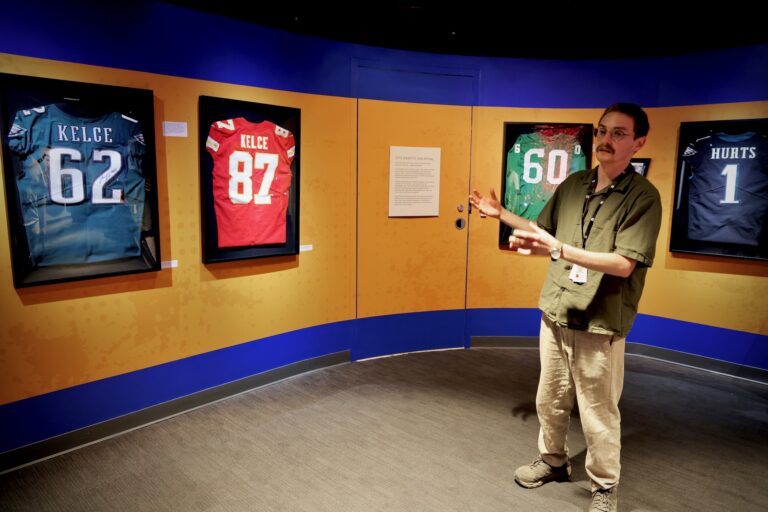
National Liberty Museum educator Tyler Fuller leads a tour of ''In the Arena,'' an exhibit on the right to assembly at sporting events. (Emma Lee/WHYY) -
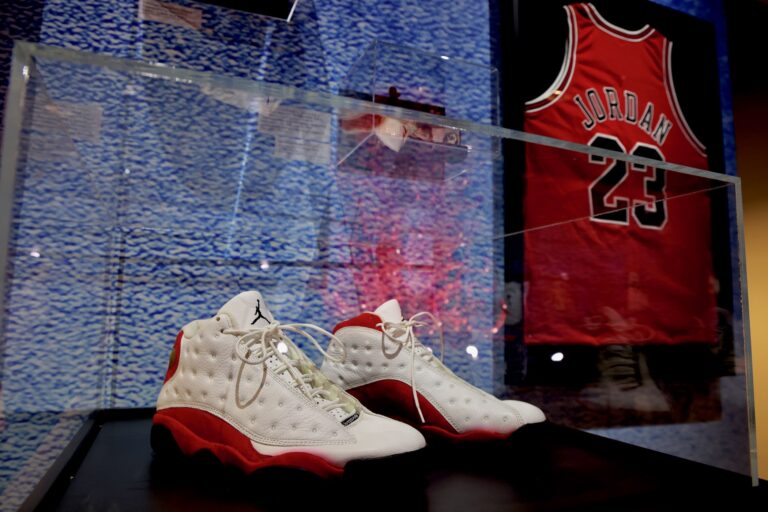
Michael Jordan's shoes and jersey are on display at the National Liberty Museum as part of the exhibit, ''In the Arena: Sports and Assembly.'' (Emma Lee/WHYY) -
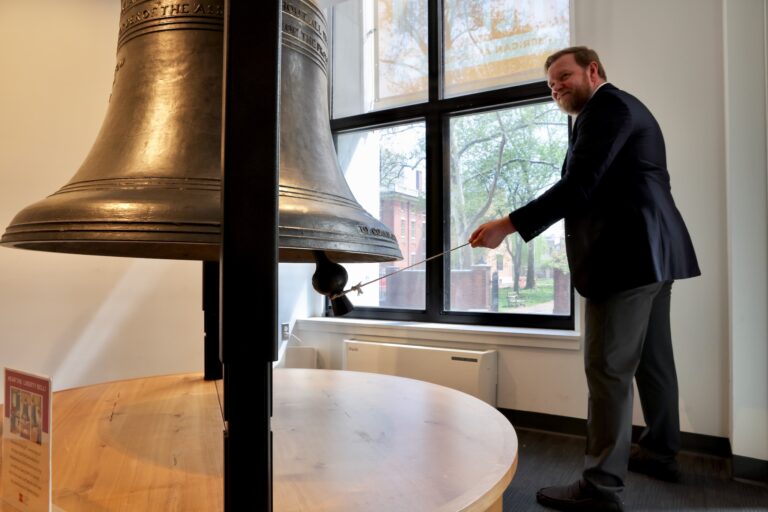
Andrew Hammond, senior director of content and interpretation at the National Liberty Museum, rings a replica Liberty Bell. The bell was made in England from the same mold used for the Liberty Bell and by the same manufacturer. (Emma Lee/WHYY) -
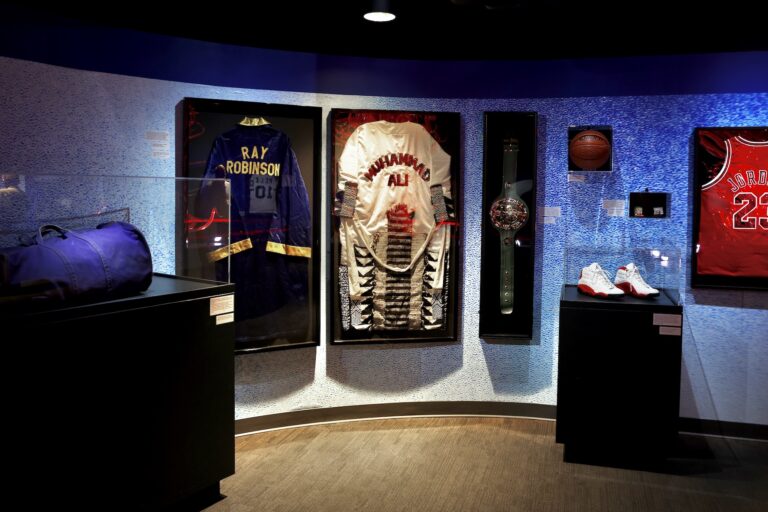
From Jackie Robinson's bag (left) to Michael Jordan's jersey (right), ''In the Arena'' at the National Liberty Museum tells the story of the desegregation of sports in America. (Emma Lee/WHYY) -
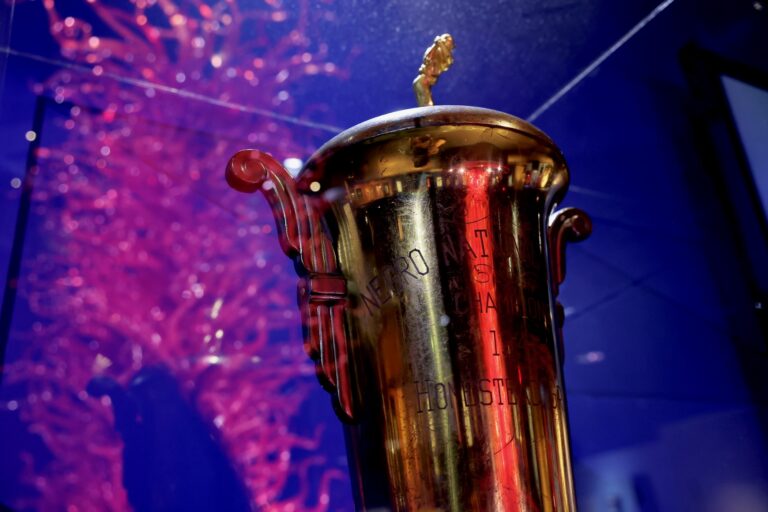
The only known surviving Negro League team trophy was awarded to the Washington Homestead Grays in 1941. It is part of the exhibit ''In the Arena: Sports and Assembly'' at the National Liberty Museum. (Emma Lee/WHYY) -
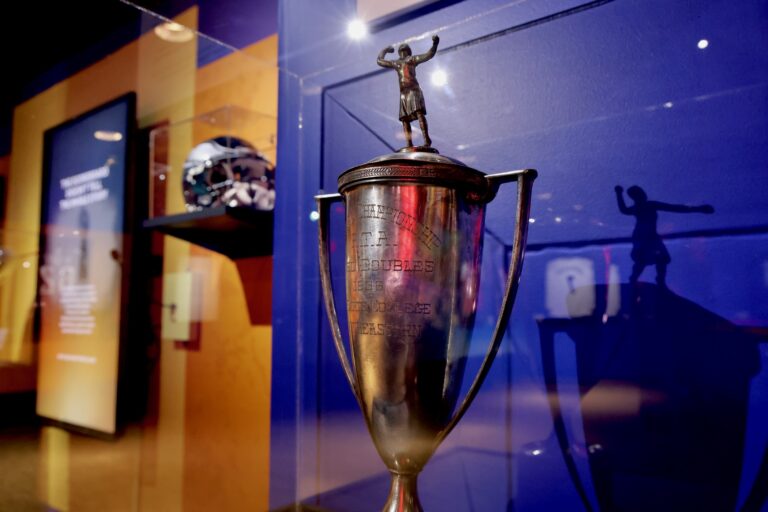
Ora Washington's American Tennis Association trophy from 1936 is on display in the National Liberty Museum's exhibit, ''In the Arena: Sports and Assembly.'' Washington dominated Black women's tennis and basketball in the 1930s and won more than 200 titles. (Emma Lee/WHYY) -
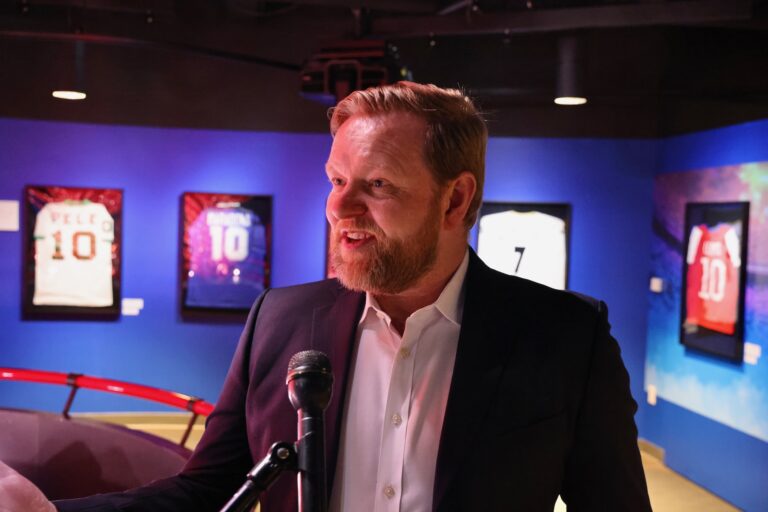
Andrew Hammond, senior director of content and interpretation at the National Liberty Museum, talks about a new exhibit, ''In the Arena: Sports and Assembly.'' (Emma Lee/WHYY)
The right to assemble may be regarded as a given when it comes to sports, but Hammond said it is the foundation for other essential American freedoms.
“This is a silent engine in the background driving American history forwards,” he said. “How can you practice freedom of religion if you can’t meet with other people? How can you practice freedom of speech if no one’s there to listen to you? It’s an underpinning freedom that allows all the other ones to take place.”
“In the Arena: Sports and Assembly” and the National Liberty Museum’s other exhibitions as part of “The Forgotten Freedom” will be on view until 2027.

Get daily updates from WHYY News!
WHYY is your source for fact-based, in-depth journalism and information. As a nonprofit organization, we rely on financial support from readers like you. Please give today.
Part of the series
Philadelphia 250
The United States is marking its semiquincentennial — or its 250th anniversary — in and around the City of Brotherly Love.
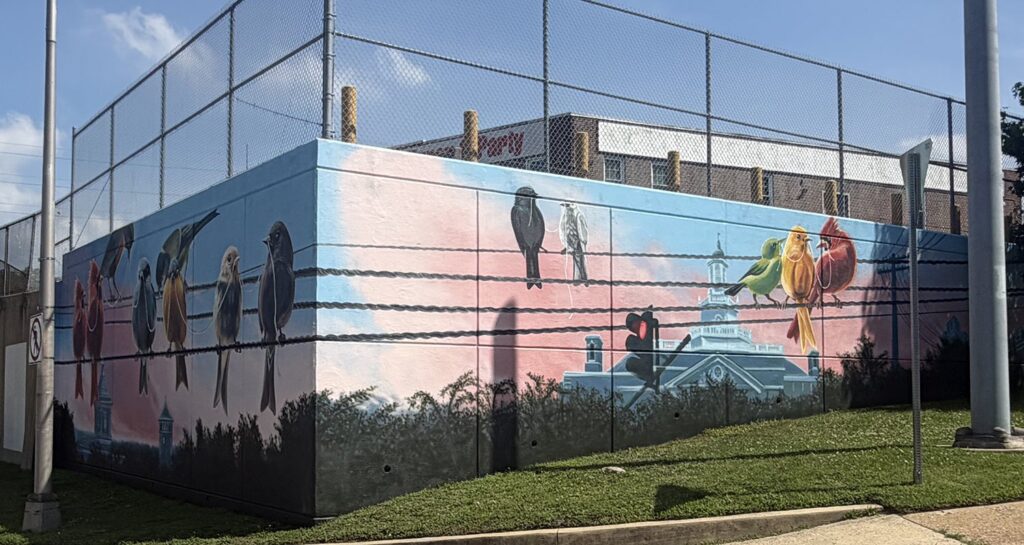
El muralista Christian Kanienberg afirma que le interesa “más crear obras de arte que, simplemente, resultan ser murales capaces de suscitar conversaciones”.
2 months ago
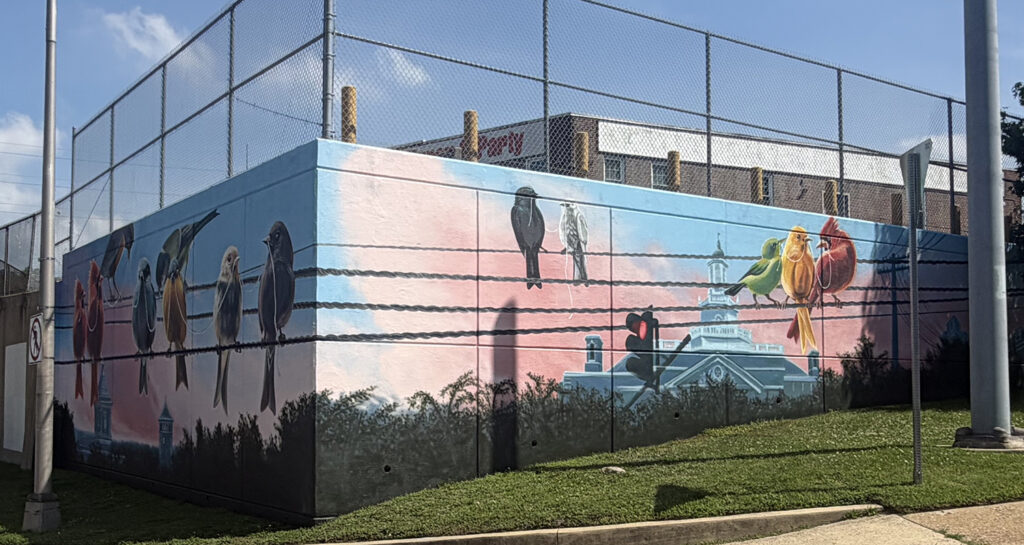
Muralist Christian Kanienberg says he’s “more interested in creating pieces of art that just happen to be murals that are conversation starters.”
3 months ago
Listen 2:11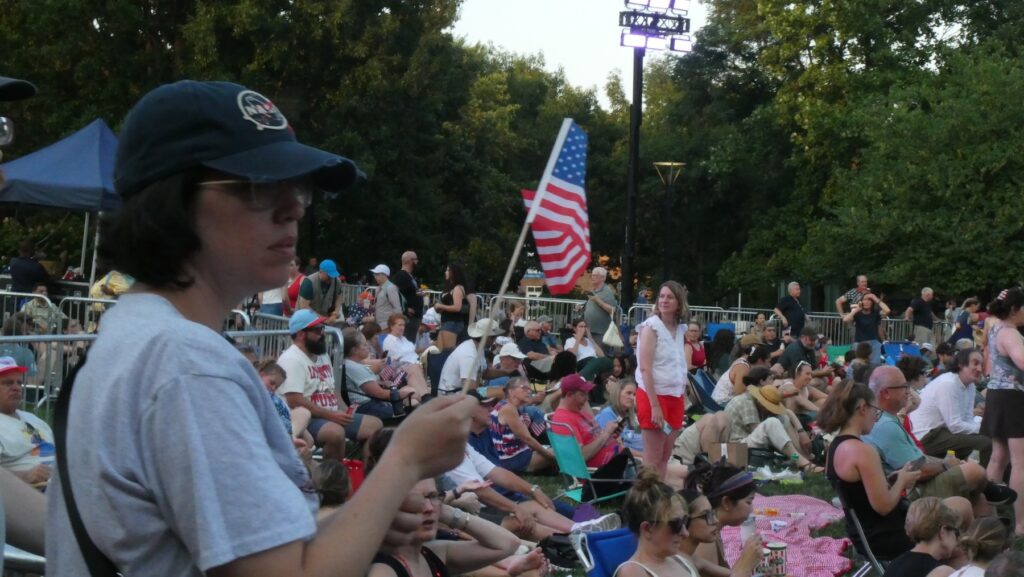
The city’s free July Fourth concert on the Parkway is still on. Organizers say Saturday's star-studded show will happen rain or shine.
3 months ago