

Philadelphia nurse hopes new tool will more accurately predict women at highest risk for postpartum hemorrhage
One study found that 4 in 10 women who had postpartum hemorrhages after delivery were considered low risk when admitted.
Listen 1:36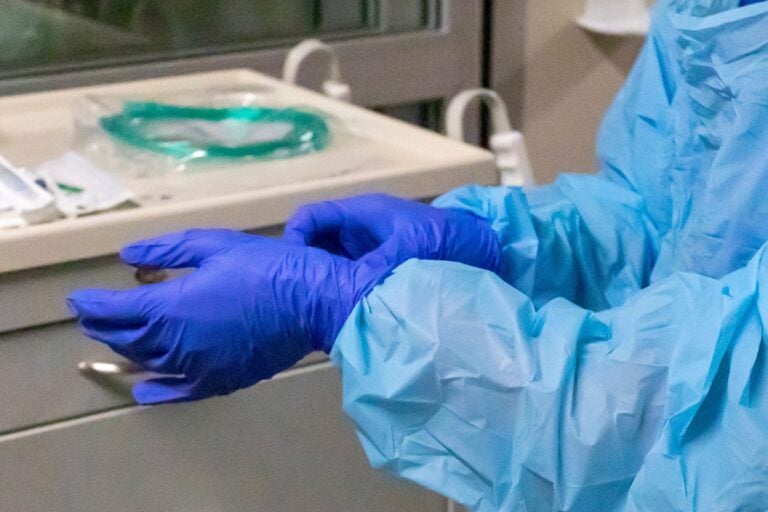
A nurse adjusts her gloves in a hospital in 2021. (Mike Zacchino/KDRV via AP, Pool)
From Philly and the Pa. suburbs to South Jersey and Delaware, what would you like WHYY News to cover? Let us know!
When a woman arrives at a hospital to give birth, medical teams assess her risk for suffering a postpartum hemorrhage, or excessive bleeding after childbirth. It’s a serious complication that is preventable and treatable, but in rare cases, it is deadly.
Patients are typically categorized as low, medium or high risk, depending on how they score in the evaluation, which uses a checklist to document placental abnormalities, prior cesarean-section deliveries, blood clotting defects and other factors.
Early and quick intervention and treatment is highly successful in slowing bleeding and preventing severe and fatal outcomes, said Stefanie Modri, a Philadelphia registered nurse who has specialized in obstetrics for nearly 30 years.
But there’s also a major problem, she said. Too many women who are labeled as “low risk” go on to have postpartum hemorrhage. In one California study, researchers found that as many as 40% of women who experienced the condition after delivery were initially admitted to the hospital as low risk.
In those cases, medical teams can be underprepared for the emergency and have a delayed response, said Modri, a clinical nursing instructor at the University of Pennsylvania.
“In pregnancy, in any type of blood loss, minutes really, really matter,” she said. “I call this a care chasm where there was a huge opportunity that was missed to be able to be properly prepared for the mothers.”
The issue inspired Modri and other researchers to partner with engineers and biotech companies to create a tool that could more accurately predict someone’s likelihood of developing postpartum hemorrhage.
The team’s software invention, called Vasowatch, tracks a woman’s heart rate during contractions to screen for a condition called myometrial fatigue, which is when the uterine muscle becomes exhausted and weak. It can be a precursor to postpartum hemorrhage.
Modri is hopeful that identifying this early and with more precision will help medical teams be better prepared and lead to overall better maternal health outcomes.
“[We’re] really trying to make the case that we need to bring in some technology to help our mothers be safer and use their own biometric data,” she said, “not just a checklist based upon what happened in a prior pregnancy and one of 40 other possible risk factors in there. We needed to be more personalized.”
Related Content
Changes to Medicaid under H.R. 1 include new work requirements and restrictions on who is eligible for the safety net insurance program.
2 months ago
Listen 1:14Postpartum hemorrhage rates and causes
Blood loss during and after childbirth is normal and expected. But it becomes a postpartum hemorrhage when a woman loses 1,000 milliliters of blood or more within the first 24 hours after delivery, as defined by the American College of Obstetricians and Gynecologists.
The medical emergency happens in an estimated 3% to 5% of deliveries — or roughly up to 180,000 live births — in the United States, according to national data. But Modri said more recent research indicates that rates of severe hemorrhage could be higher than past estimates.
The most common cause of postpartum hemorrhage is uterine atony, Modri said, which happens when the uterine muscle fails to contract after childbirth. The muscle needs to contract so that the uterus can firm up, compress and seal off blood vessels and shrink to its normal shape and size.
But with uterine atony, the uterus fails to contract and blood vessels are left open, which can lead to severe bleeding. Myometrial fatigue, the condition that Vasowatch screens for through heart rate monitoring, is a known precursor to uterine atony.
Postpartum hemorrhage can be treated with medication, repairing tears, using devices to help the uterus contract, blood transfusion, intravenous fluids and more. But if treatment is significantly delayed or unsuccessful, health providers may have to perform an emergency hysterectomy to remove the uterus and the source of bleeding before it becomes fatal.
How Vasowatch works
Vasowatch can be used with existing biowearable sensors, monitors and devices. Modri and her team partnered with Sibel Health in Chicago, which makes a chest sensor monitoring device called Anne, to test their innovation.
Early study findings showed that the software was able to identify myometrial fatigue and alert clinicians to the risk of postpartum hemorrhage about two to eight hours before delivery, which led to a 60% reduction in cases of hemorrhage, according to a paper published last year.
With new funding from the National Institutes of Health, Modri said she and her team hope to soon launch a large clinical trial with multiple hospital sites and bring the product to market by 2028.
The goal is to provide labor and delivery units and medical teams with a predictive tool that can lead to more precise intervention, Modri said.
“And the precision can be: How quickly can we get the right medication to her? The precision can look like that we have appropriately moved another staff member into the room before, and not five minutes after,” she said. “The best resourced hospitals still have not been able to do this perfectly.”
Some people have questioned the need for a new tool like Vasowatch, Modri said, especially in the U.S., where patients and clinicians have better access overall to obstetric monitoring and treatment methods compared to other parts of the world.
She points to the increasing number of labor and delivery units closing across the country, rural hospitals operating with limited resources, regular national blood shortages and persistent cases of preventable maternal complications and mortality.
“When we would approach [women] to be in the study, they said, ‘I am so happy that something is being done. I know that it’s not going to help me with this birth right now, but if it can help me with my next one, help my sister, help my cousin, I am very happy to participate,’” Modri said. “And it means a lot to me that the community knows that we are trying, we are actively working on it for a solution that will be for everyone.”

Get daily updates from WHYY News!
WHYY is your source for fact-based, in-depth journalism and information. As a nonprofit organization, we rely on financial support from readers like you. Please give today.

The two deaths occurred in Jefferson and Mifflin counties. Two other measles-associated deaths among infants in Lancaster were reported in August.
2 days ago

If approved, the two “neighborhood hospitals” proposed for Camden and Georgetown would open in 2028. Other hospital systems question if they actually comply with state law.
2 days ago
Listen 0:45
Meet ‘the Zeen’: Philly inventor behind the Steadicam creates wheelchair-walker hybrid
Nearly 50 years ago, Garrett Brown invented the Steadicam for motion picture filming. Today, he’s using his skills to give people more mobility options.
3 years ago
Listen 3:48