

Camden County announces $400 million initiative to reduce sewage overflows
Outdated sewage systems send raw sewage and stormwater through the same pipes, leading to flooding issues during heavy rainfall.
Listen 1:08
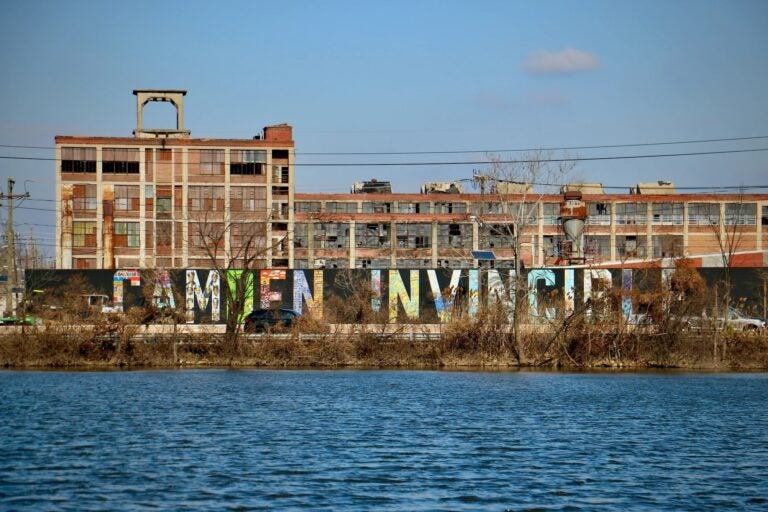
File - With the backdrop of an abandoned factory, the ''Camden Invincible'' mural faces Admiral Wilson Boulevard and the Cooper River, seen in January 2022. (Emma Lee/WHYY)
From Philly and the Pa. suburbs to South Jersey and Delaware, what would you like WHYY News to cover? Let us know!
Camden County is investing $400 million dollars in infrastructure projects to reduce the amount of sewage and stormwater that overflows into local waterways.
The county is calling the project, which aims to improve water quality and mitigate flooding, “the most ambitious water quality initiative” in its history.
“It’s a comprehensive strategy that addresses every major factor affecting the health of our rivers, lakes and streams. Perhaps most importantly, this represents a new way of thinking about water quality,” said Scott Schreiber, executive director of the Camden County Municipal Utilities Authority, or CCMUA.
Swimmable waterways have long been the goal of the federal Clean Water Act, passed in 1972. But more than 50 years after its passage, older industrial cities such as Camden and Philadelphia struggle to reach that level of cleanliness because of outdated sewer systems.
Unlike modern infrastructure, which utilizes separate piping systems, older sewer systems send stormwater and sewage through the same underground pipes.
During heavy rain, this combined sewer and stormwater system can overflow, spilling raw sewage into the region’s rivers and streams.
Camden’s main waterways, the Cooper and the Delaware rivers, often contain fecal bacteria levels that make it unsafe for humans to swim, fish or even kayak.
The overflow can also mean flooding in nearby communities. Flooding has caused basements and streets to flood in neighborhoods near the Cooper River and Newton Creek, including in Camden and Collingswood.
“The flooding impacts every business, every homeowner, everyone who’s trying to get to work,” Camden County Commissioner Jeffrey Nash said. “It is an economic problem, and it’s a human condition problem, because it harms everyone. People should not have to experience backup of sewer water in their homes, period.”
Camden County’s new investment includes $200 million to reduce combined sewer overflows by 90%. Sewage currently flows at a rate of about 220 million gallons a year, Schreiber said. The initiative includes separating Pennsauken’s combined sewer into two flows: sanitary and storm.
Pennsauken currently sends its combined sewer flow through the city of Camden, which makes its way to CCMUA’s treatment facility.
In the future, stormwater from Pennsauken and Camden will discharge into the Delaware River, while a separate sewage flow will be directed to the treatment plant.
The county is also investing millions more for green stormwater infrastructure such as rain gardens that capture water and reduce runoff, rehabilitating aging sewers, remediating sediment and restoring recreational lakes.
Officials say the countywide project will not only help the city of Camden, but also reduce flooding in neighboring communities like Collingswood.
“We can do very little to alter our geographic reality. We are bordered by the Cooper River to the north and Newton Lake to the south,” said Collingswood Mayor Daniela Solano-Ward. “Ultimately, protecting urban watersheds has fallen to local governments. But with 35 municipalities in Camden County, the weight of this lift is too heavy for any one of us to shoulder alone.”
Related Content
Levee plan not viable for Philly’s flood-prone Eastwick neighborhood, says U.S. Army Corps
Earlier this year, the U.S. Army Corps of Engineers announced that the formally proposed levee would be downsized. Now they say the levee is not feasible.
7 days ago
The initiative, which will receive state and federal funding, could also be supported by increasing the county’s open space tax, a voter-approved property tax, from 2 cents per hundred dollars of assessed value to 3 cents. The County Board of Commissioners will decide this week whether to approve a November referendum on the increase to put the decision in the hands of voters.
The first phase of the project will take about 10 years to roll out, Schreiber said.
The CCMUA, a regional facility founded 1972, provides wastewater treatment for about 500,000 residents in Camden County’s 36 municipalities.
In 2021, the authority completed construction on a $20.5 million multi-project initiative that expanded its stormwater capacity from 150 million gallons a day to 185 million. That means each year, the authority is able to accept 300 million gallons of additional sewage for treatment.
Prior to the federal Clean Water Act, the Delaware River between Trenton and Philadelphia supported virtually no life at all. More than 50 years ago, regulations requiring facilities to treat wastewater before discharging it changed what was once a “stinky, ugly mess” into a place where hundreds of thousands visit its urban shorelines each year.
Even if water quality reaches a point that allows swimming, there are parts of the Delaware and Schuylkill rivers that will never be safe for swimmers due to currents and tides.
Treatment plants along the Delaware and Schuylkill rivers provide clean drinking water to about 15 million people. However, urban parts of the Delaware River and its tributaries are still too polluted to swim in.
Swimming and kayaking are permitted in much of the Upper Delaware River, which is regulated by the Delaware River Basin Commission. But the commission restricts residents to boating and fishing for a 27-mile stretch along Camden and Philadelphia.
There are 13 regattas along the Cooper River, which infuses about $20 million a year to Camden County.
“If you add to that boating, swimming, fishing, it not only enhances the quality of life, but also property values,” Nash said. “People want to live in communities like that, have those amenities, and that is a critical part of why we’re doing this, and to have fun.”
Don Baugh of Upstream Alliance, a nonprofit that advocates for clean water and water recreation, said he believes the initiative could make that vision a reality.
“We are on the brink of thinking about, ‘Wow, what’s it going to be like to have fully restored, clean, swimmable waters,” he said. “It’s going to be transformative for this city and this county. When you see someone playing on the water, kids swimming in it, people paddling, it reinforces the vitality of a community.”

Get daily updates from WHYY News!
WHYY is your source for fact-based, in-depth journalism and information. As a nonprofit organization, we rely on financial support from readers like you. Please give today.
Part of the series
Watershed
Preserving Our Water: How we use our Delaware Watershed.
The project is funded by The William Penn Foundation.

Toxic ‘forever chemicals’ in New Jersey’s tap water have dropped 55%, Rutgers study finds
PFAS are commonly found in household items and can remain in the environment — and our blood — for decades.
3 months ago
Listen 1:19
Camden is inching toward ‘swimmable’ waterways, but Trump administration cuts threaten progress
Unlike modern infrastructure, which utilizes separate piping systems, Camden’s older sewer systems send stormwater and sewage through the same underground pipes.
1 year ago
Listen 1:03
New Jersey dentists advocate for fluoridated water as debate over the chemical continues
New Jersey has one of the lowest fluoridation rates in the U.S. Only about 16% of New Jersey residents have fluoridated water, compared to the national average of about 75%.
1 year ago
Listen 1:15