
Philadelphians who care for vacant side yards form group to push for easier land-acquisition process
The coalition wants the Land Bank to give neighbors preferential rights to apply for vacant side yards and expand eligibility.
Listen 0:58
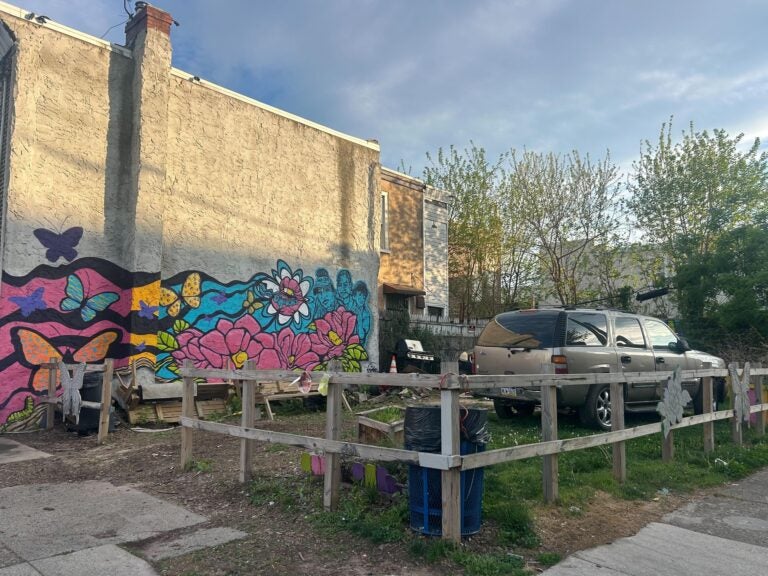
Gloria “Smooches” Cartagena Hart, a member of the new coalition, stewards this side yard in Kensington. (Sophia Schmidt/WHYY)
From Philly and the Pa. suburbs to South Jersey and Delaware, what would you like WHYY News to cover? Let us know!
Dominique Johnson has cleaned up litter, removed weeds and trimmed trees on a vacant lot beside his family’s home in North Philadelphia for around 20 years.
He hoped to acquire the lot from the Philadelphia Land Bank and said he submitted two expressions of interest for the land, without realizing these notices were not formal applications. Then in March, Johnson said he found a flyer indicating a proposal to build a home on the lot that could sell for up to $280,000. He worries that the project will not be affordable for long-term residents of the neighborhood and that the construction could harm his family’s home.
Johnson is a member of a new coalition of dozens of residents who care for the vacant lots beside their homes, called the Philadelphia Land Steward Union. The group formed last fall to draw attention to the benefits that side yard stewards bring to their communities and advocate for their interests in city land disposition policies.
The group launched its platform publicly Saturday at a meeting at the Hartranft Community Center in North Philadelphia.
For years, the city’s process of transferring vacant city-owned land to private owners has been criticized as slow and convoluted. The city revamped this process starting in 2019 after a WHYY investigation found a backlog of over 18,000 expressions of interest submitted by parties looking to buy vacant lots from the city. But advocates say the process is still slow and opaque for residents looking to gain formal ownership of vacant lots next to their homes before they are developed.
Johnson said he joined the coalition in hopes of making the land acquisition process “a little bit clearer, making sure things like this don’t happen again to individuals.”
Report finds side yard stewards strengthen neighborhoods but risk losing land
The tens of thousands of vacant lots in Philadelphia are disproportionately concentrated in communities of color and low-income neighborhoods where there is a history of redlining, according to a report by Temple University Beasley School of Law students presented at Saturday’s launch event.
The report found that, while vacant lots can attract trash and decrease quality of life when left untended, they can also help reduce crime, promote social cohesion and improve mental health when they’re greened and cared for.
“Parks are too far away, especially for the kids and older people,” said Gloria “Smooches” Cartagena Hart, a member of the new coalition who transformed a vacant lot on her street in Kensington into an outdoor space for community events. “The lot is a safe haven. A place to come together, for neighbors to know each other.”
Nearby residents like Cartagena Hart often step up to care for these vacant lots. But if there are unpaid taxes on vacant land, it can be sold at a sheriff sale, where developers with deeper pockets and lawyers often “out maneuver” nearby residents, according to the report.
“One of the biggest challenges [is] that, as [residents] invest in greening this land and bettering our communities, it then becomes valuable to outside developers who displace those same community members,” Claire Hirschberg, one of the authors of the report, said.
Related Content

The detention centers would overwhelm sewage facilities and exceed available drinking water supply, environmental advocates say.
4 months ago
Listen 0:50Coalition calls for Land Bank sales to prioritize neighbors over developers
The Philadelphia Land Steward Union is calling on the city’s Land Bank to improve transparency and prioritize nearby residents over developers when selling and transferring land.
The quasi-governmental Land Bank can dispose of side yards to the owners of adjacent properties through a special noncompetitive process for a nominal price. Adjacent owners must apply for the land through the Land Bank’s website, pay closing costs and agree not to build on the land. Land Bank staff respond to applications within 120 days, according to the Land Bank’s website. Applications must then be approved by the Land Bank board and City Council.
Between 2020 and 2023, the latest year for which the city has published data on its website, it conveyed just 67 publicly owned parcels to residents for use as side yards.
The new coalition wants the Land Bank to give neighbors preferential rights to apply for vacant side yards for 180 days before opening the properties to competitive bid and expand eligibility for its side yard program to include homeowners and long-term renters within a 1,500-foot radius of the vacant lot.
The coalition also wants the city to publish real-time acquisition and disposition statistics on its public land dashboards, including all publicly owned land and the status and type of applications for those properties. The group is also calling for the city to post physical notice of development proposals on vacant lots when they are first included in a proposal.
They want the Land Bank to dedicate specific staff to processing applications for garden and side yards, and to adhere to its own timelines for notices and approvals.
Debbie Johnson has gardened on a lot beside her home in the Nicetown-Tioga neighborhood since it became vacant more than two decades ago. She hoped to acquire the lot but said an heir to the deceased former owner came forward to claim the lot last year. She joined the new coalition to help others secure the side yards they care for.
“Even though I lost my lot, I just hope that I can be helpful with helping someone else,” Johnson said.
A spokesperson for the city Land Bank did not respond to a request for comment by publication.

Never miss a moment with the WHYY Listen App!


WHYY is your source for fact-based, in-depth journalism and information. As a nonprofit organization, we rely on financial support from readers like you. Please give today.
Brought to you by PlanPhilly

PlanPhilly
In-depth, original reporting on housing, transportation, and development.
‘Strawberries to collard greens’: The Original American Foundation grows free food in Kingsessing
Founders of the Original American Foundation say their goals are to lower food costs for neighbors and prevent gentrification.
7 months ago
Listen 0:55
Philadelphia Land Bank buys 35 garden lots, advancing land preservation plan
The lots were once tangled up with privately held tax liens. The Land Bank can now transfer them to gardeners and land trusts.
10 months ago
Listen 1:06
Philly tax sales resumed nearly a year ago. The land bank still hasn’t bid on any properties
The public agency has funding to acquire new parcels for affordable housing and community gardens, but is still not a priority bidder.
1 year ago
Listen 1:23