

Philadelphia City Council examines police crowd control tactics after Pride festival
City Councilmember Rue Landau convened a hearing to discuss what went wrong in the Gayborhood on June 7 and how the city can avoid repeating it.
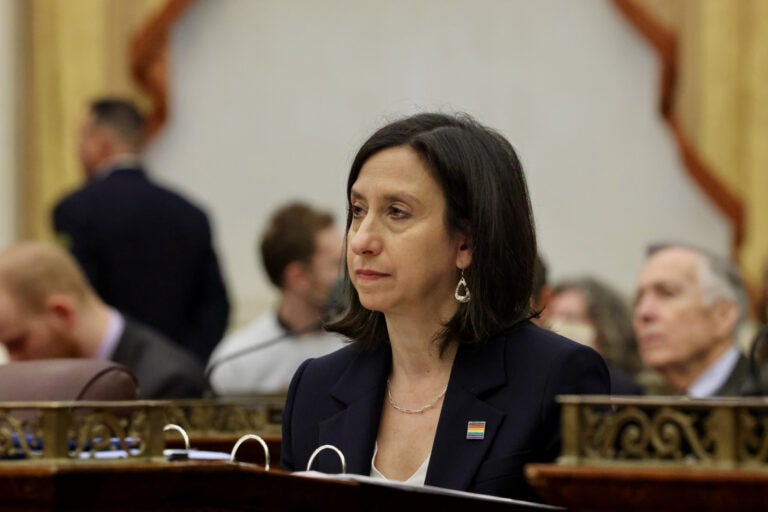
File - Philadelphia City Councilmember Rue Landau. (Emma Lee/WHYY)
From Philly and the Pa. suburbs to South Jersey and Delaware, what would you like WHYY News to cover? Let us know!
Two months after Philadelphia’s Pride celebration ended with arrests and allegations of “overly aggressive tactics,” City Council convened a hearing Wednesday that brought police leaders, LGBTQ+ advocates and residents together to examine what went wrong and how to prevent it from happening again.
Councilmember Rue Landau called for the hearing shortly following Pride after receiving messages, videos and photographs from constituents who said they were shaken by the police response to festivalgoers who moved from the official celebration on the Benjamin Franklin Parkway to the Gayborhood. Many questioned whether they would ever feel safe returning.
Landau said police have a responsibility to maintain public safety, but argued that Pride had been treated as a public safety problem rather than a celebration, prompting calls for accountability.
The hearing included tense exchanges between Police Commissioner Kevin Bethel and Councilmembers Landau and Isaiah Thomas — along with testimony from about 20 community members who spoke about their experiences with officers.
In a presentation walking through the timeline of the events leading up to June 7, Bethel defended the department’s response, describing officers’ crowd-control tactics as routine and intended to keep people safe.
“We’ve done this customarily as a rhythm, we move the kids along,” Bethel said. “It’s not pretty when you move a crowd of young people, especially when they don’t want to move. It’s not to harm them.”
Bethel also said planning was complicated because the official Pride festival took place along the Benjamin Franklin Parkway, rather than the Gayborhood, where it had been the year before, making it more difficult for police to anticipate where crowds would gather after the event ended.
Related Content
City officials respond to backlash against heavy police involvement at Philly Pride
“That is not us,” police commissioner Kevin J. Bethel said, rejecting claims that the department is hostile to Philadelphia’s LGBTQ+ community.
3 months ago
Community members describe fear, bias and mistrust
“What we witnessed was an atrocity,” said Naiymah Sanchez, a community advocate and a senior organizer for ACLU Pennsylvania, in her testimony.
She urged city officials to restore a sense of security for LGBTQ+ residents and explained that safety is not a one-size-fits-all matter.
“What I don’t want to see is our community being herded like cattle. I don’t want the police to use these forces, these tactics of threat, to get people to move on,” Sanchez said.
Some witnesses said they believed officers had deployed Tasers during Pride, but Bethel testified that “nobody got tased.” He said the confusion stemmed from officers “arcing” Tasers, a technique that creates an audible electrical crackle without shocking anyone.
Bethel said the department has since ended the practice.
The commissioner also addressed reports that some officers wore masks, despite department policy prohibiting officers from covering their faces while on duty. He testified that he had “no idea why my officers were wearing masks that day” and said the department is investigating the incidents.
Related Content
Federal immigration enforcement agents have begun arresting people with expired visas at airports across the country.
2 months ago
Listen 1:45Police questioned about department culture
Thomas questioned Bethel about accountability within the department, asking whether officers are willing to recognize their own wrongdoing and policy violations.
“Do we have a police department where the culture is, ‘If I see somebody doing something wrong, would I say something?'” Thomas asked.
Several witnesses argued the problems extended beyond officers’ actions on June 7 and reflected a deeper culture of bias against LGBTQ+ communities in the department.
Tyrell Brown, founder and executive director of Philly Pride 365, which produced the official Parkway celebration, said he was trapped in an area of the Gayborhood that was barricaded by police that day. He said, “it’s not about positionality,” referring to the way social identity, such as race and gender, shapes one’s view of the world. He said police were not letting him or anyone through, nor were they giving anyone instructions to help them move away from the scene — even after Brown had identified himself as an event organizer.
“The sentiments that were shared by individual officers on the ground were absolutely offensive [things like] not wanting to ‘be down here with these people.’ That approach is so broken,” Brown said.
He explained that, regardless of competency training, there are people inside the department who are still approaching LGBTQ+ people with their own individual bias or hatred.
Jacen Bowman, president of Philadelphia Black Pride, testified that he heard officers using homophobic slurs.
“A policing culture that dehumanizes any part of the community makes the entire community less safe,” Bowman said.
Related Content
Philly-area police launch aggressive-driver campaign to reduce highway fatalities
Extra patrols and more enforcement actions aim to reduce traffic deaths in the Philadelphia region.
2 months ago
City, organizers look to the future
Several speakers called for permanent collaboration between LGBTQ+ organizers, city officials and police when planning future Pride celebrations. Bowman described the need for dedicated LGBTQ+ public safety liaisons, an idea Bethel said the department is considering.
Tito Valdes, executive director of the city’s Office of LGBTQ+ Affairs, said the hearing marked the beginning of a broader effort to strengthen those relationships year-round.
He called the hearing an opportunity to examine tension, rooted in policing, racism and homophobia, none of which are comfortable.
“This was an overdue conversation for the city,” he said.
The police department said it is already planning to organize around the whole day next year rather than a single event.
Councilmember Mark Squilla said the city’s response to Pride fell short but expressed hope the hearing would help shape a better approach for future celebrations.
“The city of Philadelphia did a lot of great things in 2026, and this was not one of them,” Squilla said. “And we need to learn from it and have solutions moving forward.”

Get daily updates from WHYY News!
WHYY is your source for fact-based, in-depth journalism and information. As a nonprofit organization, we rely on financial support from readers like you. Please give today.
Man wanted for 5 sexual assaults near Center City, police say
Police believe the same man is responsible for all five assaults, based on the description and how close the alleged assaults happened to each other.
1 year ago
Suspect in murder of Philadelphia Police Sgt. James O’Connor sentenced to 75 years
Hassan Elliott was sentenced to 75 years in prison in the murder of Philadelphia Police Sgt. James O'Connor.
1 year ago
Man shot by police in Point Breeze was carrying airsoft-style BB gun
The 46-year-old officer who fired his weapon has been placed on administrative leave pending the outcome of this ongoing investigation.
2 years ago