

Philadelphia Parks and Rec head says she authorized Phillies’ unpermitted turf field for 250th celebrations
A former DEP commissioner says the city did not have the authority to skirt state laws in order to make the 250th anniversary deadline.
Listen 1:26
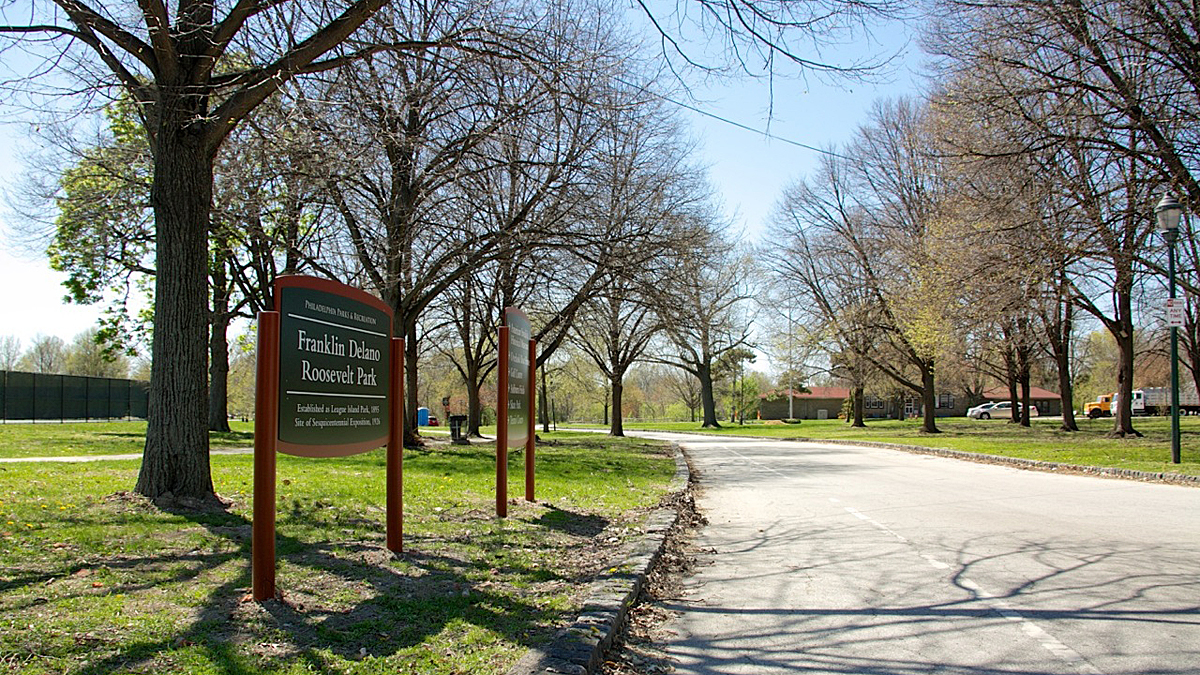
FDR Park in Philadelphia. (NewsWorks File Photo)
From Philly and the Pa. suburbs to South Jersey and Delaware, what would you like WHYY News to cover? Let us know!
Philadelphia Parks and Recreation Commissioner Susan Slawson said she authorized the Phillies to proceed with installation of synthetic turf at Ashburn Field in FDR Park, despite having not received a required environmental permit from the state.
Slawson said she authorized the Phillies to proceed with the project on city-owned property without the erosion and sediment control permit “based on the promise to Philadelphians and visitors from around the world for the 250th anniversary.”
“We wanted to fulfill our commitment,” Slawson said in an interview with WHYY News. “That’s not how we typically handle projects. Public safety was never at a risk. But we had made a promise. The Phillies were aware of the outstanding compliance items — and the city, we allowed the work to proceed to accommodate the MLB All-Star Game.”
But the city does not have the authority to circumvent state pollution control laws, according to David Hess, a former secretary of Pennsylvania’s Department of Environmental Protection.
“It is illegal for someone to go ahead without these approvals,” Hess said. The permit is a “legal requirement” for projects before any work begins, he said, and is meant to protect nearby waterways from sediment pollution that could result from the construction.
The Philadelphia Inquirer first reported the Phillies’ construction of the field without the state’s authorization late last month.
The permit, known as a general National Pollutant Discharge Elimination System permit, is “well-known” and “easy to get,” Hess said.
The Phillies hosted a ribbon cutting event on July 10 for the refurbished field, which is used for the team’s youth baseball programs, as part of this summer’s MLB All-Star Week.
Just days before the ribbon cutting, the Pennsylvania DEP had sent a letter to the Phillies, informing them that their application for the permit was deficient.
Why projects need erosion control permits
Pennsylvania law requires all projects that will disturb at least an acre of earth to obtain a sediment and erosion control permit before earth disturbance starts. These permits are designed to prevent sediment from running off of a construction site and into a nearby stream, Hess said.
“Sediment … can choke off aquatic life,” Hess said. “It is very much a hazard to anything that’s living in the stream.”
Ashburn Field, which is in the southwest corner of FDR Park and named after Hall of Famer Richie Asburn, is located near a stream, several lakes and the new 33-acre tidal wetland built as part of the renovation of the park. The park is located near the confluence of the Schuylkill and Delaware rivers.
The Phillies submitted an application for a sediment and erosion control permit in May. Later that month, DEP informed the Phillies their application was incomplete, according to correspondence provided to WHYY News by DEP officials.
In early July, the agency sent the Phillies a deficiency letter regarding the application, identifying close to a dozen issues with the application, including with the organization’s plans for compost socks to control runoff and blanketing of slopes.
Days later, the Phillie Phanatic cut the ribbon on the new artificial turf field, designed as a weather-resistant surface in an area that had habitually flooded. Phillies officials told local media that before the renovation, wet weather cancelled close to one-third of the events held at the field each year. The Fairmount Park Conservancy, which is leading the FDR Park renovation, has said that synthetic turf offers far more playing time than traditional grass fields.
Mike Barsotti, Philadelphia Parks and Recreation’s director of youth sports, said at the time the turf field would “make a huge difference for decades,” while acknowledging MLB’s contribution.
“We need to give families these affordable, accessible, but high-quality options by placing really big, meaningful assets like this in the heart of the city,” Barsotti said. “I know the All-Star Game will come and go, but a lot of us here will always remember where this came from.”
Related Content
A judge declined to halt renovations at FDR Park. Residents opposing the plan are trying again
A Philadelphia judge wrote that most of the work the residents object to is done, and future project phases only “endeavor to improve” the park.
7 months ago
Two weeks after the ribbon cutting, DEP sent the Phillies another deficiency letter for their permit application, saying the Phillies had failed to provide an approval letter from the Philadelphia Water Department for their post-construction stormwater management plan.
Phillies spokesperson Bonnie Clark said the field upgrades were undertaken in coordination with the city and “relevant governmental agencies.”
“The City authorized the work to proceed while the applicable permit applications were in process so the upgraded field could host MLB’s 2026 All-Star Week events,” Clark wrote in an email in late August. “We expect to obtain all necessary final approvals in the near future.”
It’s not clear whether the Phillies’ construction of the field without the permit approval resulted in pollution of nearby waterways. Clark said the Phillies’ contractor installed erosion control measures “in compliance with PADEP and PWD requirements” during construction of the field and that there were “no observed failures” of these control measures.
The Philadelphia Water Department is responsible for inspecting earth disturbance during construction in the city, but did not inspect the field renovations until July 8, when the department was “alerted to the project’s construction status,” said Assistant Deputy Commissioner Paul Fugazzotto II in an emailed response to questions. The project began construction without PWD approval, Fugazzotto said, which includes a post-construction stormwater management plan that is required before construction starts.
“The project applicant has been mostly cooperative, working with PWD to bring the project into compliance,” Fugazzotto wrote. “The field, as constructed, was not compliant with PWD regulations.”
A DEP spokesperson declined to say whether the agency suspects the field construction may have resulted in erosion or damage to nearby waterways, saying instead that the agency’s investigation is ongoing.
Phillies could face a fine for missing permit
A DEP spokesperson said in late August the agency was reviewing the “compliance situation” at Ashburn Field and declined to comment on whether the agency would take enforcement action. Violations of Pennsylvania’s Clean Streams Law can carry a penalty of up to $10,000 per day.
Slawson said her department had no concerns about runoff from the field renovations because, in spite of documented deficiencies with the original permit application, “it was all contained.”
Despite the fact that the Phillies have already unveiled the new field, Clark said the team is still seeking retroactive approval of the National Pollutant Discharge Elimination System permit from the state. Slawson said the project team is also seeking approval for its post-construction stormwater management plan.
“It’s always been the intent to ensure that we were compliant,” Slawson said.
South Philadelphia resident Rich Garella filed a complaint with DEP about the Phillies’ unpermitted work in early July. He said the city and the Phillies should have known that the city cannot override state environmental law.
“Everybody in Philadelphia knows that you ask for the permit before you get the work done,” he said.
Garella hopes the state requires the Phillies to remove the field and obtain the correct permitting before they can reinstall it. Garella, who challenged the city’s renovation of FDR Park in court and is an organizer with the activist group Save the Meadows, opposes artificial turf playing fields in FDR Park over concerns about the potential health risks.
“The city seems to be run by people who think that they don’t have to follow the law,” Garella said.

Get daily updates from WHYY News!
WHYY is your source for fact-based, in-depth journalism and information. As a nonprofit organization, we rely on financial support from readers like you. Please give today.
A judge declined to halt renovations at FDR Park. Residents opposing the plan are trying again
A Philadelphia judge wrote that most of the work the residents object to is done, and future project phases only “endeavor to improve” the park.
7 months ago
Philadelphians fighting FDR Park renovation can continue their case in city court, judge says
It’s a procedural win for opponents of the renovation, who argue turf athletic fields and a new tidal wetland will radically change the park.
1 year ago
Listen 1:07
Tree clearing in FDR Park gets approval from Philly zoning board
The decision comes days after a group of residents filed a lawsuit seeking to stop the park renovation.
3 years ago
Listen 1:09